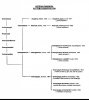
View Full Version : SCIENTIFIC SYSTEM CLASSIFICATION OF BONYTONGUE SPECIES
kriztu
04-03-2006, 8:13 AM
I HOPE THIS HELPS GUIDE ALL AROWANA ENTHUSIASTS
kriztu
04-03-2006, 8:26 AM
guys, about the two classifications for the silver arowana, i really dont know why the silver is classified this way. the O. bicirrhosum is quite familiar to all of us, i gotta admit the O. vandelli is not familiar. so is the S. scheichardti from australia. maybe obsolete classes? extinct species? i really dont know, but im really curious how these fishes look. if anyone can give light on these few dark bits please do. everything else in the diagram is familiar except these two.
WyldFya
04-03-2006, 5:40 PM
Osteoglossum Vandelli is just another synonym for Osteoglossum Bicirrhosum. also included in these are ischnosoma bicirrhosum, osteoglossum arowana and osteoglossum minus.
WyldFya
04-03-2006, 5:42 PM
I could find nothing on Scleropages Scheichardti... curious, might be an extinct form... or just another name for Leichardti is the most likely.
this is something new. :)
thanks.
kriztu
04-03-2006, 8:51 PM
Osteoglossum Vandelli is just another synonym for Osteoglossum Bicirrhosum. also included in these are ischnosoma bicirrhosum, osteoglossum arowana and osteoglossum minus.
tanx WyldFa, but why classify it twice? i mean wouldnt that be just confusing hobbyists? or maybe these are old forms of classifications, O. bicirrhosum being the updated class. first time ive heard of ischnosoma bicirrhosum and O. arowana, tanx. how about S. scheichardti, any info on that?
this is something new. :)
thanks.
No, it is something old. The subfamily Herotidinae was recently upgraded to full family status, now called Arapaimatidae. Thus, the breakdown of the two families is as follows:
Family Arapaimatidae includes two genera: Arapaima and Heterotis.
Genus Arapaima includes a single species, Arapaima gigas
Genus Heterotis includes a single species, Heterotis niloticus
Family Osteoglossidae includes two genera: Scleropages and Osteoglossum.
Genus Scleropages includes three species, S. formosus, S. leichardti, and S. jardini.
Genus Osteoglossum includes two species, O. bicirrhosum and O. ferrarai.
The other species listed in the outdated chart are synonyms.
kriztu
04-03-2006, 9:08 PM
tanx icthyophile, perhaps you could add in a new and updated chart for the guidance of other members. perhaps the moderators can sticky this too
Hey, fishbase apparently has three other purportedly valid species listed in the genus Scleropages:
S. aureus
S. legendrei
S. macrocephalus
All hail from Indonesia and were first described in 2003 by Pouyard, Sudarto, and Teugels.
Does anyone know anything about these?
tanx WyldFa, but why classify it twice?
The rules of taxonomy require that the first described species trump all subsequent synonyms. My guess is that, after Cuvier's description of O. bichirrhosum in 1829, someone else, erroneously thinking they had discovered a new species, described O. vandelli, which was subsequently discovered to be nothing but a synonym of O. bicirrhosum.
WyldFya
04-04-2006, 3:15 AM
The rules of taxonomy require that the first described species trump all subsequent synonyms. My guess is that, after Cuvier's description of O. bichirrhosum in 1829, someone else, erroneously thinking they had discovered a new species, described O. vandelli, which was subsequently discovered to be nothing but a synonym of O. bicirrhosum.
Yup
WyldFya
04-04-2006, 3:19 AM
Hey, fishbase apparently has three other purportedly valid species listed in the genus Scleropages:
S. aureus
S. legendrei
S. macrocephalus
All hail from Indonesia and were first described in 2003 by Pouyard, Sudarto, and Teugels.
Does anyone know anything about these?
These are the new names for the three other types of Asian arowana.
S. Augeus is the gold or red-tail golden
S. Legendrei is the red, super red arowana
S. Macrocephalus is the "silver variety" asian Arowana
Is this news to anyone else???
WyldFya
04-04-2006, 4:19 AM
S. Formosus is now the Green arowana, asian bony tongue and malayan arowana.
Thanks for the info, WF. I wasn't aware that the various Asian arowana varieties were now recognized as separate species.
Assuming the taxonomic validity of this change, the current breakdown of the two families would be as follows:
Family Arapaimatidae includes two single-species genera: Arapaima and Heterotis.
Arapaima gigas (arapaima or piracucu)
Heterotis niloticus (African arowana/bony-tongue)
Family Osteoglossidae includes two genera: Scleropages and Osteoglossum.
Genus Scleropages includes six species:
S. formosus (Asian green arowana)
S. aureus (Asian gold and RTG arowana)
S. legenderei (Asian red/super red arowana)
S. macrocephalus (Asian silver arowana)
S. leichardti (Australian arowana, leichardti arowana)
S. jardini (Australian arowana, jardini arowana)
Genus Osteoglossum includes two species:
O. bicirrhosum (silver arowana)
O. ferrarai (black arowana)
WyldFya
04-04-2006, 5:04 PM
Thanks for the info, WF. I wasn't aware that the various Asian arowana varieties were now recognized as separate species.
Assuming the taxonomic validity of this change, the current breakdown of the two families would be as follows:
Family Arapaimatidae includes two single-species genera: Arapaima and Heterotis.
Arapaima gigas (arapaima or piracucu)
Heterotis niloticus (African arowana/bony-tongue)
Family Osteoglossidae includes two genera: Scleropages and Osteoglossum.
Genus Scleropages includes six species:
S. formosus (Asian green arowana)
S. aureus (Asian gold and RTG arowana)
S. legenderei (Asian red/super red arowana)
S. macrocephalus (Asian silver arowana)
S. leichardti (Australian arowana, leichardti arowana)
S. jardini (Australian arowana, jardini arowana)
Genus Osteoglossum includes two species:
O. bicirrhosum (silver arowana)
O. ferrarai (black arowana)
That is correct.
cool....now we can classify the aisan arowans more accurately.
thanks for the information. but wait......asian silver arowana????? tought silvers hail from South america?
cool....now we can classify the aisan arowans more accurately.
thanks for the information. but wait......asian silver arowana????? tought silvers hail from South america?
That's just to distinguish the silver colored varieties of Asian arowana, i.e., what was all formerly known as S. formosus, now S. macrocephalus. The commonly known "silver arowana" is still O. bicirrhosum and comes from South America.
To simplify matters, Asian arowanas were prior to 2003 lumped in a single species, Scleropages formosus. Now, there are four species of Asian arowana: S. formosus, S. aureus, S. legenderei, and S. macrocephalus.
That's just to distinguish the silver colored varieties of Asian arowana, i.e., what was all formerly known as S. formosus, now S. macrocephalus. The commonly known "silver arowana" is still O. bicirrhosum and comes from South America.
To simplify matters, Asian arowanas were prior to 2003 lumped in a single species, Scleropages formosus. Now, there are four species of Asian arowana: S. formosus, S. aureus, S. legenderei, and S. macrocephalus.
where can i find more information on this? i'd like to read more about it :naughty:
I have no idea. I'll look though. All I've seen is the wikipedia stuff WyldFya posted in the other thread. I do know that fishbase.org, a generally reputable source relied upon by ichthyologists and taxonomists alike, confirms the description of three new species of Asian arowana by Pouyard, Sudarto, and Teugels in 2003. That's enough proof for me, although I'd like to find out more details. I would suggest combing the ichthyological journals for some 2003 article by Pouyard, Sudarto, and Teugels that describes S. aureus, S. legenderei, and S. macrocephalus as separate species rather than merely varieties of S. formosus.
I FOUND IT!:
Scleropages formosus color varieties are separate species (http://www.mnhn.fr/sfi/cybium/numeros/french/274/07.sumpouyaud.html)
WyldFya
04-04-2006, 9:19 PM
Unfortunately all of these will still be illegal in the US. Nice find icthyophile.
redtailfool
04-04-2006, 11:41 PM
stickied. Thanks for the info Kriztu !
kriztu
04-05-2006, 12:18 AM
Hey, fishbase apparently has three other purportedly valid species listed in the genus Scleropages:
S. aureus
S. legendrei
S. macrocephalus
All hail from Indonesia and were first described in 2003 by Pouyard, Sudarto, and Teugels.
Does anyone know anything about these?
not a thing! tanx for the info
kriztu
04-05-2006, 12:22 AM
I FOUND IT!:
Scleropages formosus color varieties are separate species (http://www.mnhn.fr/sfi/cybium/numeros/french/274/07.sumpouyaud.html)
dude, i hope you can diagram all this and post it here for everyone to get updated. this sure is new info for me :) and im taking notes right now. tanx for the research :headbang2
Jesse
04-05-2006, 12:49 AM
Sheesh, you're asking someone who can't even legally keep Asian arows to sort this out. :( When in doubt, I would follow the abstract of the article I found, since that's straight from the three ichthyologists who described the three new Scleropages species. The abstract indicates:
S. aureus = RTG
S. legendrei = Super Red
S. macrocephalus = "silver" varieties, including those w/ yellow or grey tails
That would leave all other Asian arows as S. formosus, i.e., greens and x-backs/Malayan, is my guess. I still have no idea what a "silver" variety is, but I have no expertise whatsoever in Asian arows, only general taxonomic knowledge and experience in keeping U.S legal bonytongues.
meiling
04-12-2006, 12:06 PM
For those of you entranced by evolution and Darwinisn, David Quammen , is an author that retakes Darwins ideas and writes some incredible books. Song Of The Dodo is about evolutionary biology and extinction. If you like to read, it'll knock your socks off.
kriztu
04-22-2006, 8:05 PM
any real reason why greens and x-backs have the same classification? all i see is the same body proportions
meiling
05-17-2006, 9:52 AM
In looking and names and dates, I sould agree with civier, 1829 because of the amount of work he did. He classified before that, so I think in his world, he's right, it just isn't clear.
islander671
05-17-2006, 12:44 PM
This maybe a dumb question, but where does the African Arowana fit in to all this?
The African arowana (Heterotis niloticus) and the arapaima/piracucu (Arapaima gigas) have recently been placed in a separate family Arapaimatidae that is within the order Osteoglossiformes. The two species were previously part of the subfamily Heterotinae, within the family Osteoglossidae, but, as mentioned, were recently elevated to a separate family within the same order. Thus, African arowana and arapaima are no longer placed within the same family as the true arowanas of the genera Scleropages and Osteoglossum.
islander671
05-17-2006, 9:41 PM
The African arowana (Heterotis niloticus) and the arapaima/piracucu (Arapaima gigas) have recently been placed in a separate family Arapaimatidae that is within the order Osteoglossiformes. The two species were previously part of the subfamily Heterotinae, within the family Osteoglossidae, but, as mentioned, were recently elevated to a separate family within the same order. Thus, African arowana and arapaima are no longer placed within the same family as the true arowanas of the genera Scleropages and Osteoglossum.
Thanks! I must have missed it in the chart when i looked at it the first time. i see it now. Thanks again!
kriztu
06-20-2006, 8:32 AM
HERE ARE CLEARER DESCRIPTIONS OF THE DIFFERENCES BETWEEN THE ASIAN VARIETIES:
The different colour varieties of the Asian arowana Scleropages formosus (Osteoglossidae) are distinct species: Morphologic and genetic evidences
Laurent POUYAUD (1), SUDARTO (2) & Guy G. TEUGELS (3)
(1) Institut de Recherches pour le Développement (IRD), Instalasi Penelitian Perikanan Air Tawar, Jalan Ragunan-Pasar Minggu, P.O. Box 7220/jkspm, Jakarta 12540, INDONESIA; Present address: Institut de Recherches pour le Développement (IRD-ORSTOM), GAMET, B.P. 5095, F-34033 Montpellier cedex 01, FRANCE.
(2) Research Institute of Freshwater Fisheries (RIFF), Instalasi Penelitian Perikanan Air Tawar, Jalan Ragunan-Pasar Minggu, P.O. Box 7220/jkspm, Jakarta 12540, INDONESIA.
(3) Africa Museum (MRAC), Ichthyology Department, B-3080 Tervuren and KULeuven Laboratory of Comparative Anatomy and Biodiversity, B-3000 Leuven, BELGIUM.
Abstract. - Description of three new species within Scleropages formosus. Phylogenetic analysis of partial mitochondrial sequence variation of the cytochrome b gene was undertaken on several colour varieties of S. formosus and revealed that each colour variant represented a distinct monophyletic entity. Because these results were supported by morphological data, it is concluded that S. formosus is composed of four distinct species, of which three are new to science. Scleropages formosus (Müller & Schlegel, 1844) is restricted to the green variety and is characterised by long maxillaries reaching far behind the eyes (upper jaw length: 106.2-109.2% HL), a low head depth (86.5-101.2% HL), a narrow head width (65.3-74.0% HL), a long pre-pectoral length (25.0-27.2% SL), a short pectoral-pelvic length (27.8-30.4% SL) a short pre-anal length (68.6-72.4% SL) and a short anal fin length (25.9-28.0% SL). Scleropages macrocephalus sp. nov. also known as the Silver variety in the aquarium trade (including those with yellow or grey tails) is characterised by long maxillaries reaching the posterior border of eyes (upper jaw length: 106.3-108.9% HL), a high head depth (106.3-116.0% HL), a broad head width (76.3-82.5% HL), a long pre-pectoral length (25.3-27.4% SL), a long pectoral-pelvic length (31.2-35.3% SL), a long pre-anal length (73.2-77.2% SL) and a short anal fin length (24.7-27.6% SL). Scleropages aureus sp. nov. known as the Red Tail Golden in the aquarium trade is distinguished by short maxillaries never reaching the posterior border of eyes (its length: 99.1-101.8% HL), a high head depth (104.8-110.0% HL), a narrow head width (68.6-73.8% HL), a relative intermediate pre-pectoral length (23.9-24.6% SL), a short pectoral-pelvic length (28.3-30.1% SL), a short pre-anal length (68.9-71.0% SL) and a long anal fin (28.7-29.6% SL). Scleropages legendrei sp. nov. which is known as the Super Red arowana in the aquarium trade is diagnosed by its very short maxillaries only reaching the middle of eyes (its length: 95.9-97.7% HL), a low head depth (90.1-102.3% HL), a narrow head width (65.9-73.9% HL), a short pre-pectoral length (22.2-23.4% SL), a short pectoral-pelvic length (28.6-30.6% SL), a short pre-anal length (68.3-72.1% SL) and a short anal fin (25.6-27.9% SL). The occurrence of first generation hybrids specimens was observed in some Indonesian farms mainly between S. legendrei and S. macrocephalus. These specimens are easily distinguished from their parental species by their intermediate morphological and molecular characters.
MistirE
02-09-2007, 12:40 AM
Anyone have a pix of the other type of silver arowana?
filiportela
03-25-2007, 2:03 PM
do you mind if i use this graphic in an article for a fish magazine? writting 3 pages on SA arows;)
kriztu
04-01-2007, 1:35 AM
i dont know, just be sure to include the proper credits, i just copied most of whats in here....
jerrym
08-24-2007, 8:44 AM
2 kinds of silver?
pics?
kriztu
09-12-2007, 4:51 AM
2 kinds of silver?
pics?
sorry bro, been trying hard to find that one too.....
tagorester
10-29-2007, 4:25 PM
Wow this is neat. I am keen to participate in this project. Pls email me at tagorester@gmail.com if i am not online to see replies..fantastic job. damien
HERE ARE CLEARER DESCRIPTIONS OF THE DIFFERENCES BETWEEN THE ASIAN VARIETIES:
The different colour varieties of the Asian arowana Scleropages formosus (Osteoglossidae) are distinct species: Morphologic and genetic evidences
Laurent POUYAUD (1), SUDARTO (2) & Guy G. TEUGELS (3)
(1) Institut de Recherches pour le Développement (IRD), Instalasi Penelitian Perikanan Air Tawar, Jalan Ragunan-Pasar Minggu, P.O. Box 7220/jkspm, Jakarta 12540, INDONESIA; Present address: Institut de Recherches pour le Développement (IRD-ORSTOM), GAMET, B.P. 5095, F-34033 Montpellier cedex 01, FRANCE.
(2) Research Institute of Freshwater Fisheries (RIFF), Instalasi Penelitian Perikanan Air Tawar, Jalan Ragunan-Pasar Minggu, P.O. Box 7220/jkspm, Jakarta 12540, INDONESIA.
(3) Africa Museum (MRAC), Ichthyology Department, B-3080 Tervuren and KULeuven Laboratory of Comparative Anatomy and Biodiversity, B-3000 Leuven, BELGIUM.
Abstract. - Description of three new species within Scleropages formosus. Phylogenetic analysis of partial mitochondrial sequence variation of the cytochrome b gene was undertaken on several colour varieties of S. formosus and revealed that each colour variant represented a distinct monophyletic entity. Because these results were supported by morphological data, it is concluded that S. formosus is composed of four distinct species, of which three are new to science. Scleropages formosus (Müller & Schlegel, 1844) is restricted to the green variety and is characterised by long maxillaries reaching far behind the eyes (upper jaw length: 106.2-109.2% HL), a low head depth (86.5-101.2% HL), a narrow head width (65.3-74.0% HL), a long pre-pectoral length (25.0-27.2% SL), a short pectoral-pelvic length (27.8-30.4% SL) a short pre-anal length (68.6-72.4% SL) and a short anal fin length (25.9-28.0% SL). Scleropages macrocephalus sp. nov. also known as the Silver variety in the aquarium trade (including those with yellow or grey tails) is characterised by long maxillaries reaching the posterior border of eyes (upper jaw length: 106.3-108.9% HL), a high head depth (106.3-116.0% HL), a broad head width (76.3-82.5% HL), a long pre-pectoral length (25.3-27.4% SL), a long pectoral-pelvic length (31.2-35.3% SL), a long pre-anal length (73.2-77.2% SL) and a short anal fin length (24.7-27.6% SL). Scleropages aureus sp. nov. known as the Red Tail Golden in the aquarium trade is distinguished by short maxillaries never reaching the posterior border of eyes (its length: 99.1-101.8% HL), a high head depth (104.8-110.0% HL), a narrow head width (68.6-73.8% HL), a relative intermediate pre-pectoral length (23.9-24.6% SL), a short pectoral-pelvic length (28.3-30.1% SL), a short pre-anal length (68.9-71.0% SL) and a long anal fin (28.7-29.6% SL). Scleropages legendrei sp. nov. which is known as the Super Red arowana in the aquarium trade is diagnosed by its very short maxillaries only reaching the middle of eyes (its length: 95.9-97.7% HL), a low head depth (90.1-102.3% HL), a narrow head width (65.9-73.9% HL), a short pre-pectoral length (22.2-23.4% SL), a short pectoral-pelvic length (28.6-30.6% SL), a short pre-anal length (68.3-72.1% SL) and a short anal fin (25.6-27.9% SL). The occurrence of first generation hybrids specimens was observed in some Indonesian farms mainly between S. legendrei and S. macrocephalus. These specimens are easily distinguished from their parental species by their intermediate morphological and molecular characters.
any real reason why greens and x-backs have the same classification? all i see is the same body proportions
I think they consider greens and x-backs to be different colour morphs of the same species, due to the similarities of the body proportions. When classifying different species, more importance is placed on things like number of fin rays, skeletal structure etc. compared to colour.
A similar example I can think of is the pictus cat, where the Colombian and Peruvian varieties have slight differences in their body markings, but both are the same species, pimelodus pictus.
kriztu
11-09-2008, 3:46 AM
yeah, thought so too
iLoveHebe
11-26-2008, 8:20 PM
im sure learning alot