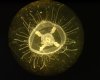
You may notice that their life cycle may never reach the medusa stage (bottom of the illustration). This occurs usually in closed bodies of water where the entire population of jellyfish are either all male or all female. Without mixed sexes, there's no need to expend the energy needed to form the free-swimming adult medusa to perform sexual reproduction. Here's a note on their life history:
Natural History of the the freshwater jellyfish
A tiny, stalked form of the jellyfish (the polyp) lives as colonies attached to stable underwater surfaces such as rooted plants, rocks, or tree stumps. The microscopic polyp colonies feed and reproduce during the spring and summer months. The polyps reproduce asexually. Some of their offspring are the jellyfish that can be seen at the surface. The "jellyfish" or medusa reproduce sexually. Fertilized eggs develop into planula larvae which eventually settle to the bottom of the pond or lake and develop into polyps. However, in the United States, most populations of jellyfish are either all male or all female, so sexual reproduction may be rare.
The appearance of the jellyfish is described as sporadic and unpredictable. Often, jellyfish will appear in a body of water in large numbers even though they were never reported there before. The following year they may be absent and may not reappear until several years later. It is also possible for the jellyfish to appear once and never appear in that body of water again.
During the winter, the polyps contract and become "resting bodies" that are capable of surviving the cold temperatures. Some scientists believe that the resting bodies, called podocysts, are one way in which the jellyfish are transported from lake to lake. It is believed that the podocysts may be transported on aquatic plants, by aquatic animals, or perhaps on the feet of birds. When conditions become favorable, the podocysts develop into polyps, and the life cycle is continued.