135g SA "Renewal" Project

  • We are currently upgrading MFK. thanks! -neo
I would only add the very largest of Cory species such as splendens.
A Cory is quite a deadly mouthful if it gets stuck.They have razor sharp pectoral spines that they lock when attacked.
This could prove deadly to both the Cory and the rivulatus.
I kept around 20 splendens with mine but added them fully grown when the rivulatus where juveniles. They were completely ignored.
For mid water swimming tank mates, I can think of no better candidates than hoplo catfish.
 
I would only add the very largest of Cory species such as splendens.
A Cory is quite a deadly mouthful if it gets stuck.They have razor sharp pectoral spines that they lock when attacked.
This could prove deadly to both the Cory and the rivulatus.
I kept around 20 splendens with mine but added them fully grown when the rivulatus where juveniles. They were completely ignored.
For mid water swimming tank mates, I can think of no better candidates than hoplo catfish.

How long did it take your splendens to reach their full grown size? And in addition to the hoplos would balas make it eith the GTs?
 
Your balas may be OK.
They get large and are fast and agile.The only problem that may occur with fish like balas is they have large easily dislodged scales.
I have known many cichlids develop a taste for scales once they get to sample a dislodged one.
This can lead to a habit and a constant pita.
However these are if's and maybes, so it's worth a try.
I would say I had my splendens about 2.5 years until they were around 3 inches.
 
Brochis Splendens would be my first choice if I can find them. I've got 5 adult Sterbais in there now. The females are a decent size.

Speaking of deadly snack I lost a male Geo. Red head Tapajos and a panda Cory that way (two panda's actually, it happened twice). They did exactly what Stanzzzz said - locked their pectorals and got stuck the the throat.
 
Finally! Ich treatment finished. On Friday it was 14 days from last sign of white spots. I did a 50% water change in the morning to help get rid of the salt. Then in the evening I did a ~75% - 80% water change. In between I removed my big Eheim heater and installed a second 250w inline heater while I cleaned one of my canisters. I also installed a DIY intake and it's awesome - you can't see it, which is what I want. Over the next 2 months as i clean my other canisters I will install the remaining DIY intakes. Here are a couple of full tank shots;

Lights back (to encourage growth of valisnaria):

IMG_1948.JPG

And lights pulled forward (which I think looks better for viewing purposes):

IMG_1949.JPG

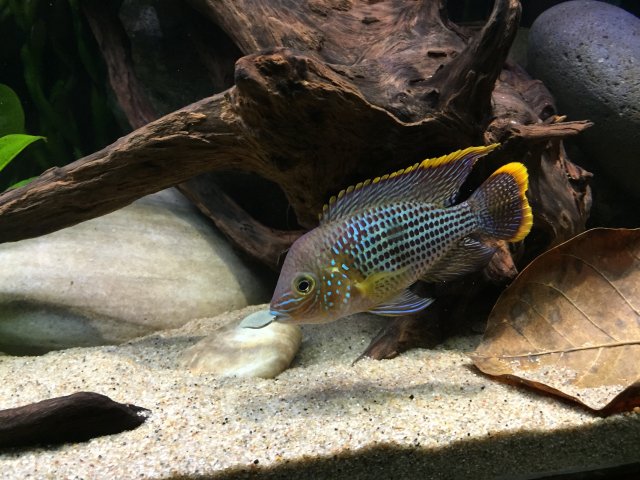
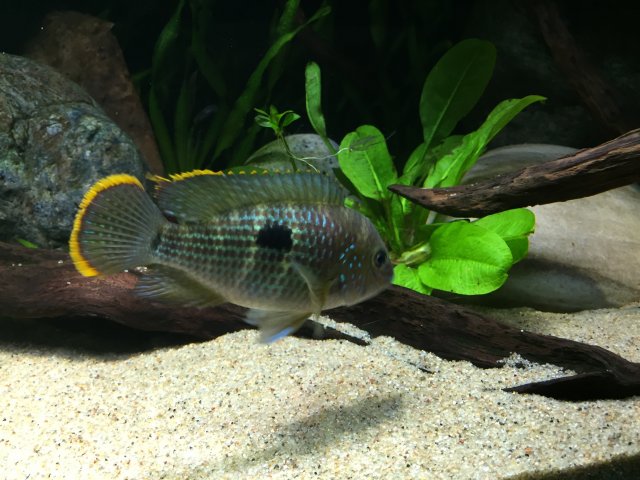
And here are pics of the 4 GT's I see all of the time. The second, sub-dominant male hides all of the time. He and the smallest female have sunken bellies and everyone is outgrowing them. I treated the tank once for internal parasites. I've decided I will pull these two and hospitalize them in a 15g and treat them again. Not sure if I will pull at same time or individually.

Male;
IMG_1950.JPG
IMG_1951.JPG

Largest female;
IMG_1953.JPG

2nd largest female;
IMG_1954.JPG

Smallest, skinny belly female;
IMG_1955.JPG
IMG_1956.JPG
 
I've noticed that ever since the smaller male has started hiding most of the time the larger males hump has shrunk.

I've also been doing a salt & heat treatment so I don't know if that's a factor - but my working theory is that because the largest male has established dominance his hump has shrunk.

I have no data to back that up of course! But hey, it's the era of Alt Facts and what not so why should a verifiable evidence keep me from hypothesizing. Ha!
 
Not really. There is some chasing, but the big guy doesn't chase him much more than he chases the females.

Still, the potential for a problem is there. Once I pull him to treat him he won't be going back into this tank. I will either sell him on a local forum or try to trade him in for store credit.
 
MonsterFishKeepers.com