Never thought I'd be posting in this section but I have a quick ICH question

  • We are currently upgrading MFK. thanks! -neo

the big kahuna

Aimara
MFK Member
Oct 13, 2007
779
665
130
new york city
So my 55 gallon quarantine tank started leaking a few months ago. Didn't rush to replace it because I had no plans of adding new fish anytime soon and my current fish was doing great. Two weeks ago I added a bass directly into the tank without quarantine that I got for a great deal. Couple of days later I have ICH in my tank. I did my research and will go with the raised temperature and salt treatment. I have the everything ready to start but there's one piece of information I'm having a hard time finding. Once I start the salt process for the 12 days, do I perform a water change every day or every 2 days or stay with my normal twice a week? I know also to replace the amount of salt according to the amount of water I change.

 
So my 55 gallon quarantine tank started leaking a few months ago. Didn't rush to replace it because I had no plans of adding new fish anytime soon and my current fish was doing great. Two weeks ago I added a bass directly into the tank without quarantine that I got for a great deal. Couple of days later I have ICH in my tank. I did my research and will go with the raised temperature and salt treatment. I have the everything ready to start but there's one piece of information I'm having a hard time finding. Once I start the salt process for the 12 days, do I perform a water change every day or every 2 days or stay with my normal twice a week? I know also to replace the amount of salt according to the amount of water I change.
So per ur regular cleaning schedule, so 2x per week.
 
  • Like
Reactions: the big kahuna
That sucks man....had the same issue when I added two Kels....P-Bass are really sensitive. Dont skimp on the salt....The first time my bass got ich i cured them both with above treatment....dont waste your money on aquarium salt. Kosher salt is waaaaay cheaper and just as effective as a cure. When I had to treat in my planted tank I found that the "reef" safe chems are not as effective as salt and temp. Hopefully everyone pulls thru!!!
 
Each ick spot on a fish erupts into up to 100 new ick, if your salinity is strong enough, osmotic pressure makes these new ick implode.(3lbs of salt per 100 gallons is sufficient)
If not, these new ick drop into the substrate, and after a short dormancy period, they move up (attracted to fish urine and exhalations) and reattach to fish. The more you vacuum the substrate, get rid of that old water and detritus, the more potential ick infections you are getting rid of.
This cycle is constantly reoccurring until you get rid of every microscopic protozoa, one reason it is suggested to continue treatment for at least 12 days, and during that time the salinity should remain no lower than 3ppt (parts per thousand)
 
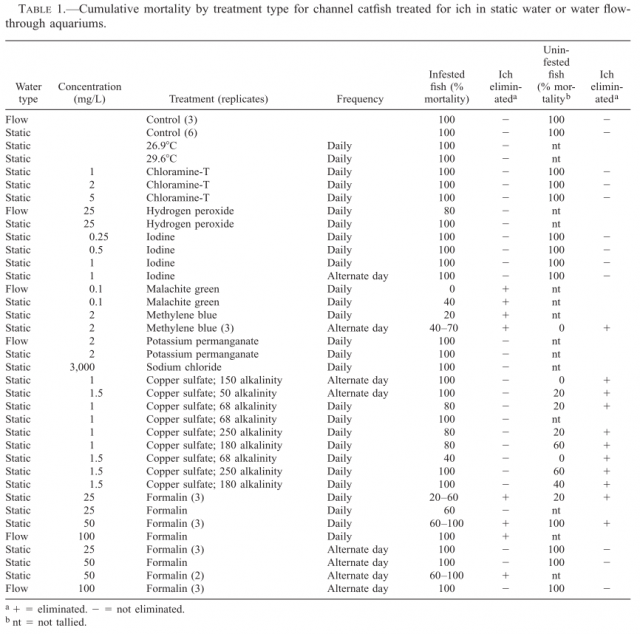
Dont waste your time on salt and temp treatment which is slow and ineffective. The most effective remedy is Malachite green. According to this aquaculture study evaluating 10+ remedies, MG can penetrate fish skin and attack ich in all stages. Most other remedies attack only free swimming larvae to stop ich transmission, so are slow and ineffective.

Check this thread out for more discussion.

https://www.monsterfishkeepers.com/forums/threads/ich-treatment.700554/


upload_2019-1-5_12-12-46.png
 
Thanks for all the quick replies. Last question should I continue using Prime while treating the tank?
 
Each ick spot on a fish erupts into up to 100 new ick, if your salinity is strong enough, osmotic pressure makes these new ick implode.(3lbs of salt per 100 gallons is sufficient)
If not, these new ick drop into the substrate, and after a short dormancy period, they move up (attracted to fish urine and exhalations) and reattach to fish. The more you vacuum the substrate, get rid of that old water and detritus, the more potential ick infections you are getting rid of.
This cycle is constantly reoccurring until you get rid of every microscopic protozoa, one reason it is suggested to continue treatment for at least 12 days, and during that time the salinity should remain no lower than 3ppt (parts per thousand)


Wow 3 lbs per 100 gallons? I read 3 cups per 100 gallons.
 
The reason salt doesn't work for many aquarists, is they use to wimpy a dose. 3 lbs per 100 gallons, creates a 3ppt salinity, the magic kill solution needed for salt.
There has to be enough salinity to create an implosion of osmotic pressure.
It's a similar thing to what other meds such as meth blue and malachite green do, they saturate the tank water with a toxic substance that has osmotic pressure enough to kill the emerging vulnerable protozoa. Hopefully not toxic enough to hurt fish.
Some of the med are more toxic than others, and lead to a quicker kill time, but can also do damage to sensitive membranes on the fish (especially scale less type).
Salt has the potential osmotic pressure without the toxicity..
I have used them all over the last 50 years, Nox-Ick , formalize and all the dyes.


When I add salt, I get a 50 lb bag of rock salt, or water softener salt and dump it in by the lb over a day until the salinity reading on my salinity/conductivity meter hit 3.3 or 3.5.

Here is the result.
This fish and others arrived covered in ick spots.

A week later using only salt (no extra heat
 
  • Like
Reactions: the big kahuna
The reason salt doesn't work for many aquarists, is they use to wimpy a dose. 3 lbs per 100 gallons, creates a 3ppt salinity, the magic kill solution needed for salt.
There has to be enough salinity to create an implosion of osmotic pressure.
It's a similar thing to what other meds such as meth blue and malachite green do, they saturate the tank water with a toxic substance that has osmotic pressure enough to kill the emerging vulnerable protozoa. Hopefully not toxic enough to hurt fish.
Some of the med are more toxic than others, and lead to a quicker kill time, but can also do damage to sensitive membranes on the fish (especially scale less type).
Salt has the potential osmotic pressure without the toxicity..
I have used them all over the last 50 years, Nox-Ick , formalize and all the dyes.


When I add salt, I get a 50 lb bag of rock salt, or water softener salt and dump it in by the lb over a day until the salinity reading on my salinity/conductivity meter hit 3.3 or 3.5.

Here is the result.
This fish and others arrived covered in ick spots.

A week later using only salt (no extra heat
Thanks for the info. I don't have a salinity/conductivity meter but will go with the 3lbs per 100 gallons
 
The reason salt doesn't work for many aquarists, is they use to wimpy a dose. 3 lbs per 100 gallons, creates a 3ppt salinity, the magic kill solution needed for salt.
There has to be enough salinity to create an implosion of osmotic pressure.
It's a similar thing to what other meds such as meth blue and malachite green do, they saturate the tank water with a toxic substance that has osmotic pressure enough to kill the emerging vulnerable protozoa. Hopefully not toxic enough to hurt fish.
Some of the med are more toxic than others, and lead to a quicker kill time, but can also do damage to sensitive membranes on the fish (especially scale less type).
Salt has the potential osmotic pressure without the toxicity..
I have used them all over the last 50 years, Nox-Ick , formalize and all the dyes.


When I add salt, I get a 50 lb bag of rock salt, or water softener salt and dump it in by the lb over a day until the salinity reading on my salinity/conductivity meter hit 3.3 or 3.5.

Here is the result.
This fish and others arrived covered in ick spots.

A week later using only salt (no extra heat
Are there fish ( commonly kept in the aquarium) where a 3ppt salinity would likely pose more of an issue than using a malachite/victoria green proprietary blend?

I know salt in this concentration is highly effective in eradicating Ich in many species; but, I have soft water species like discus, South American black water tetras (tucanoichthys tucano), African Congo tetras from waters very soft, tannin stained, and low in TDS( alestopetersius brichardii and nigroptersus, phenocogrammus aurentius) , and geophagus, biotodoma cupidos, and Altum Angels-- to name a few.
 
MonsterFishKeepers.com