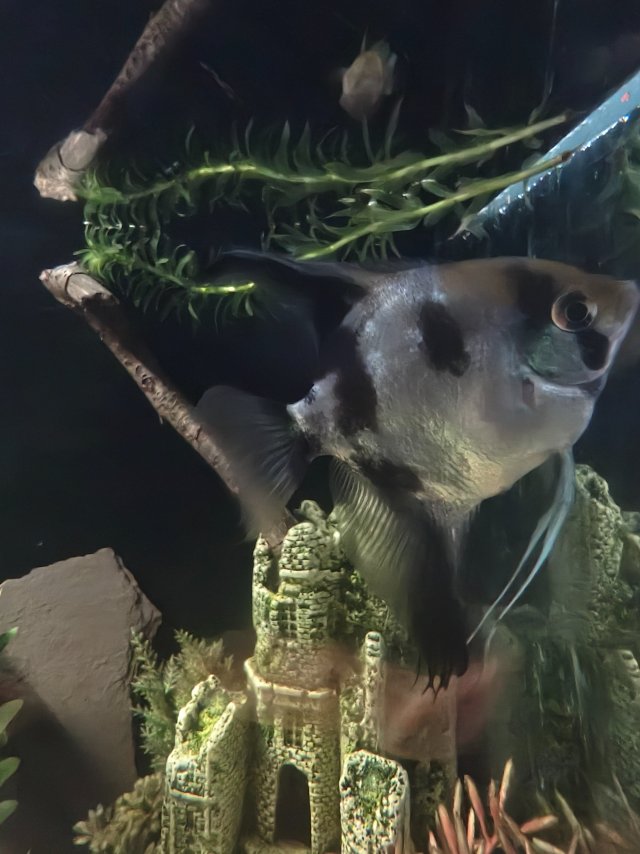
Rethinking standard practice: 8 years, no testing, no disease.

  • We are currently upgrading MFK. thanks! -neo
I cycle the water when I'm usually adding stuff to the tank for example 5 weeks ago I added live plants and all the large rocks seen in the video , the fish get removed into a bucket of there own tank water before a 50 percent water change is done , then that bucket of water is added straight back into the tank , the tank itself is never actually full and I always leave space at the top for tank to breath

And before people come at me about my methods a) the fish were removed for their own safety and b) you can't argue with their condition shown in these photos

And please bare in mind these live with barbs and a Chinese algae Eater on a day to day basis
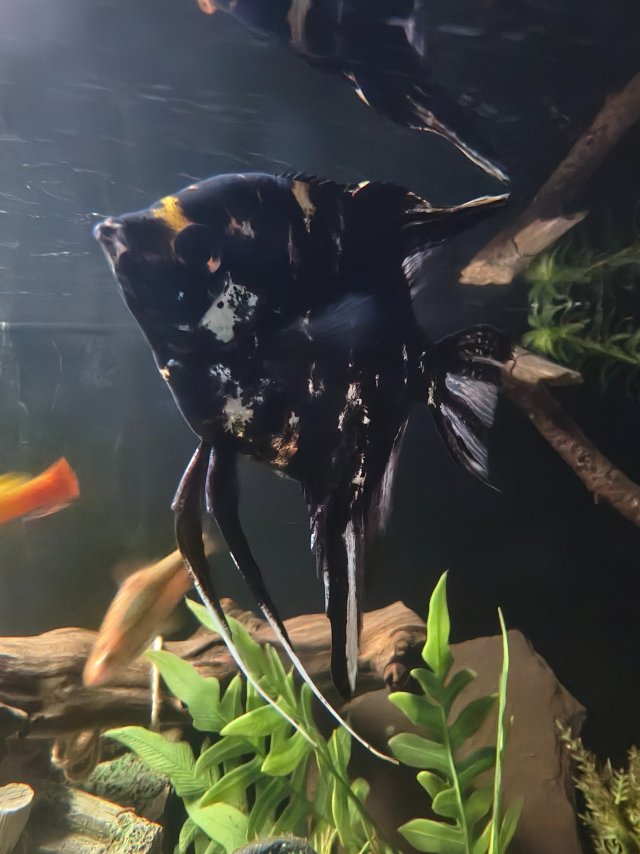
1000006951.jpg

1000006952.jpg
 
Last edited:
If you'd had stated from the very start that this was a heavily planted tank then I don't think any eyebrows would have been raised at all.

But hardly any plants and only a 50% water change every three months, even with quite a low bio load, that scenario is still going to give you a nitrate creep.

I suspect that you certainly do have elevated nitrate but your stock have become "immune" to the higher levels over time. And your once every three months water changes are maybe just keeping that high creeping nitrate from going off the scale.

An actual nitrate reading from before and after a water change would tell us a great deal. But you don't intend to start testing anytime soon so basically I don't even know why you've bothered posting these claims. They tell us absolutely nothing.
 
If you'd had stated from the very start that this was a heavily planted tank then I don't think any eyebrows would have been raised at all.

But hardly any plants and only a 50% water change every three months, even with quite a low bio load, that scenario is still going to give you a nitrate creep.

I suspect that you certainly do have elevated nitrate but your stock have become "immune" to the higher levels over time. And your once every three months water changes are maybe just keeping that high creeping nitrate from going off the scale.

An actual nitrate reading from before and after a water change would tell us a great deal. But you don't intend to start testing anytime soon so basically I don't even know why you've bothered posting these claims. They tell us absolutely nothing.
If you actually read the first sentence of my post, you'll see the live plants were only added 5 weeks ago. For nearly 8 years before that, it was just fake decorations, a castle, and a ship. The plants aren't doing the work here.
Also, fish don't just become 'immune' to high nitrates. If the water was toxic, their fins would be melting and they'd look terrible. You can't argue with their condition in the photos, their fins are pristine.
And I never said I wouldn't test it. I'm picking up a liquid test kit at the end of the month so I'll be posting the exact numbers then. Just to prove that everything you get taught in a physical "handbook" is nothing but a lie or a starters guide for new tanks
 
the tank itself is never actually full and I always leave space at the top for tank to breath

live plants were only added 5 weeks ago. For nearly 8 years before that, it was just fake decorations, a castle, and a ship. The plants aren't doing the work here.
Hello; Alas, a clue. Let me toss out an observation. A partly full tank as yours is in the pictures and a tank full to the top have the same surface area exposed to the air. Think about it. The surface area for gaseous exchange remains constant in a rectangular tank, full or nearly empty. The glass of the tank creates a boundary on the sides. I begin to get a clue. May I call your fish keeping practice the Vincent Vangouh (sp) style. He apparently had a somewhat different perception of the world around him, at least in the color spectrum.

Hello; I do agree that the plants have had no effect over eight years since they are present for only weeks.


Continue please.
 
I'll take the Van Gogh comment as a compliment since he didn't paint by numbers from a beginner's guide either.

You're looking at the surface area like a flat math problem and ignoring how water actually moves. Leaving the water level down lets the filter splash and physically break the surface tension, driving oxygen deep into the tank instead of just pushing it around under the glass.

If we're talking about standard rules, let's look at what's actually in here. The books say my South American Angels need soft acidic water, the Platy(again mislabelled by the pet shop as a guppy) needs hard alkaline water, and the Asian Barbs and CAE need cold river currents, and the red paradise fish needs a completely stagnant zero flow water.

Every handbook also guarantees that Tiger Barbs will shred an Angelfish. By textbook logic, half this tank should be dead from shock and the Angels should have no fins left, yet they are all thriving together.

But thanks for agreeing with me in your second paragraph. Since we both agree the plants aren't doing the heavy lifting after only 5 weeks, it proves my 8-year biological foundation is what's keeping everything stable. I'll post the liquid test numbers at the end of the month when I pick up the kit.
 
Last edited:
And lol no, nitrates don't evaporate.
Obviously, it was quite apparent that it was sarcastic comment but since you clearly know that nitrates, phosphates, and organic waste simply don’t evaporate so where are they going? No where is the answer as you’re not completing the nitrogen cycle. You’re creating the perfect environment for an Old Tank Syndrome crash.

I have spent the last couple of years along with a significant amount of money to find the holy grail of the aquarium hobby to fully complete the nitrogen cycle. So far using Moderna technology the best results were a 30% reduction of nitrates.

Fish can absolutely slowly adapt to this toxic environment so the fact they’re still alive isn’t quite the flex you seem to think it is. A 10 minute Google search will yield you dozens of scientific studies proving that. I will add you have made a definitive statements but are unwilling to prove said statements. The tank is eight years old including the stock so I’m quite skeptical that you have a guppy that’s also eight years old.

Lastly, speaking of stock please stop saying your tiger barbs as you clearly don’t know what tiger barbs are, you have semifasciolatus which is commonly called the gold barb.

But, as others have said you do you boo…
 
Last edited:
  • Like
Reactions: Cal Amari
Obviously, it was quite apparent that it was sarcastic comment but since you clearly know that nitrates, phosphates, and organic waste simply don’t evaporate so where are they going? No where is the answer as you’re not completing the nitrogen cycle. You’re creating the perfect environment for an Old Tank Syndrome crash.

I have spent the last couple of years along with a significant amount of money to find the holy grail of the aquarium hobby to fully complete the nitrogen cycle. So far using Moderna technology the best results were a 30% reduction of nitrates.

Fish can absolutely slowly adapt to this toxic environment so the fact they’re still alive isn’t quite the flex you seem to think it is. A 10 minute Google search will yield you dozens of scientific studies proving that. I will add you have made a definitive statements that the tank is eight years old including the stock so I’m quite skeptical that you have a guppy that’s also eight years old.

Lastly, speaking of stock please stop saying your tiger barbs as you clearly don’t know what tiger barbs are, you have semifasciolatus which is commonly called the gold barb.

But, as others have said you do you boo…
To clear it up I’ve said it before, but the 8 year foundation is the tank, the substrate, and the established biological core that used to house my Goldfish and Weather Loaches. The current fish aren't 8 years old at most 3 years old but they are clearly thriving because of the bacterial foundation that the mature substrate provides.

It is funny that you have spent years and a lot of money on tech just to get a 30% nitrate reduction. It makes sense why you are skeptical of a stable system that manages itself without all that hardware.

As for the toxic theory, fish might adapt to things, but they do not build heavy muscle, stay vibrant, and keep perfect, unnipped fins in a tank that is crashing. The fish in the photos speak for themselves.

And if you want to call those barbs Gold Barbs instead of Tiger Barbs, that just proves my point even more. Gold Barbs are cold water fish that need 18 to 22 degrees. That means I am successfully running a cold water Asian species alongside tropical South American Angels and a Central American livebearer, all in perfect health, while breaking every biotope rule you guys swear by.

Like I said, the liquid test numbers will be posted at the end of the month
 
  • Haha
Reactions: jjohnwm
Like I said, the liquid test numbers will be posted at the end of the month
I can make any test results I want to fit my agenda if I’m given three weeks so that doesn’t mean anything.

The more you speak the more cracks are becoming obvious that you really don’t have a clue what you’re talking about.
 
Leaving the water level down lets the filter splash and physically break the surface tension, driving oxygen deep into the tank instead of just pushing it around under the glass.

it proves my 8-year biological foundation is what's keeping everything stable.
Hello; Afraid you lost me with the filter splash, surface tension driving oxygen deep. I do not fill a tank to the brim so lets get that straight. My tanks have a plastic rim so i use that as a fill point. I like to have the top of the water just hidden by the rim. Leaves maybe a half inch of distance from the top of the water and a cover glass.
This goes back to partial pressures of gasses and other things I am steadily forgetting. Left unaided the surface of a body of water with exchange gasses at a known rate. The rate can be affected by temperature of the water and the air as well as the pressure of the air. We aid the opportunity for oxygen to enter the water by surface agitation and also with air pump bubblers. Afraid I am one of those unfortunate folks contaminated by science books and graduate courses such ass Limnology. I now understand why I do not catch big fish with topwater flies in midsummer but do so in spring & fall. Turned out to not just be luck.

I am pretty sure the half inch or so of space above my tank water is adequate for gas exchange but have not tested such. maybe someone has. However, I remain unconvinced of your assertion just yet. Perhaps because I have been doing it that way for over 65 years. Which brings me to my next comment.

Hello; So far you have not provided "proofs" of your take about how you tank setup works. At best you have a hypothesis about what is going on. Sorry to have pulled out one of the science book terms. I think you a testable hypothesis if you wanted to go for such. A thing is once you present the results of the testing then we get to try your procedures and reproduce them.
Stated another way. I can cite something because i have done it that way for the 65 + years I have kept tanks. Such is not a proof. Another thing is I have had to revise my procedures over those years. I started in 1959 but was not fully into WC until the early 1970's. I started playing with WC in the 60's as I overheard a conversation in a fish shop, but was too prideful to admit i did not know about it so did not ask questions. That makes it over 11 years for me to learn. You are ahead of that.
 
I wouldn't even know how to use the test kit and I've only just looked them up , they are 30 quid a pop online , that is money as a single parent I don't have right now. Nor do I see myself pulling this kind of money out weekly just to satisfy the need of those online. The same water marks you see now will be there at the end of the month because I don't play on touching the tank till late July/August at least for a water change

The bottom line is this tank has history to me and my son because it was the first thing we did when I brought him home from the care system. As he has aged so has the tank.

It is interesting to hear about your experience since 1959. It sounds like you have seen a lot of changes in the hobby, which makes it even more surprising that you are struggling to accept that a stable system can look different from the one you have been practicing for decades. You call my setup a hypothesis, but it is a system that has been running for eight years without a failure. In science, a hypothesis that consistently produces the expected result over nearly a decade becomes an observation.

I am not looking to reproduce the standard procedures found in textbooks because those methods are clearly not the only way to achieve stability. My tank is the proof. You do not need a degree in Limnology to see that the fish in the photos are healthy and thriving. I am getting the test kit specifically to provide the data points you are asking for; once I post those numbers, the data will be there for everyone to see. Until then, there is really nothing left to debate.
 
MonsterFishKeepers.com