

Here is some information about brackish plants that may be helpful.
Brackish Plants
[TABLE="width: 100%"]
[TR]
[TD="width: 75%"]
[/TD]
[TD="width: 25%"]
[/TD]
[/TR]
[/TABLE]
There are many and diverse species of true aquatic, bog and near-water brackish plants suitable for semi fresh/marine aquarium use. And not surprisingly, it follows/is coincident that most brackish water fishes and invertebrates greatly prefer/benefit from the presence of these true/vascular plants. Live brackish water plants fulfill the same functions and aesthetics as with freshwater planted aquariums and "reef" type marine set-ups... The plants condition, stabilize water conditions, provide food, habitat, and are good looking.
There are a few "rules" re brackish water plant use beyond simple selection and placement. Here we'll introduce the basics of their use including review of the varieties the hobbyist is most likely to be able to locate for their brackish system/s.
First Off, A Few Necessary Definitions:
Brackish:
What do we or at least I mean by "brackish"? Some "in-between" concentration beyond "freshwater" (almost all freshwater sources have appreciable salts in them) and typical seawater (most seawaters have about 3.5% salt content, or a specific gravity of approximately 1.025. Many pet-fish writers include specific values, so we will as well. In the way of spg, brackish systems have water with salt content between 1.005 and 1.012.
Salts:
In chemistry, salts are combinations of metals and non-metals, ionic compounds. Some examples: sodium is a metal, chlorine a non-metal halogen... together they're sodium chloride, aka table salt. Magnesium is a metal, sulfate (a Sulfur, and three oxygen atoms) a non-metal radical... together they're magnesium sulfate, Epsom salts...
I have seen a few articles in recent years that state "any salt" is okay to use to make brackish water from fresh, examples given include table (iodized or not), kosher, ice cream salt (these are all principally sodium chloride). I caution and advise against these uses and encourage you to either use mixed in "real" seawater or a synthetic seawater mix for your brackish/salt additions. Here's an important exception. IF you're simply adding some/more salt to a freshwater system, on the order of a teaspoon or so per gallon, the "other" simpler salts are fine to use. Seawater has about twelve teaspoons of a combination of many salts (the preponderant one of which is sodium chloride). The mix, blend of other ions in real seawater or its facsimile are important to real/true brackish livestock (fishes, invertebrates, plants, microbes...). Your system will be healthier, more stable using real or faux seawater blended in with fresh.
Plants:
There are some thallophytes, algae, that look like true/vascular plants... for the most part these are undesirable forms that are best controlled by the cultivation of the true plants (Kingdom Metaphyta). As with selection of freshwater aquarium plants, one must be on their guard, aware that what are sold as "true aquatics" are often cuttings, growths of "bog" plants or worse, terrestrial growings that have been dunked underwater. Study of appropriate species, examination of stocks (e.g. for presence/location of stomata) is essential.
Rates of Change/Acclimation:
As with experiments and practices of conversion of tolerant "freshwater" fish livestock to saltier environs, most plants have known ranges AND rates in which these changes can be made safely. When, where in doubt, do consult reference works re both these aspects, measure the water your plants are currently growing in, and acclimate them slowly (a thousandth of spg per every few days) to your systems water density. Similarly, check for yourself what the ambient pH, hardness/alkalinity and temperature of the systems you're moving your livestock from are and adjust these slowly.
More and Less Brackish Water Aquarium Plant Species:
You'll likely be surprised at how many common aquarium plants are to some degree brackish. Most all do tolerate salts to some extent. On the most successfully kept species you will find notes and a last list below... All those listed can do okay to well at the lower end of brackish range... near densities of 1.005.
The groups and species presented below are all recorded as brackish-useful in the literature (pet-fish and scientific). The "best" list following these categories are ones I have kept in such circumstances.
[TABLE="width: 100%"]
[TR]
[TD="width: 50%"]" Anacharis", actually members of the genera Egeria, Elodea are either the most common species of aquarium plant or close to it.[/TD]
[TD="width: 50%"]
 [/TD]
[/TD]
[/TR]
[/TABLE]
[TABLE="width: 100%"]
[TR]
[TD="width: 50%"]Anubias spp. A large assemblage of African species and cultivars that are very resistant to both salt intrusion and fish predation.[/TD]
[TD="width: 50%"]
 [/TD]
[/TD]
[/TR]
[/TABLE]
[TABLE="width: 100%"]
[TR]
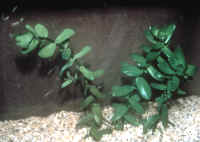
[TD="width: 50%"]Bacopa spp., especially B. monniera is found in brackish waters.[/TD]
[TD="width: 50%"]
 [/TD]
[/TD]
[/TR]
[/TABLE]
[TABLE="width: 100%"]
[TR]
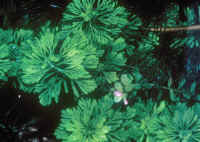
[TD="width: 50%"]Cabomba species. Beautiful, but easily fall apart when moved, and readily eaten. Take care to cut away rubber bands, remove lead weights, and gently plant individual stems if bought in typical "bunches".[/TD]
[TD="width: 50%"]
 [/TD]
[/TD]
[/TR]
[/TABLE]
[TABLE="width: 100%"]
[TR]
[TD="width: 50%"]Hornwort, Ceratophyllum demersum et al. spp. (coontail to pond people). Cool and tropical water species occur. Generally unpalatable to brackish water fishes.[/TD]
[TD="width: 50%"]
 [/TD]
[/TD]
[/TR]
[/TABLE]
[TABLE="width: 100%"]
[TR]
[TD="width: 50%"]Water Sprite, Ceratopteris spp. Amongst my favorite aquarium plants period. Beautiful, undemanding, adaptable. Here Ceratopteris cornuta in a floating phase.[/TD]
[TD="width: 50%"]
 [/TD]
[/TD]
[/TR]
[/TABLE]
[TABLE="width: 100%"]
[TR]
[TD="width: 50%"]Cryptocoryne spp., particularly C. ciliata is well-adapted to brackish water.[/TD]
[TD="width: 50%"]
 [/TD]
[/TD]
[/TR]
[/TABLE]
[TABLE="width: 100%"]
[TR]
[TD="width: 50%"]Echinodorus spp. The Pygmy Chain Sword, E. tenellus is well-regarded as a part-marine species.[/TD]
[TD="width: 50%"]
 [/TD]
[/TD]
[/TR]
[/TABLE]
[TABLE="width: 100%"]
[TR]
[TD="width: 50%"]Hairgrass, Eleocharis, particularly the more popular E. acicularis. Lives well in cool water, unheated aquariums. Of the 150 or so species, there are ones found in the tropics to the Arctic.[/TD]
[TD="width: 50%"]
 [/TD]
[/TD]
[/TR]
[/TABLE]
[TABLE="width: 100%"]
[TR]
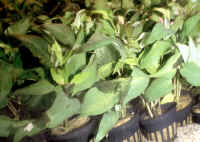
[TD="width: 50%"]Hygrophila polysperma, Hygrophilia sticta, many others. "Hygros". Distasteful to many brackish fishes. Do check on the individual species requirements. Most prefer pH's no greater than 7.5, some get very large, others more suitable as closely cropped foreground plants. Some occur in red colors. Emergent species. At right, H. polysperma at a wholesale growing facility.[/TD]
[TD="width: 50%"]
 [/TD]
[/TD]
[/TR]
[/TABLE]
[TABLE="width: 100%"]
[TR]
[TD="width: 50%"]Microsorium pteropus , Java Fern. One of the best brackish water plant species. In fact, about the only regularly sold aquarium plant that is "naturally" brackish. Slow, but steady grower, attached to wood.[/TD]
[TD="width: 50%"]
 [/TD]
[/TD]
[/TR]
[TR]
[TD="width: 50%"]Myriophyllum spp., Foxtails, Parrot Feather.[/TD]
[TD="width: 50%"]
 [/TD]
[/TD]
[/TR]
[/TABLE]
[TABLE="width: 100%"]
[TR]
[TD="width: 50%"]Temple Plant, Nomaphila spp. A close relative to Hygrophila.[/TD]
[TD="width: 50%"]
[/TD]
[/TR]
[/TABLE]
[TABLE="width: 100%"]
[TR]
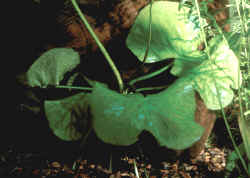
[TD="width: 50%"]Banana Plant, Nymphoides sp. Close relatives of water lilies.[/TD]
[TD="width: 50%"]
 [/TD]
[/TD]
[/TR]
[/TABLE]
[TABLE="width: 100%"]
[TR]
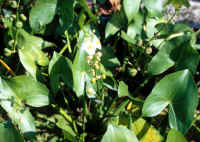
[TD="width: 50%"]Sagittaria spp. Tough, waxy leaves help this genus of attractive tall and short plant species to resist salt leaching and consumption by brackish fishes.[/TD]
[TD="width: 50%"]

 [/TD]
[/TD]
[/TR]
[/TABLE]
[TABLE="width: 100%"]
[TR]
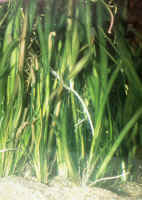
[TD="width: 50%"]Vallisneria spp., particularly the "Giant" Val.s, like V. americana, hold up well to browsing and salt intrusion.[/TD]
[TD="width: 50%"]
 [/TD]
[/TD]
[/TR]
[/TABLE]
[TABLE="width: 100%"]
[TR]
[TD="width: 50%"]Vesicularia dubyana, Java Moss. Can tolerate low to high light intensity, soft to very hard waters.[/TD]
[TD="width: 50%"]
 [/TD]
[/TD]
[/TR]
[/TABLE]
Best/hardiest brackish water plant species I have used: Microsorium pteropus, Hygrophila polysperma, Sagittaria spp., Vallisneria spp., Echinodorus tenellus, Ceratopteris spp.,
Maintenence:
Like their so-called freshwater counterparts (often the same species), brackish plant cultivation calls for regular fertilization with complete preparations and possible soil addition (fine, w/ clay) mixed into the lower gravel/substrate area. Stumped as to why your plants won't/don't grow? Why their leaves are yellowing? How to make them more luxurious. Often these are matters of too little (sometimes too much) of "something". Help is available. Visit "the krib" on the Internet for troubleshooting information and common-sense solutions (link below).
I trust I've made a large and often enough mention of the benefits of pre-making and storing new/make-up water... In these times of vacillating tapwater quality, there is no better, cheaper, safer way to assure that the watery environment you're re-supplying is about what you want it to be than to utilize a dedicated container like a plastic trash can, pump, heater... to have new water ready on hand.
Due to most hobbyists' insatiable desire to overstock, overfeed their systems, many brackish tanks are downright turbulent in their water movement. Bear this in mind when placing pumps, airstones, picking out gravel types/grades, placing your green livestock... that your plants may be overly buffeted about by such circulation.
Some authors on brackish topics suggest that these environments are more/less tropical than the seas they border... Some are both depending on the seasons... For the most part I suggest setting your systems' temperatures on the lower side of the livestock's known ranges to slow down their metabolisms (less food, wastes, longer lives... more gas solubility.) with once again, consulting references on each species preferences, tolerances.
About Brackish Water Plant Eaters:
As yet we haven't mentioned the palatability of live plants and fishes. Rest-assured, some brackish water animals are pure terrors with plantings. Scats for instance, revel in eating and uprooting any and all plant stocks. Soft, easily torn varieties are out when keeping these fishes. Alternatives exist for keeping the plants and there would-be consumers apart. Iit's not difficult to grow your plants in either a tied-in sump arrangement, just moving water back and forth between the fishes and plants areas, or to place tastier varieties behind a glass or plastic partition.
Cloze:
Do brackish systems absolutely require live plants to be successful? Strictly speaking no. The benefits of using live plant material can be supplied in other ways. As food, brackish fishes do engage in eating "their" plants... expect this. If you don't supply living sources, "green" foods can be supplemented. For shade? Other decor items can be used. For waste removal, supplying oxygen... yes, filtration can be boosted, maintenance done religiously.
For a "complete" look and set-up however, as with all-freshwater systems, there is nothing like live plants to complete a brackish water display. Do consider them if you get try brackish aquarium keeping.
Brackish Plants
[TABLE="width: 100%"]
[TR]
[TD="width: 75%"]
[/TD]
[TD="width: 25%"]
[/TD]
[/TR]
[/TABLE]
There are many and diverse species of true aquatic, bog and near-water brackish plants suitable for semi fresh/marine aquarium use. And not surprisingly, it follows/is coincident that most brackish water fishes and invertebrates greatly prefer/benefit from the presence of these true/vascular plants. Live brackish water plants fulfill the same functions and aesthetics as with freshwater planted aquariums and "reef" type marine set-ups... The plants condition, stabilize water conditions, provide food, habitat, and are good looking.
There are a few "rules" re brackish water plant use beyond simple selection and placement. Here we'll introduce the basics of their use including review of the varieties the hobbyist is most likely to be able to locate for their brackish system/s.
First Off, A Few Necessary Definitions:
Brackish:
What do we or at least I mean by "brackish"? Some "in-between" concentration beyond "freshwater" (almost all freshwater sources have appreciable salts in them) and typical seawater (most seawaters have about 3.5% salt content, or a specific gravity of approximately 1.025. Many pet-fish writers include specific values, so we will as well. In the way of spg, brackish systems have water with salt content between 1.005 and 1.012.
Salts:
In chemistry, salts are combinations of metals and non-metals, ionic compounds. Some examples: sodium is a metal, chlorine a non-metal halogen... together they're sodium chloride, aka table salt. Magnesium is a metal, sulfate (a Sulfur, and three oxygen atoms) a non-metal radical... together they're magnesium sulfate, Epsom salts...
I have seen a few articles in recent years that state "any salt" is okay to use to make brackish water from fresh, examples given include table (iodized or not), kosher, ice cream salt (these are all principally sodium chloride). I caution and advise against these uses and encourage you to either use mixed in "real" seawater or a synthetic seawater mix for your brackish/salt additions. Here's an important exception. IF you're simply adding some/more salt to a freshwater system, on the order of a teaspoon or so per gallon, the "other" simpler salts are fine to use. Seawater has about twelve teaspoons of a combination of many salts (the preponderant one of which is sodium chloride). The mix, blend of other ions in real seawater or its facsimile are important to real/true brackish livestock (fishes, invertebrates, plants, microbes...). Your system will be healthier, more stable using real or faux seawater blended in with fresh.
Plants:
There are some thallophytes, algae, that look like true/vascular plants... for the most part these are undesirable forms that are best controlled by the cultivation of the true plants (Kingdom Metaphyta). As with selection of freshwater aquarium plants, one must be on their guard, aware that what are sold as "true aquatics" are often cuttings, growths of "bog" plants or worse, terrestrial growings that have been dunked underwater. Study of appropriate species, examination of stocks (e.g. for presence/location of stomata) is essential.
Rates of Change/Acclimation:
As with experiments and practices of conversion of tolerant "freshwater" fish livestock to saltier environs, most plants have known ranges AND rates in which these changes can be made safely. When, where in doubt, do consult reference works re both these aspects, measure the water your plants are currently growing in, and acclimate them slowly (a thousandth of spg per every few days) to your systems water density. Similarly, check for yourself what the ambient pH, hardness/alkalinity and temperature of the systems you're moving your livestock from are and adjust these slowly.
More and Less Brackish Water Aquarium Plant Species:
You'll likely be surprised at how many common aquarium plants are to some degree brackish. Most all do tolerate salts to some extent. On the most successfully kept species you will find notes and a last list below... All those listed can do okay to well at the lower end of brackish range... near densities of 1.005.
The groups and species presented below are all recorded as brackish-useful in the literature (pet-fish and scientific). The "best" list following these categories are ones I have kept in such circumstances.
[TABLE="width: 100%"]
[TR]
[TD="width: 50%"]" Anacharis", actually members of the genera Egeria, Elodea are either the most common species of aquarium plant or close to it.[/TD]
[TD="width: 50%"]
[/TR]
[/TABLE]
[TABLE="width: 100%"]
[TR]
[TD="width: 50%"]Anubias spp. A large assemblage of African species and cultivars that are very resistant to both salt intrusion and fish predation.[/TD]
[TD="width: 50%"]
[/TR]
[/TABLE]
[TABLE="width: 100%"]
[TR]
[TD="width: 50%"]Bacopa spp., especially B. monniera is found in brackish waters.[/TD]
[TD="width: 50%"]
[/TR]
[/TABLE]
[TABLE="width: 100%"]
[TR]
[TD="width: 50%"]Cabomba species. Beautiful, but easily fall apart when moved, and readily eaten. Take care to cut away rubber bands, remove lead weights, and gently plant individual stems if bought in typical "bunches".[/TD]
[TD="width: 50%"]
[/TR]
[/TABLE]
[TABLE="width: 100%"]
[TR]
[TD="width: 50%"]Hornwort, Ceratophyllum demersum et al. spp. (coontail to pond people). Cool and tropical water species occur. Generally unpalatable to brackish water fishes.[/TD]
[TD="width: 50%"]
[/TR]
[/TABLE]
[TABLE="width: 100%"]
[TR]
[TD="width: 50%"]Water Sprite, Ceratopteris spp. Amongst my favorite aquarium plants period. Beautiful, undemanding, adaptable. Here Ceratopteris cornuta in a floating phase.[/TD]
[TD="width: 50%"]
[/TR]
[/TABLE]
[TABLE="width: 100%"]
[TR]
[TD="width: 50%"]Cryptocoryne spp., particularly C. ciliata is well-adapted to brackish water.[/TD]
[TD="width: 50%"]
[/TR]
[/TABLE]
[TABLE="width: 100%"]
[TR]
[TD="width: 50%"]Echinodorus spp. The Pygmy Chain Sword, E. tenellus is well-regarded as a part-marine species.[/TD]
[TD="width: 50%"]
[/TR]
[/TABLE]
[TABLE="width: 100%"]
[TR]
[TD="width: 50%"]Hairgrass, Eleocharis, particularly the more popular E. acicularis. Lives well in cool water, unheated aquariums. Of the 150 or so species, there are ones found in the tropics to the Arctic.[/TD]
[TD="width: 50%"]
[/TR]
[/TABLE]
[TABLE="width: 100%"]
[TR]
[TD="width: 50%"]Hygrophila polysperma, Hygrophilia sticta, many others. "Hygros". Distasteful to many brackish fishes. Do check on the individual species requirements. Most prefer pH's no greater than 7.5, some get very large, others more suitable as closely cropped foreground plants. Some occur in red colors. Emergent species. At right, H. polysperma at a wholesale growing facility.[/TD]
[TD="width: 50%"]
[/TR]
[/TABLE]
[TABLE="width: 100%"]
[TR]
[TD="width: 50%"]Microsorium pteropus , Java Fern. One of the best brackish water plant species. In fact, about the only regularly sold aquarium plant that is "naturally" brackish. Slow, but steady grower, attached to wood.[/TD]
[TD="width: 50%"]
[/TR]
[TR]
[TD="width: 50%"]Myriophyllum spp., Foxtails, Parrot Feather.[/TD]
[TD="width: 50%"]
[/TR]
[/TABLE]
[TABLE="width: 100%"]
[TR]
[TD="width: 50%"]Temple Plant, Nomaphila spp. A close relative to Hygrophila.[/TD]
[TD="width: 50%"]
[/TD]
[/TR]
[/TABLE]
[TABLE="width: 100%"]
[TR]
[TD="width: 50%"]Banana Plant, Nymphoides sp. Close relatives of water lilies.[/TD]
[TD="width: 50%"]
[/TR]
[/TABLE]
[TABLE="width: 100%"]
[TR]
[TD="width: 50%"]Sagittaria spp. Tough, waxy leaves help this genus of attractive tall and short plant species to resist salt leaching and consumption by brackish fishes.[/TD]
[TD="width: 50%"]
[/TR]
[/TABLE]
[TABLE="width: 100%"]
[TR]
[TD="width: 50%"]Vallisneria spp., particularly the "Giant" Val.s, like V. americana, hold up well to browsing and salt intrusion.[/TD]
[TD="width: 50%"]
[/TR]
[/TABLE]
[TABLE="width: 100%"]
[TR]
[TD="width: 50%"]Vesicularia dubyana, Java Moss. Can tolerate low to high light intensity, soft to very hard waters.[/TD]
[TD="width: 50%"]
[/TR]
[/TABLE]
Best/hardiest brackish water plant species I have used: Microsorium pteropus, Hygrophila polysperma, Sagittaria spp., Vallisneria spp., Echinodorus tenellus, Ceratopteris spp.,
Maintenence:
Like their so-called freshwater counterparts (often the same species), brackish plant cultivation calls for regular fertilization with complete preparations and possible soil addition (fine, w/ clay) mixed into the lower gravel/substrate area. Stumped as to why your plants won't/don't grow? Why their leaves are yellowing? How to make them more luxurious. Often these are matters of too little (sometimes too much) of "something". Help is available. Visit "the krib" on the Internet for troubleshooting information and common-sense solutions (link below).
I trust I've made a large and often enough mention of the benefits of pre-making and storing new/make-up water... In these times of vacillating tapwater quality, there is no better, cheaper, safer way to assure that the watery environment you're re-supplying is about what you want it to be than to utilize a dedicated container like a plastic trash can, pump, heater... to have new water ready on hand.
Due to most hobbyists' insatiable desire to overstock, overfeed their systems, many brackish tanks are downright turbulent in their water movement. Bear this in mind when placing pumps, airstones, picking out gravel types/grades, placing your green livestock... that your plants may be overly buffeted about by such circulation.
Some authors on brackish topics suggest that these environments are more/less tropical than the seas they border... Some are both depending on the seasons... For the most part I suggest setting your systems' temperatures on the lower side of the livestock's known ranges to slow down their metabolisms (less food, wastes, longer lives... more gas solubility.) with once again, consulting references on each species preferences, tolerances.
About Brackish Water Plant Eaters:
As yet we haven't mentioned the palatability of live plants and fishes. Rest-assured, some brackish water animals are pure terrors with plantings. Scats for instance, revel in eating and uprooting any and all plant stocks. Soft, easily torn varieties are out when keeping these fishes. Alternatives exist for keeping the plants and there would-be consumers apart. Iit's not difficult to grow your plants in either a tied-in sump arrangement, just moving water back and forth between the fishes and plants areas, or to place tastier varieties behind a glass or plastic partition.
Cloze:
Do brackish systems absolutely require live plants to be successful? Strictly speaking no. The benefits of using live plant material can be supplied in other ways. As food, brackish fishes do engage in eating "their" plants... expect this. If you don't supply living sources, "green" foods can be supplemented. For shade? Other decor items can be used. For waste removal, supplying oxygen... yes, filtration can be boosted, maintenance done religiously.
For a "complete" look and set-up however, as with all-freshwater systems, there is nothing like live plants to complete a brackish water display. Do consider them if you get try brackish aquarium keeping.

