


Ceramic biomedia?
- Thread starter jpcampbell123
- Start date
You are using an out of date browser. It may not display this or other websites correctly.
You should upgrade or use an alternative browser.
You should upgrade or use an alternative browser.

It does depend on what type of ceramic media you are talking about.
For example, CerMedia did a test to evaluate the performance of their product against others: https://www.cermedia.com/MarinePure Project Report.pdf. In that one year study, they found that 1.65 litres of ceramic spheres (as defined by them) could handle approximately 63ppm ammonia a day in a 20 gallon tank, so for a 300 gallon tank that's 4.2ppm or so. Assuming you only need to target 2ppm ammonia consumption a day, you'd only need 0.8 litres of ceramic spheres or so. Sintered ceramic (again, check their study to see how they define what that is), can only handle like 30ppm ammonia or so a day in a 20 gallon tank, just eyeballing their test results. So while you only need 0.8 litres of ceramic spheres, you'd probably need about 1.7 litres or so of sintered ceramic. There's some other considerations, but yeah probably that's a good starting point for you to make a decision on.
For example, CerMedia did a test to evaluate the performance of their product against others: https://www.cermedia.com/MarinePure Project Report.pdf. In that one year study, they found that 1.65 litres of ceramic spheres (as defined by them) could handle approximately 63ppm ammonia a day in a 20 gallon tank, so for a 300 gallon tank that's 4.2ppm or so. Assuming you only need to target 2ppm ammonia consumption a day, you'd only need 0.8 litres of ceramic spheres or so. Sintered ceramic (again, check their study to see how they define what that is), can only handle like 30ppm ammonia or so a day in a 20 gallon tank, just eyeballing their test results. So while you only need 0.8 litres of ceramic spheres, you'd probably need about 1.7 litres or so of sintered ceramic. There's some other considerations, but yeah probably that's a good starting point for you to make a decision on.

The most difficult problem in this question is that size of fish is not considered,
If the P-bass are 6" they will produce considerably less ammonia than when 12" P-bass, or even much less than 18" P-bass or logarithmically less as 24 " bass.
So filtration will constantantly be re-evaluated with growth, and feeding needs, same for the rays, with testing.
Same will apply, and need to be evaluated to your water change schedule.
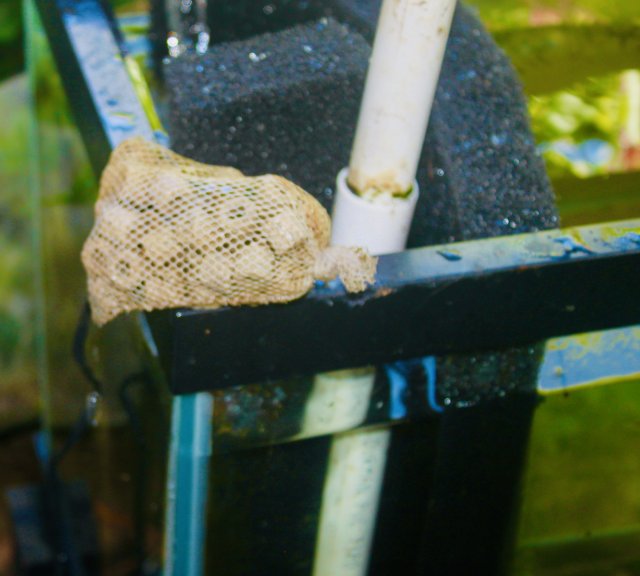
I have a 300 gal system at the moment, and only use a couple small bags of ceramic media, and a porous block for ammonia reduction, but my largest fish is only about 10".
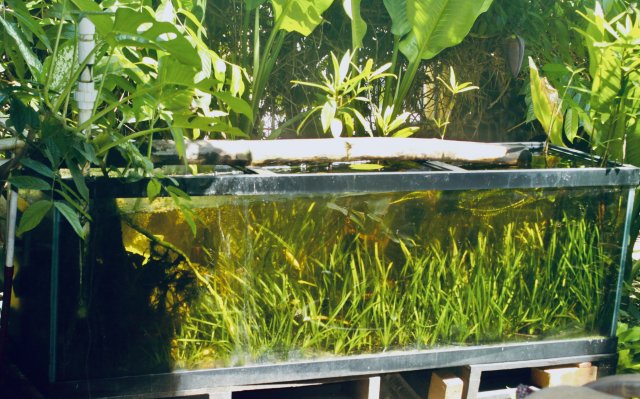
But my main concern in the long term, is nitrate reduction. So instead of a simple filter, a 125 gal heavily planted refugium is used, (the plants also provide surface area for ammonia consumers) , and I never detect any ammonia , or nitrate, in my tests and t,he water change schedule also is appropriate to fish size..
If I had the fish you list now, (as adults, and I have raised P-bass in the past,), with their feeding and high protein demands, I would add a foam fractionation/ bioreactor to the system, to remove those type waste components before they end up in the filter.
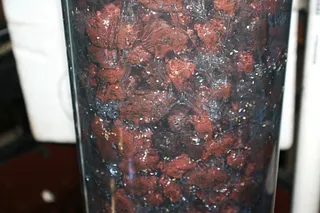
Below the same DIY type bio/fractionator on a 500 gal koi pond, for fish that get similar size to yours.
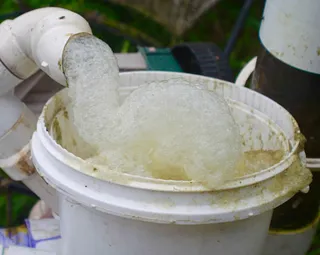
In the version below, waste (as foam) is removed directly from the water column, not stored in a filter.
koi pond fractionation
Inside, proteinaceous waste is easily collected in a 5 gallon bucket.
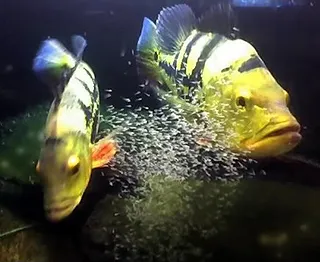
If the P-bass are 6" they will produce considerably less ammonia than when 12" P-bass, or even much less than 18" P-bass or logarithmically less as 24 " bass.
So filtration will constantantly be re-evaluated with growth, and feeding needs, same for the rays, with testing.
Same will apply, and need to be evaluated to your water change schedule.
I have a 300 gal system at the moment, and only use a couple small bags of ceramic media, and a porous block for ammonia reduction, but my largest fish is only about 10".
But my main concern in the long term, is nitrate reduction. So instead of a simple filter, a 125 gal heavily planted refugium is used, (the plants also provide surface area for ammonia consumers) , and I never detect any ammonia , or nitrate, in my tests and t,he water change schedule also is appropriate to fish size..
If I had the fish you list now, (as adults, and I have raised P-bass in the past,), with their feeding and high protein demands, I would add a foam fractionation/ bioreactor to the system, to remove those type waste components before they end up in the filter.
Below the same DIY type bio/fractionator on a 500 gal koi pond, for fish that get similar size to yours.
In the version below, waste (as foam) is removed directly from the water column, not stored in a filter.
koi pond fractionation
Inside, proteinaceous waste is easily collected in a 5 gallon bucket.


It does depend on what type of ceramic media you are talking about.
For example, CerMedia did a test to evaluate the performance of their product against others: https://www.cermedia.com/MarinePure Project Report.pdf. In that one year study, they found that 1.65 litres of ceramic spheres (as defined by them) could handle approximately 63ppm ammonia a day in a 20 gallon tank, so for a 300 gallon tank that's 4.2ppm or so. Assuming you only need to target 2ppm ammonia consumption a day, you'd only need 0.8 litres of ceramic spheres or so. Sintered ceramic (again, check their study to see how they define what that is), can only handle like 30ppm ammonia or so a day in a 20 gallon tank, just eyeballing their test results. So while you only need 0.8 litres of ceramic spheres, you'd probably need about 1.7 litres or so of sintered ceramic. There's some other considerations, but yeah probably that's a good starting point for you to make a decision on.
This just has me scratching my head. So these people say that 'x' amount of a given media will neutralise 'y' amount of ammonia, in a given timescale?
How can this be remotely right? Everybody knows that BB aren't just within the bio media, but in fact on every last square millimetre of all underwater surfaces.
How can they confidently quote such results when their media alone isn't solely responsible for neutralising the ammonia? I just don't get it.
It seems to me like they are just trying to "big up" their product.
I have a system with a total volume nudging 400g. I could literally hold the ceramic rings I have in my system in both my hands cupped together!
All I use are cheap sponges of varying grades, plastic bio balls and a smidgen of ceramic rings. I have quite a large bio load and have never had problems with ammonia spikes, or any other spikes for that matter.
I'd seriously ask the OP to think again before buying 100+ lbs of ceramic media, you simply don't need it.
Last edited:
This just has me scratching my head. So these people say that 'x' amount of a given media will neutralise 'y' amount of ammonia, in a given timescale?
How can this be remotely right? Everybody knows that BB aren't just within the bio media, but in fact on every last square millimetre of all underwater surfaces.
How can they confidently quote such results when their media alone isn't solely responsible for neutralising the ammonia? I just don't get it.
It seems to me like they are just trying to "big up" their product.
I have a system with a total volume nudging 400g. I could literally hold the ceramic rings I have in my system in both my hands cupped together!
All I use are cheap sponges of varying grades, plastic bio balls and a smidgen of ceramic rings. I have quite a large bio load and have never had problems with ammonia spikes, or any other spikes for that matter.
I'd seriously ask the OP to think again before buying 100+ lbs of ceramic media, you simply don't need it.
That's why they have the control - what if the tank and filter was completely empty? Actually, that does change my calculations a lot, my bad. So then the additional amount would be on top of what the tank can just handle. And yes, nitrifiers will colonize all manners of surfaces, though at the same time, I believe at least one study I have read found that nitrifiers mainly colonize the biomedia. Can't remember where I read it (it was an actual scientific paper, but could not find it again), and the reasonings that were hypothesized. I think it may be just due to the amount of water that circulates through the filter itself versus everywhere else in the tank. It's kind of like sponges (the animal, not the material). They have a much higher concentration of microorganisms inside them as they pump a large amount of seawater through them, and thus providing these microorganisms with a constant food source.
Now, I will also say - the experiment done by CerMedia concluded at one year, prior to the biomedia reaching the maximum amount of ammonia they can consume too. There are of course a lot of other factors, like for example what nitrifiers had grown in the CerMedia tests. Different species, and even strains, perform differently (and at different pH too).
To be fair, the main purpose of me quoting that study is to firstly outline how different products even under the mantle of 'ceramic media' can perform differently from each other, and secondly that one don't need heaps and heaps of biomedia. Like you said, one does not need much at all, and yeah, even 1.7 litres of ceramic rings ain't much. Definitely do not need 100+ lb of ceramic media.
That's why they have the control - what if the tank and filter was completely empty? Actually, that does change my calculations a lot, my bad. So then the additional amount would be on top of what the tank can just handle. And yes, nitrifiers will colonize all manners of surfaces, though at the same time, I believe at least one study I have read found that nitrifiers mainly colonize the biomedia. Can't remember where I read it (it was an actual scientific paper, but could not find it again), and the reasonings that were hypothesized. I think it may be just due to the amount of water that circulates through the filter itself versus everywhere else in the tank. It's kind of like sponges (the animal, not the material). They have a much higher concentration of microorganisms inside them as they pump a large amount of seawater through them, and thus providing these microorganisms with a constant food source.
Now, I will also say - the experiment done by CerMedia concluded at one year, prior to the biomedia reaching the maximum amount of ammonia they can consume too. There are of course a lot of other factors, like for example what nitrifiers had grown in the CerMedia tests. Different species, and even strains, perform differently (and at different pH too).
To be fair, the main purpose of me quoting that study is to firstly outline how different products even under the mantle of 'ceramic media' can perform differently from each other, and secondly that one don't need heaps and heaps of biomedia. Like you said, one does not need much at all, and yeah, even 1.7 litres of ceramic rings ain't much. Definitely do not need 100+ lb of ceramic media.
I suppose anybody who's as long in the tooth as I am knows only too well that what these companies say you need, compared to what you actually need to do exactly the same job, are sometimes light years apart, not to mention leaving you light in the pocket!
Too many inexperienced hobbyists fall for their marketing patter. The long and short of it is, is that their product will be good, no doubt about it, and pricy, but I can do just as good, for next to nothing. I'll take my option everytime.
I mean how much would the OP's mention of 120lbs of ceramic media cost? Jeez!
I suppose anybody who's as long in the tooth as I am knows only too well that what these companies say you need, compared to what you actually need to do exactly the same job, are sometimes light years apart, not to mention leaving you light in the pocket!
Too many inexperienced hobbyists fall for their marketing patter. The long and short of it is, is that their product will be good, no doubt about it, and pricy, but I can do just as good, for next to nothing. I'll take my option everytime.
I mean how much would the OP's mention of 120lbs of ceramic media cost? Jeez!
I mean yeah to be fair to CerMedia, I did my own experiments and MarinePure does indeed far outperform all other biomedia, like by far. But yes - the question is of course, is it needed. I tend to go for MarinePure just because I can shove more into the same small space, but that's just me. I do absolutely understand and fully support others who use something like sponges or whatever else.

How exactly does one biomedium outperform another one? It's not as though they will nurture different species of bacteria, some of which are better nitrificators than others. A biomedium does one thing and one thing only: it provides a surface suitable for colonization by nitrifying bacteria. That's it. So the only real measure of how well a given medium works is how much useable surface area it provides for this purpose.
So, on the face of it, the "best" medium is the one that has the most surface are per unit volume...right? Well, maybe not. The surface area also has to be exposed to an excellent flow of aerated aquarium water, carrying food to the bacteria and also providing them with sufficient oxygen. So...a medium that, over time, clogs up and reduces the flow to part or all of its surface area won't be as "good" as one that remains clear and unclogged, with no reduction in flow over time. I have never used ceramic media, so I certainly don't know for certain...but I can't help but suspect that over time, biofilm will coat most of its surface area, perhaps even clogging some of the minute pathways through which water flows when it is clean and new. In a practical sense, this doesn't matter, as long as the remaining surface area is still sufficient to maintain the required bacterial colony. Like most biomedia, it has such a large surface area that losing a good portion of it will not impact the effectiveness of the filter. Any tank requires a bacterial colony that is the correct size to utilize the ammonia being produced; beyond that point, having extra surface area is immaterial, since a given bioload will produce only so much ammonia, and that will support only so many bacteria. If surface area per unit volume is your Holy Grail, I seem to recall seeing a chart here on MFK comparing this feature of various biomedia, and Poret foam (a huge favourite of mine) was right at or near the top.
I personally consider many other aspects when choosing a biomedia, and since my filters tend to be oversized, with much more volume than the existing bioloads will ever require, actual surface area is pretty far down my list. A much higher priority is weight; I don't want 20 pounds of biomedia when an alternative choice would give me the same surface area while weighing only 2 pounds. Again, ceramic is pretty heavy and this alone would turn me off its use.
How about cost? Ceramic is expensive stuff; where's the benefit of it compared to much more inexpensive media? Cost is, of course, a major consideration for most people...and sometimes for opposite reasons. There are aquarists like me who are simply too cheap to pay more than is required...and there are others, like one of my friends in Ontario, who won't buy something expensive when there is the option to buy something extremely expensive. Some of these guys also worry about the appearance of their media and filters, while others (like me) don't care about the appearance of a filter and can't understand why anyone would. Oops, scratch that...one of my sumps has a few gallons of micro K1 churning and swirling around; it's there strictly because my granddaughters think its cool to watch, so I suppose I do assign some value to appearance. But...I got it in a trade, essentially for free; no way I would pay what that stuff costs.
Ease of cleaning is a biggie, one that is largely tied in with weight. The biomedia in one of my filters takes up a volume of around 20 gallons, but weighs maybe a couple pounds and is easily lifted out with one hand, rinsed under a faucet (unchlorinated well water at the correct temperature) and replaced in minutes. I'd love to see a video of an aquarist cleaning 100 pounds of ceramic media.
So, in the grand scheme of things as seen from my perspective, ceramic is heavy, expensive, possibly losing some of its effectiveness over extended periods of use due to clogging, a PITA to clean (which is admittedly something that is rarely done, but still...) and in general has virtually nothing to recommend it...to me. But to each his own; if you need your filter to be as cool as your fish, fill your boots!
So, on the face of it, the "best" medium is the one that has the most surface are per unit volume...right? Well, maybe not. The surface area also has to be exposed to an excellent flow of aerated aquarium water, carrying food to the bacteria and also providing them with sufficient oxygen. So...a medium that, over time, clogs up and reduces the flow to part or all of its surface area won't be as "good" as one that remains clear and unclogged, with no reduction in flow over time. I have never used ceramic media, so I certainly don't know for certain...but I can't help but suspect that over time, biofilm will coat most of its surface area, perhaps even clogging some of the minute pathways through which water flows when it is clean and new. In a practical sense, this doesn't matter, as long as the remaining surface area is still sufficient to maintain the required bacterial colony. Like most biomedia, it has such a large surface area that losing a good portion of it will not impact the effectiveness of the filter. Any tank requires a bacterial colony that is the correct size to utilize the ammonia being produced; beyond that point, having extra surface area is immaterial, since a given bioload will produce only so much ammonia, and that will support only so many bacteria. If surface area per unit volume is your Holy Grail, I seem to recall seeing a chart here on MFK comparing this feature of various biomedia, and Poret foam (a huge favourite of mine) was right at or near the top.
I personally consider many other aspects when choosing a biomedia, and since my filters tend to be oversized, with much more volume than the existing bioloads will ever require, actual surface area is pretty far down my list. A much higher priority is weight; I don't want 20 pounds of biomedia when an alternative choice would give me the same surface area while weighing only 2 pounds. Again, ceramic is pretty heavy and this alone would turn me off its use.
How about cost? Ceramic is expensive stuff; where's the benefit of it compared to much more inexpensive media? Cost is, of course, a major consideration for most people...and sometimes for opposite reasons. There are aquarists like me who are simply too cheap to pay more than is required...and there are others, like one of my friends in Ontario, who won't buy something expensive when there is the option to buy something extremely expensive. Some of these guys also worry about the appearance of their media and filters, while others (like me) don't care about the appearance of a filter and can't understand why anyone would. Oops, scratch that...one of my sumps has a few gallons of micro K1 churning and swirling around; it's there strictly because my granddaughters think its cool to watch, so I suppose I do assign some value to appearance.
But...I got it in a trade, essentially for free; no way I would pay what that stuff costs.Ease of cleaning is a biggie, one that is largely tied in with weight. The biomedia in one of my filters takes up a volume of around 20 gallons, but weighs maybe a couple pounds and is easily lifted out with one hand, rinsed under a faucet (unchlorinated well water at the correct temperature) and replaced in minutes. I'd love to see a video of an aquarist cleaning 100 pounds of ceramic media.
So, in the grand scheme of things as seen from my perspective, ceramic is heavy, expensive, possibly losing some of its effectiveness over extended periods of use due to clogging, a PITA to clean (which is admittedly something that is rarely done, but still...) and in general has virtually nothing to recommend it...to me. But to each his own; if you need your filter to be as cool as your fish, fill your boots!
Last edited:
I agree with jjohmwm
This whole argument and claim that one is better than another seems moot to me
In over 60 years of aquarium keeping, and twenty years of working in a water filtration plant, I have used, and done evaluations of just about every kind of media, and have never noticed one better than another. In the filtration plant, I did bacterial and physicals assays
The only way you would know is if one could could count microbiological colonies, or in the home aquarium, if fish started dying with the use of one vs another, or you get an ammonia spike on one ant the other, there are no simple visual cues other than with ammonia testing.


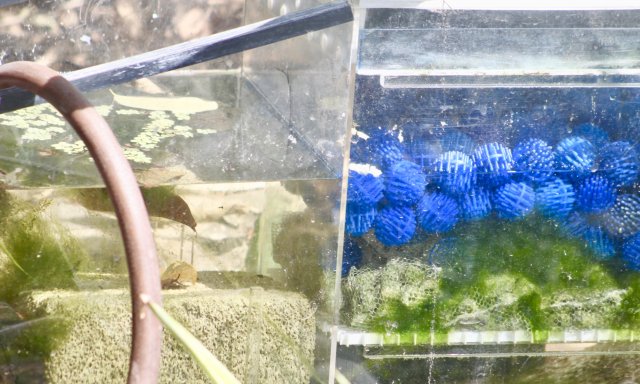
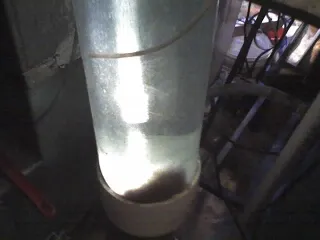
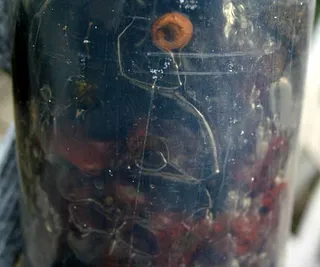
Above fluidized media, to its right lava rock
As yet I have not noticed any one of the six examples above better than another, how would I know?
Below a couple of the biological filters I would do yearly assays on, as a microbiologist.

This whole argument and claim that one is better than another seems moot to me
In over 60 years of aquarium keeping, and twenty years of working in a water filtration plant, I have used, and done evaluations of just about every kind of media, and have never noticed one better than another. In the filtration plant, I did bacterial and physicals assays
The only way you would know is if one could could count microbiological colonies, or in the home aquarium, if fish started dying with the use of one vs another, or you get an ammonia spike on one ant the other, there are no simple visual cues other than with ammonia testing.
Above fluidized media, to its right lava rock
As yet I have not noticed any one of the six examples above better than another, how would I know?
Below a couple of the biological filters I would do yearly assays on, as a microbiologist.