


Right now I am making a website with species profiles of all the fish that I have kept. The list so far is not complete. Feel free to suggest edits if certain information is wrong!




Thank you so much! Is there any information that is incorrect on the species profile?I like the site! interesting research paper too, well executed

Thanks for the corrections!I would like to comment on a couple assertions made, that I consider in error.
And these errors may be because you have not kept the species long enough to know.
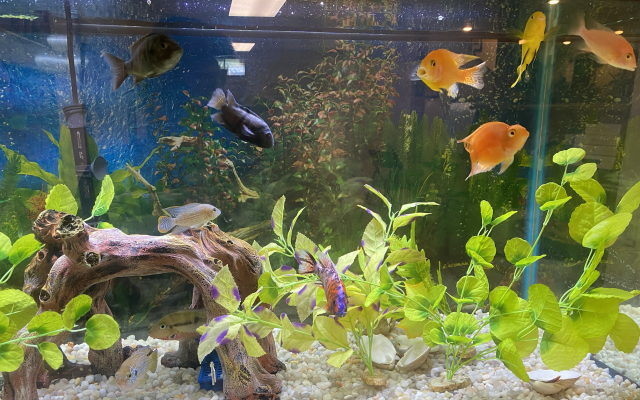
The ones in your pic, are barely more than juvies, and these cichlids often live up to 10 years.
So unless you have kept them for at least 3 or 4, your actual experience may not be relevant.
First the T meeki.
I have seen meeki in the 10-12" range.
I visited an aquarists home in Chicago, that had a male of 12".
I believe the reason we don't "often" see them that size, is because people keep them in smallish tanks, where water quality quickly degrades, and stunts them.
The 12" one in Chicago was in a 450 gal tank that got daily, large, automatic water changes.
I believe a "minimum" size tank for them to reach even close to full potential, would be in the 6 ft 100+ gallon range, larger would be better for a compatible group.
In a proper size tank, you would not see the interspecies aggression you speak of in the profile.
The Andinoacara
They come from lowlands west of the Andes.
Any adult cichlid that reaches 12" needs much larger tanks, and the aggression is usually a result of being kept in too small tanks.
And many times the aggression is cichlid on cichlid, because of lack of space, all cichlids are territorial, and I believe recommending other cichlids as tank mates in an inadequate space, is not good practice
Again I believe a 6 ft 100+ gal tank would be minimal for this species as adults to reach potential (and even in that size tank, maybe no more than a pair).
The parrot
This is not a species, it is a line bred mutation (possibly a hybrid?).
And (probably because it may be considered unethical practice) how it was developed info is a bit sketchy
There is confusion, and I believe that is intentional.Thanks for the corrections!
Do you know what the parent species are for parrot cichlids? I can see Amphilophus in them but I also have found sources of Severums being their parent species.
I wonder how he got his funding in the first place lol.Parrot and FH hybrids have been kept a secret for a long time 1 rumor is some biologist in China made the FH and Parrot and refuse to give up the secret. LOL
