Chloramine in source water with Auto Drip System?

  • We are currently upgrading MFK. thanks! -neo

wednesday13

Silver Tier VIP
MFK Member
Mar 2, 2008
4,863
5,136
1,629
The deep south
Well… looks like my luck has run out after Auto dripping free and easy for 12+ yrs or so now. My small towns infrastructure is basically collapsing around me 😂💀… water line breaks almost daily and they flush the lines with Chloramine to disinfect them. Its a shame because we have great source water from a reservior with no recreation or people allowed on it.

Im testing Ammonia right out of the tap that shows the result of Chloramine for weeks now. I know it gasses off after 24hrs or so, so i cut my drips back in half for starters. Tanks are still testing good, 0 ammonia, 5-10 nitrates.

Working on a pre filtration system for the drip lines. Went with a 3 stage standard unit. Id like a larger one of course but this is whats in my budget right now. The filters that came with it are for “chloramine” specifically. Pretty much granulated carbon and catalytic carbon annnnd they seem to be doing nothing at all lol… 🤦‍♂️💀… still testing ammonia in my new filtered water as well as the tap in the same amount. 😑

What types of filter cartridge or trio of them is everyone running for Chloramine removal? I also installed a spin down sediment filter before the 3 stage unit to prolong my filter carts and also be able to not run a sediment inside the unit. Sooo, i have 3 available housings to try and remove this chit 😂… do i need resin/di as well as catylitic carbon? Any “Chloramine” cart i find or info just says use catalytic carbon. Im using the “ispring” brand Chloramine cartridge and im thinking its just a gimmick.

Thanks to anyone for reading and offering advice 💀🤙
 
  • Sad
Reactions: jjohnwm
No experience with Chloramine filters. However it seems that will quickly become expensive because of filters need of regenerating carbon or altogether replace modules.
Another option (unsure if feasible) is to install a large storage system, which would drip into tanks, and a refill schedule. Then, chloramine can be treated chemically (pond Prime or equivalent) in the storage reservoir(s).

It would come down to the relative costs of the two options, and whether space is available. Sorry that you have entered the permanent chloramine blues many of us have to endure.
 
No experience with Chloramine filters. However it seems that will quickly become expensive because of filters need of regenerating carbon or altogether replace modules.
Another option (unsure if feasible) is to install a large storage system, which would drip into tanks, and a refill schedule. Then, chloramine can be treated chemically (pond Prime or equivalent) in the storage reservoir(s).

It would come down to the relative costs of the two options, and whether space is available. Sorry that you have entered the permanent chloramine blues many of us have to endure.
Hoping an aging barrel and chemical treatment is not needed. I need 400-500 gal a day minimum and ive cut back lol… used to run 37 gph for 850+ gal a day 😬. At the least i can walk around the room and dose prime i guess.
 
i just ordered pentair pentek from amazon, i think i can tell the difference
 
  • Like
Reactions: wednesday13
Im testing Ammonia right out of the tap that shows the result of Chloramine for weeks now. I know it gasses off after 24hrs or so, so i cut my drips back in half for starters. Tanks are still testing good, 0 ammonia, 5-10 nitrates.

Chloramine does not gas off. Unlike chlorine, chloramine remains stable for weeks - which is exactly why your town is using it to flush the lines after a line repairs.

Then, chloramine can be treated chemically (pond Prime or equivalent) in the storage reservoir(s).

Fyi…… Pond Prime is the exact same formula, as regular Seachem Prime. It’s simply a marketing gimmick for pond owners. Seachem Safe is the more economical way to go for larger tanks etc, where free ammonia is an issue.
 
Agree with RD, when I lived in Wisconsin, my tap water has always been treated with Chloramine.
I did an experiment to see how long chloramine would remain stable over time, it was still stable as a disinfectant even after 2 weeks .
I treated the Chloramine Ion with a regular dechlorinator such as Sodium Thio (Prime) which always immediately neutralized it, and my sumps beneficial bacteria took care of the ammonia.
When doing large water changes, (I usually did 40% every other day) just adding a bloop of Sodium Thio, would handle the chlorine part, but instead of adding water directly to my tanks, I always added new water directly to my sumps 1st, so by the time the make up water hit the tanks with fish, ammonia was also neutralized.
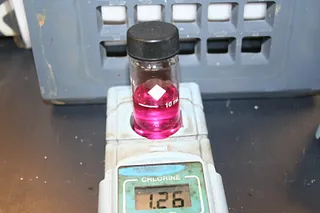
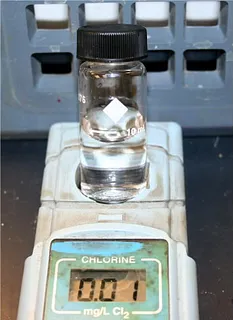
Normal chloramine residual in my tap water averaged 1.25 ppm.
1771095652591.png1771095692655.png
Normal tap water with Chloramine left, right after the addition of Sodium thio.
The meter used read the Chloramine Ion.
 
i just ordered pentair pentek from amazon, i think i can tell the difference
I have that in a cart actually 😂… was going to go with the 4.5”x10” housing and just one of those but the cart itself is $100 a pop. The small ones are $29 and up so not terrible. 💀🤙 appreciate the feedback
 
Chloramine does not gas off. Unlike chlorine, chloramine remains stable for weeks - which is exactly why your town is using it to flush the lines after a line repairs.


Fyi…… Pond Prime is the exact same formula, as regular Seachem Prime. It’s simply a marketing gimmick for pond owners. Seachem Safe is the more economical way to go for larger tanks etc, where free ammonia is an issue.
Thanks for the info 💀🤙… Ill get some sechem safe to have on hand… havent used any type of water conditioner in way to many years to even know what to buy these days. Appreciate it.
 
Agree with RD, when I lived in Wisconsin, my tap water has always been treated with Chloramine.
I did an experiment to see how long chloramine would remain stable over time, it was still stable as a disinfectant even after 2 weeks .
I treated the Chloramine Ion with a regular dechlorinator such as Sodium Thio (Prime) which always immediately neutralized it, and my sumps beneficial bacteria took care of the ammonia.
When doing large water changes, (I usually did 40% every other day) just adding a bloop of Sodium Thio, would handle the chlorine part, but instead of adding water directly to my tanks, I always added new water directly to my sumps 1st, so by the time the make up water hit the tanks with fish, ammonia was also neutralized.
Normal chloramine residual in my tap water averaged 1.25 ppm.
View attachment 1572787View attachment 1572788
Normal tap water with Chloramine left, right after the addition of Sodium thio.
The meter used read the Chloramine Ion.
Very good tip on adding to the sumps rather than the main tank… thats probably the cheapest improvement i can make and quickly. Thank you.
 
MonsterFishKeepers.com