Constant/automatic water change system - drain height considerations

  • We are currently upgrading MFK. thanks! -neo

harrisonsaid

Exodon
MFK Member
Feb 6, 2022
40
44
26
38
Hope everyone is having a great day!

I'm in the process of setting up a pair of 210g freshwater aquariums with sumps, and I'm looking for a way to set up a constant water system for it. The tanks are on a wall containing both water supply and drains (shared wall with bathroom), and I'm on a whole house water filter so no chlorine is present from the supply lines. My big challenge is drainage...the sumps sit low enough I don't believe I can safely have enough elevation in the drain pipes along with space for a p trap (the tie in to the drains would be below the sink trap so it would need it's own). I've thought through some pump and float based ideas, but they all scare be due to failures.

The idea would be to fill the main tank, and detain from the return section of the sump.

Any ideas would be greatly appreciated!
 
  • Like
Reactions: tlindsey
You could possibly add an additional stand pipe in your overflow the same height as the sump drain or a 1/16-1/8in shorter. It could be 1/2-3/4in since it will only be flow a couple gallons an hour.
 
  • Like
Reactions: tlindsey
How would I balance this against the fill rate? If I'm thinking about it correctly, if I'm filling faster than I'm draining won't the return section eventually overflow?
 
Even dripping 42g in a 24hr period would only be 1.75g/hr which a 1/2in drain tube should be able to handle.
 
 
As long as the usual full water level on sump is higher than the highest point of drain, you can use a gravity drain. A simple dip in pipe to hold a pocket of water will create your own P trap.

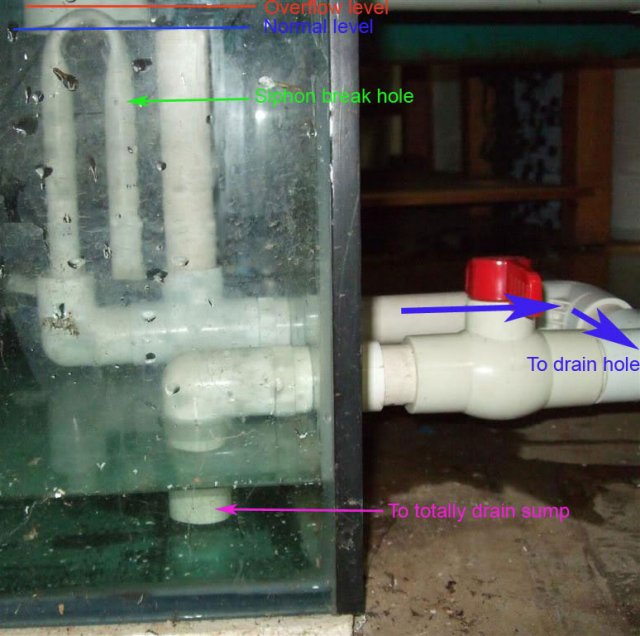
If there isn't much free board left in the sump or you are worried about power outages dumping too much water too quickly into the sump, you can use an automatic start & stop siphon drain. No moving parts or electrical components needed. A siphon being able to drain water much faster than gravity drain (overflow hole) alone. As long as the sump retains enough water so the pump can resume when the power returns. So set the start and stop limits of siphon drain accordingly.

If your sump is undersized, I would use a normal gravity drain as Fishguy recommends but place a siphon drain slightly above this for redundancy and power outages. If your sump has ample capacity, no siphon drain required.
 
Example photo of an auto start and stop siphon I made below. Unfortunately the photo isn't showing the sump full of water.
This system has 20 x 500L tubs into a deliberately small glass sump because I harvest fish into the sump (via a net cage) by pulling a central standpipe to drain.
There is only a 4cm freeboard from full water level to top of the sump before I rapidly drain a 500L tub onto a 150L sump.

1991140163_Autodrainsump.JPGDSCF4689Large.thumb.JPG
 
I ended up calling around to plumbers until I found one to talk through the project with me. He agreed that he can get the drain low enough for a gravity drain to work, but ended up informing me about a number of things in addition that needed to be done to stay in code (this is a new house and I do want to do things right). I'm normally a very DIY guy and the price was a little rough, but with this amount of water I'm pretty concerned with getting it wrong.
 
  • Like
Reactions: fishguy1978
I did a standpipe drain in my sump, with a 1/4 inch PVC overflow to my backyard. I just drilled a hole in the wall and ran the PVC outside. I drip 60 GPD, been doing it for years, 1/4 inch PVC is way more than adequate.

I have a big enough sump that it holds all the overflow from drain/return lines should a power outage occur.
 
MonsterFishKeepers.com