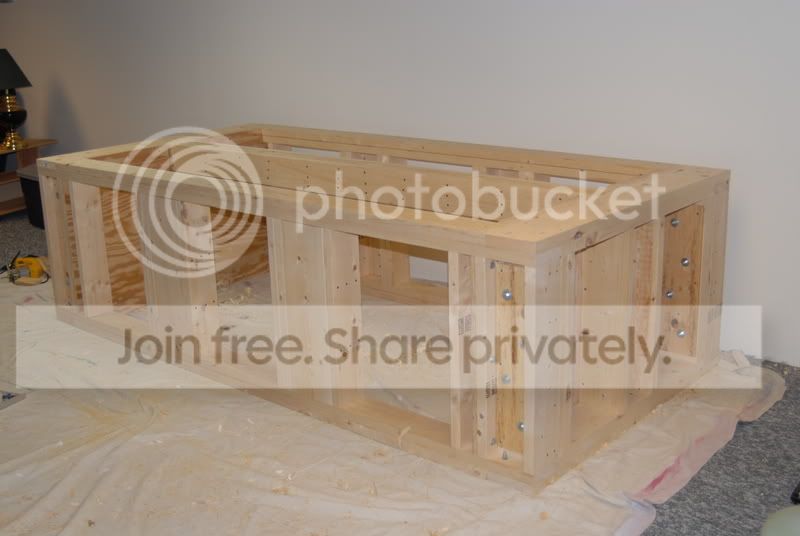
The idea is to have a tank that can be broken down into it's base parts (sides) when moving, then re-assembled at a new site. I beleive this can be done.
The seams on an aquarium under the most stress are the ones holding the sides to the bottom. The idea is to use Silicon as a compression gasket between each side. Everything is attached using large bolts and washers. The aquarium is divided into 6 parts: 1) Base, 2) Front, 3) Back, 4) Left Side, 5) Right Side, 6) Center Brace.
Each piece requires a bit more epoxy sealant then normal, but not too much more. The full surface of the plywood needs to be epoxied on the Base piece. The Front and Back require Epoxy on the inside surfaces, and surface that connects to the base. The sides require the inside surfaces, the surface that connects to the base, and both sides epoxied. The Center Brace is fully epoxied due to it's location: It'll be in a high moisture area, and a splash-zone.
Bolts will connect the Front and Back to the Sides. Again, Silicon will be used as a gasket. After the initial tightening of all the bolts and studs, a traditional bead of silicon should be spread smoothly on all inside connections, as is seen in a typical all-glass tank.
I have it mocked up in Google Sketchup but the connection over here isn't letting me upload the pictures right now...hopefully I can get them up soon.
Any ideas on this...could it possibly work?
The seams on an aquarium under the most stress are the ones holding the sides to the bottom. The idea is to use Silicon as a compression gasket between each side. Everything is attached using large bolts and washers. The aquarium is divided into 6 parts: 1) Base, 2) Front, 3) Back, 4) Left Side, 5) Right Side, 6) Center Brace.
Each piece requires a bit more epoxy sealant then normal, but not too much more. The full surface of the plywood needs to be epoxied on the Base piece. The Front and Back require Epoxy on the inside surfaces, and surface that connects to the base. The sides require the inside surfaces, the surface that connects to the base, and both sides epoxied. The Center Brace is fully epoxied due to it's location: It'll be in a high moisture area, and a splash-zone.
Bolts will connect the Front and Back to the Sides. Again, Silicon will be used as a gasket. After the initial tightening of all the bolts and studs, a traditional bead of silicon should be spread smoothly on all inside connections, as is seen in a typical all-glass tank.
I have it mocked up in Google Sketchup but the connection over here isn't letting me upload the pictures right now...hopefully I can get them up soon.
Any ideas on this...could it possibly work?