Due to the ammount of info I found on them (next to nothing) I'd say it's rare, or at least a newer species of catfish that has recently been discovered. You'd have to ask some importers, or some of the guys in the buy/sell section about if they can get them, but I have doubts if they can get them in. If so I too would be interested, mainly because that would mean that it's possible for them to get other rarely seen doradids in, and that excits me lol. In any case here's what fishbase has to say
Doras carinatus (Linnaeus, 1766)
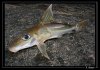
Family: Doradidae (Thorny catfishes) picture (Docar_u0.jpg) by Holm, E.
Point map
Order: Siluriformes (catfish)
Class: Actinopterygii (ray-finned fishes)
FishBase name:
Max. size: 30.0 cm SL (male/unsexed; Ref. 37054)
Environment: demersal; freshwater
Climate: tropical
Importance:
Resilience: Medium, minimum population doubling time 1.4 - 4.4 years (Preliminary K or Fecundity.)
Distribution:
Gazetteer South America: Essequibo River basin and other coastal drainages east to mouth of Amazon River, possibly in lower Amazon and lower Orinoco River basins.
Morphology: Dorsal spines (total): 1 - 1; Dorsal soft rays (total): 6 - 6; Anal soft rays: 11 – 15. Body elongated, without scales but with a range of 33-35 spiny bony plaque which runs along the length of the lateral, starting from the extreme end of the caudal fin up to the point directly below the origin of the dorsal fin. Head is pointed and laterally compressed, its width being far less than its length. Eyes are high and are situated in the posterior half of the head. Mouth is inferior, provided with a pair of maxillary barbels branching into 12 or 13 branches and 4 short mandibular barbels. Adipose fin short
Biology: Can emit sounds by moving its pectoral spines. Every basic unit of sound emitted lasts for 60-70 millisecond, with a frequency of 60-90 Hertz corresponding to the reply frequency of the muscles utilized (Ref. 35381).
Red List Status: Not in IUCN Red List (Ref. 57073)
Dangerous: harmless
Coordinator: Ferraris, Jr., Carl J.
Main Ref: Burgess, W.E.. 1989. (Ref. 6868)






 Lince, and bolts
