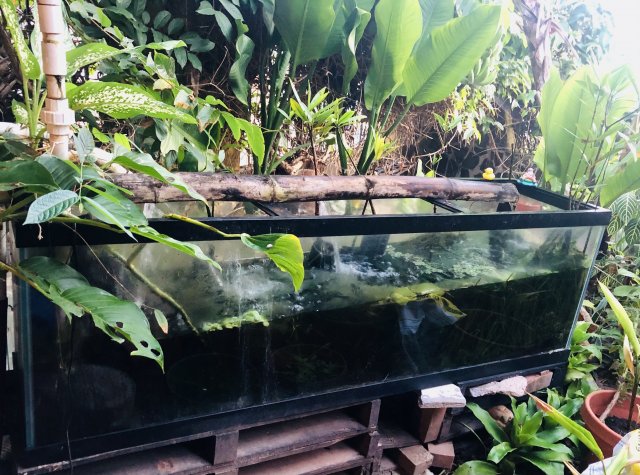
It is the dry season here in Panama at the moment.
And because my tanks are outside, some "pseudo" natural things occur during this time. (even in a recirculating system)
As the rainy season ended, (when it did rain) tannins from the surrounding drying vegetation inundated the tank, and more leaves, fallen flowers and branch litter fell into tank and tinted the waters color.

As an experiment to keep a higher tannin concentration, instead of 3 or 4 regular 30-40% water changes per week, I have cut back to two, which has allowed for more evaporation, and a lower water level in the sump, and the tannins not to be washed out.
The normal water change routine (and every day rain inundations) during the rainy season, normally maintain the sump almost full.

Since rains have stopped, and I cut back a little on filling after the smaller water change routine, evaporation has lowered the sump surface, by at least 6 inches, and the mangrove roots, and bamboo tubes they are planted in, (normally submerged) are now breaking the surface.
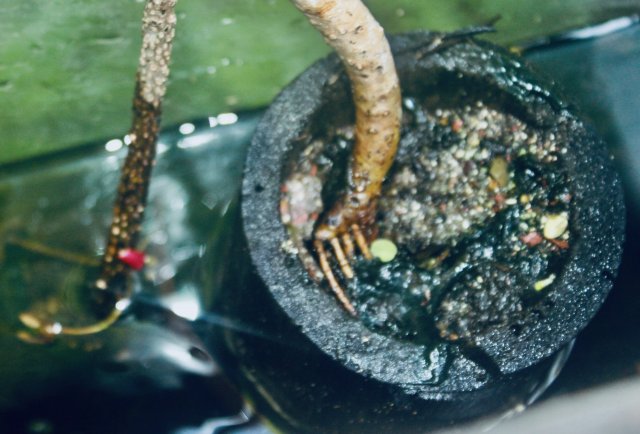

Even with a couple less water changes per week, nitrate is so far, undectable, and pH has not fallen (still 8.2), "probably" because of the intensely planted sump.
Although that's not that surprising, because stocking levels are low.
It is breeding season for the Andinoacara, and as usual, they have taken advantage of the fallen leaves to spawn on.

My theory is....with such a heavily planted sump, the plants remove nitrate almost as fast as the fish can produce them.
Beside the Vallisneria, Hygrophilla, and water lilies, I have recently added floating Salvinia and water lettuce, and there are at least 10 young mangrove sapplings in the sump, and some terrestrial plants as well (and some in the main tank).





 duanes
may be able to chime in on this.
duanes
may be able to chime in on this.