

I am selling a breeding trio of EBJD, the quality of which is better than I have ever seen before. If anybody has pics of better looking mature EBJD than these please let me know! I have developed this breeding group with the intent of growing out EBJD fry, but this task is beyond my current time and budget being in grad school. These fish currently reside with my parents and I have been remotely consulting on care. The current male is getting old now (he is about 5 yrs old and about a pound in weight) and has started to show very very early signs of HITH disease (can't even see it in the very recent video!). I believe this is due to old age or diet deficiency as it has not happened previously. Water quality is NOT the problem. I am currently feeding him metronidizole in pellets to ward off any Hexamita that may be contributing to this HITH case and supplementing his diet. He appears to be responding well to metro and the HITH has not spread in the last month. Keep in mind the fish still eats very healthily and so advancement of the HITH can very easily be warded off with more stringent care and more diverse diet. This is the primary reason why I want to hand off this project, I feel bad offloading the care of these difficult fish on my parents. Even though they enjoy it, they do not wish to attempt spawning without me around. I feel it is time to start turn that system into a community/shrimp tank and hand this off to someone else!
Notes on Breeding EBJD:
Breeding EBJD is very hard because the color morph is a recessive trait and because it is not possible to create a true breeding line of EBJD. This is because of reduced fitness in individuals with two copies of this recessive gene (EBJD). Because of this fact, to produce EBJD fry you have to first cross an EBJD male with a JD female, then use the grown out F1 het females to cross to a DIFFERENT EBJD male which results in ~50:50 EBJD:JD fry. The EBJD fry are especially sensitive, and require the BEST conditions to survive.
First I purchased a juvenile male EBJD from Forest Lake Pets, MN. I grew this guy out in a planted tank with UV, C02 and immaculate care. Here are some pics of him (now dead, after a lethal fight with the first female):
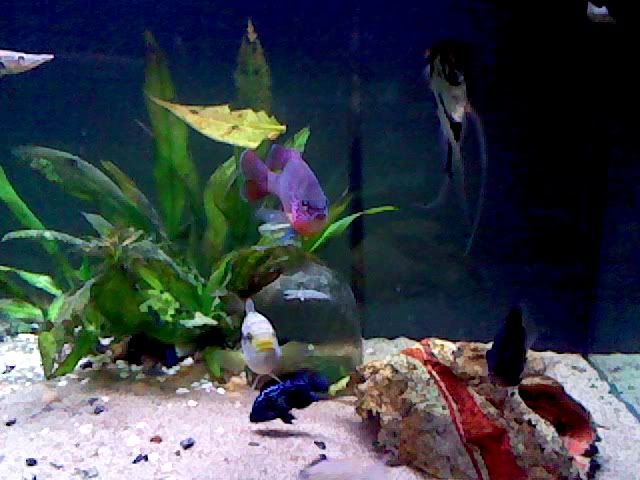
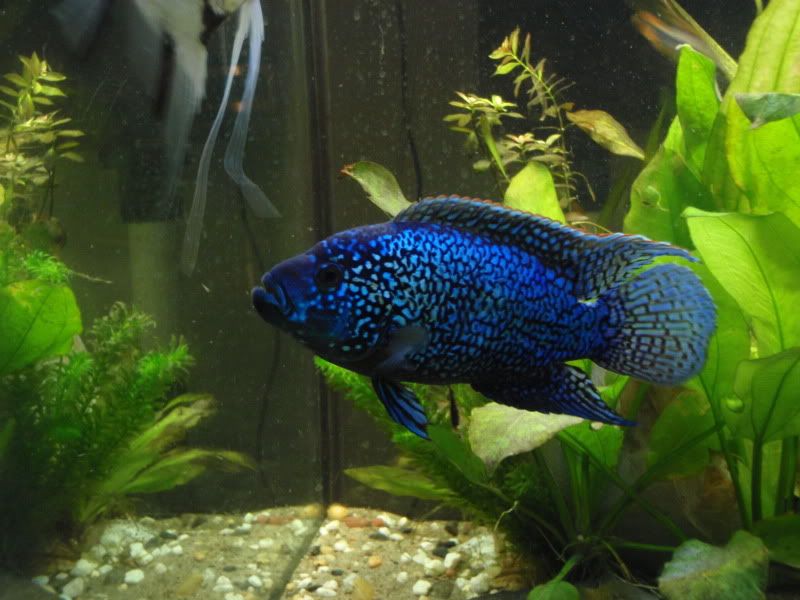
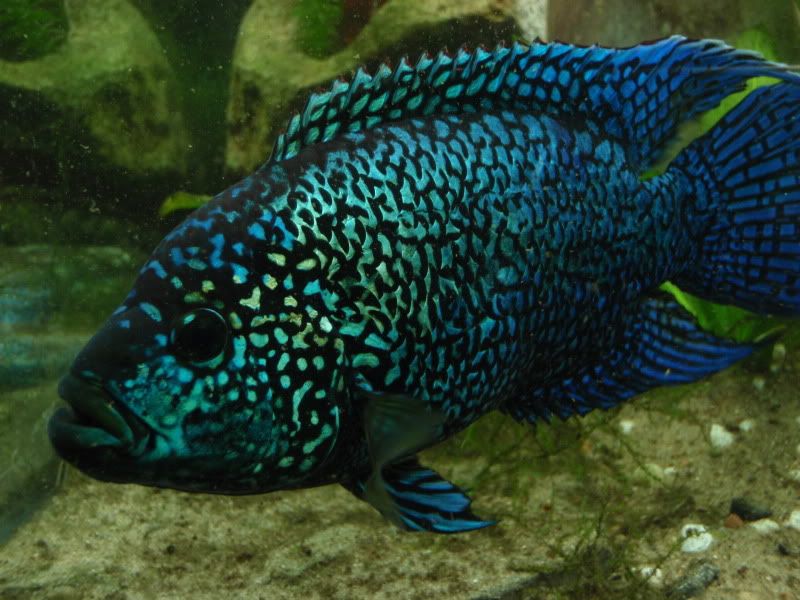
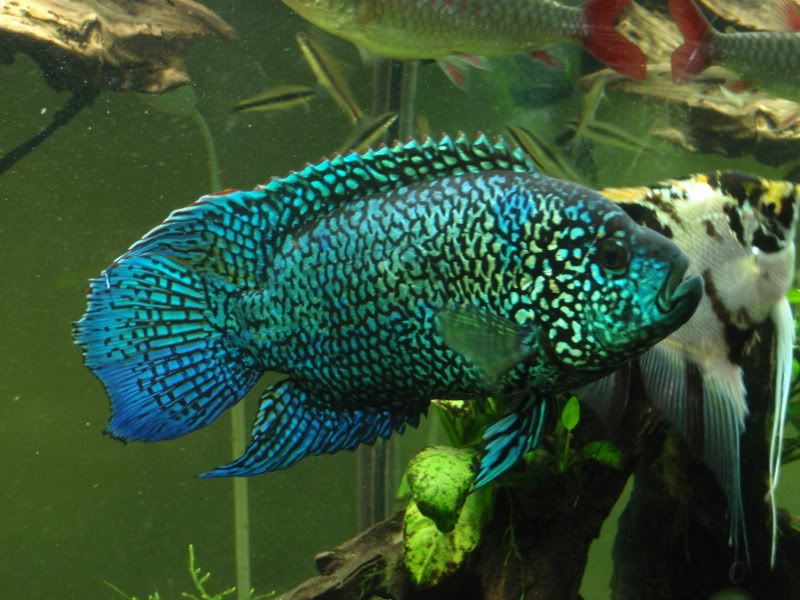
Then I purchased an unrelated "normal phenotype" JD from somewhere I can't remember (also in first picture). These two spawned much earlier than I would have expected while I was away at a summer internship. ~50 of the het fry survived (they spawned many many more larvae) but unfortunately the parents inflicted fatal wounds on each other during this time because my tenant did not separate the parents as I had instructed. It was a tragedy but I moved on and let the ~50 fry grow out in the planted tank and them selected two of the largest females. Keep in mind these females are Het for EBJD color morph and have better color than a normal JD (they carry the recessive copy but only partially express it leading to the intermediate form). You will see this in the video below
While growing out these Het females I also purchased a new EBJD male from same source and grew him out. He got even larger than the first male and equally as colorful. One of the females is now pushing 2 lbs! They live (male separated from females) in a planted 130 gallon system that is immaculately maintained and has UV, fully automatic C02, and 600gph pressurized canister filter. They are only fed the best foods. Keep in mind that these are difficult fish to keep healthy in the long run! They will require at LEAST this caliber of setup to spawn and even more additional tank space to grow out juveniles. This is an advanced breeding project! The good news is that if you are really interested in taking this on I have done a lot of the work for you. The het females are fat with eggs, and I'm sure they will spawn immediately once they see each other just as they did last time, except now they will likely produce over 1000 fry each!
Video of the breeding trio in early december 2013 (shot with gopro hero3+ in 2.7k res, but had to compress):

Price: I am asking for $800 for the breeding trio with no questions asked about where they go. If separated, the male only will be $600 and Het Females will be $400 each (knowingly high prices mind you). Please know that this is a very rare group of fish that will cost much more than this to develop yourself, which is why separating them will cost you. I plan to keep them going as is if I cannot find a buyer and spawn them when I can afford it. However I am willing to reduce the price for somebody who can demonstrate a proper home for them and/or the drive to breed them at least once (I would like the first pick of the litter!) and preferably local. If I get any out of state interested parties who cannot pick them up I can negotiate driving halfway or shipment on a case by case basis (paid for by the buyer). I deal with shipping fish often through my job and would like to avoid it at all costs.
Please hit me with any questions on this forum.
Notes on Breeding EBJD:
Breeding EBJD is very hard because the color morph is a recessive trait and because it is not possible to create a true breeding line of EBJD. This is because of reduced fitness in individuals with two copies of this recessive gene (EBJD). Because of this fact, to produce EBJD fry you have to first cross an EBJD male with a JD female, then use the grown out F1 het females to cross to a DIFFERENT EBJD male which results in ~50:50 EBJD:JD fry. The EBJD fry are especially sensitive, and require the BEST conditions to survive.
First I purchased a juvenile male EBJD from Forest Lake Pets, MN. I grew this guy out in a planted tank with UV, C02 and immaculate care. Here are some pics of him (now dead, after a lethal fight with the first female):


Then I purchased an unrelated "normal phenotype" JD from somewhere I can't remember (also in first picture). These two spawned much earlier than I would have expected while I was away at a summer internship. ~50 of the het fry survived (they spawned many many more larvae) but unfortunately the parents inflicted fatal wounds on each other during this time because my tenant did not separate the parents as I had instructed. It was a tragedy but I moved on and let the ~50 fry grow out in the planted tank and them selected two of the largest females. Keep in mind these females are Het for EBJD color morph and have better color than a normal JD (they carry the recessive copy but only partially express it leading to the intermediate form). You will see this in the video below
While growing out these Het females I also purchased a new EBJD male from same source and grew him out. He got even larger than the first male and equally as colorful. One of the females is now pushing 2 lbs! They live (male separated from females) in a planted 130 gallon system that is immaculately maintained and has UV, fully automatic C02, and 600gph pressurized canister filter. They are only fed the best foods. Keep in mind that these are difficult fish to keep healthy in the long run! They will require at LEAST this caliber of setup to spawn and even more additional tank space to grow out juveniles. This is an advanced breeding project! The good news is that if you are really interested in taking this on I have done a lot of the work for you. The het females are fat with eggs, and I'm sure they will spawn immediately once they see each other just as they did last time, except now they will likely produce over 1000 fry each!
Video of the breeding trio in early december 2013 (shot with gopro hero3+ in 2.7k res, but had to compress):
Price: I am asking for $800 for the breeding trio with no questions asked about where they go. If separated, the male only will be $600 and Het Females will be $400 each (knowingly high prices mind you). Please know that this is a very rare group of fish that will cost much more than this to develop yourself, which is why separating them will cost you. I plan to keep them going as is if I cannot find a buyer and spawn them when I can afford it. However I am willing to reduce the price for somebody who can demonstrate a proper home for them and/or the drive to breed them at least once (I would like the first pick of the litter!) and preferably local. If I get any out of state interested parties who cannot pick them up I can negotiate driving halfway or shipment on a case by case basis (paid for by the buyer). I deal with shipping fish often through my job and would like to avoid it at all costs.
Please hit me with any questions on this forum.

