

As everyone has seen there is a hierarchy in any cichlid tank where often the more dominant fish grows larger more colorful etc. Wondering if anyone has experience with what happens when the alpha fish is removed? Does the smaller fish catch up on size to where it might have been, or is it forever "stunted". Is it's behavior any different i.e. Will it always be timid?
Effects of dominance
- Thread starter guapoteman
- Start date
You are using an out of date browser. It may not display this or other websites correctly.
You should upgrade or use an alternative browser.
You should upgrade or use an alternative browser.


One reason could be that more dominant fish will usually gets most of the food, thus will grow faster. Plus, not having the added stress of being constantly harassed and beat up, makes for a more enjoyable life........I would think

I have been doing an experiment for the last 6 months where I have a group of 5 Tilapia zilli, and 3 Nimbochromis livingstoni living together in one tank. (all fish were bought from an auction, from same species spawns, exact same age, and similar in size)
When I bought the fish, I also took one of each (Tilapia and Nimbo) and put it in another varied species community tank.
Each tank gets the same number of water changes, same foods.
In the community tank, both the single fish are almost double the size of the ones living in the tank in groups.
My theory is that in a same species group tank, there are hormones produced by the alpha fish that suppress the growth of others in the group (beyond simple amount of food intake).
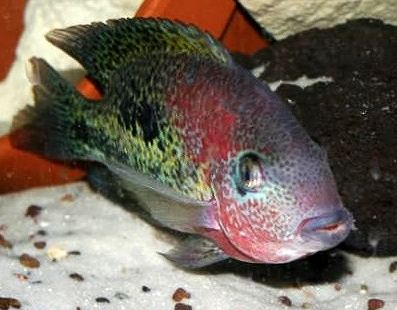
I have noticed in tanks where an alpha fish is removed, a transformation takes place in a previously sub-dominant fish, many times almost over night, in growth and appearance

above Tilapia in group tank are @ 3"
below in the tank where there is only 1 Tilapia, it is almost 6", and much more robust.


above Nimbochromis growing in group tank, 3+"
below as a single individual in a tank, 5+"

as an aside, a few years back the bifiasciata below was a runt in a group of 6 (what turned out to be 5 females),
I removed it to a smaller tank by itself for a while, it immediately had a growth spurt, and grew to become much larger than the rest (13"), turned out to be male, and sired many spawns with its former suppressors.
When I bought the fish, I also took one of each (Tilapia and Nimbo) and put it in another varied species community tank.
Each tank gets the same number of water changes, same foods.
In the community tank, both the single fish are almost double the size of the ones living in the tank in groups.
My theory is that in a same species group tank, there are hormones produced by the alpha fish that suppress the growth of others in the group (beyond simple amount of food intake).
I have noticed in tanks where an alpha fish is removed, a transformation takes place in a previously sub-dominant fish, many times almost over night, in growth and appearance

above Tilapia in group tank are @ 3"
below in the tank where there is only 1 Tilapia, it is almost 6", and much more robust.


above Nimbochromis growing in group tank, 3+"
below as a single individual in a tank, 5+"

as an aside, a few years back the bifiasciata below was a runt in a group of 6 (what turned out to be 5 females),
I removed it to a smaller tank by itself for a while, it immediately had a growth spurt, and grew to become much larger than the rest (13"), turned out to be male, and sired many spawns with its former suppressors.


In fish, stress causes an increase in both cortisol and glucose levels, which in turn affects growth levels in the stressed fish. Stress increases energy consumption, which is part of the reason that sub dominant specimens do not achieve the same growth as their superior dominant siblings. Elevated cortisol levels have also been shown to not just inhibit growth, but also inhibit digestion, energy storage, and reproduction.
In fish, stress causes an increase in both cortisol and glucose levels, which in turn affects growth levels in the stressed fish. Stress increases energy consumption, which is part of the reason that sub dominant specimens do not achieve the same growth as their superior dominant siblings. Elevated cortisol levels have also been shown to not just inhibit growth, but also inhibit digestion, energy storage, and reproduction.
Isn't that what I already said RD?

Not exactly. Most hobbyists do not understand the role that hormones such as cortisol play in growth, etc, which is why I took the time to explain it in a little more detail. I hope that's ok? 
Not exactly. Most hobbyists do not understand the role that hormones such as cortisol play in growth, etc, which is why I took the time to explain it in a little more detail. I hope that's ok?
Well, if you're gonna be all brainy about it lol
Hope you know that my first reply to you was just a joke. Thanks for the insight on these hormonal effects.
I suspect that would depend on the growth stage of the fish, as in it's overall age and maturity. Some fish bounce back, some remain stunted for life.