


So recently on the news here in FL there was a segment about this huge python that was out in the everglades that attempted to eat a 6ft. Alligator... needless to say the python ended up exploding because the alligator was just way to big for that dumb python. I thought it was an intresting story. Also in the news around here recently is man-eating lizards in Ft. Myers. Apparently people have to fence off their houses becuase they are eating small pets and small childern. Things are getting a little strange. No I am not kidding.
-------------------------------------------------------------------------------------
MIAMI -- Alligators have clashed with non-native pythons before in Everglades National Park. But when a 6-foot gator tangled with a 13-foot python recently, the result wasn't pretty.
The snake apparently tried to swallow the gator whole -- and then exploded. Scientists stumbled upon the gory remains last week.
The species have battled with increasing frequency -- scientists have documented four encounters in the last three years. The encroachment of Burmese pythons into the Everglades could threaten an $8 billion restoration project and endanger smaller species, said Frank Mazzotti, a University of Florida wildlife professor.
The gators have had to share their territory with a python population that has swelled over the past 20 years after owners dropped off pythons they no longer wanted in the Everglades. The Asian snakes have thrived in the wet, hot climate.
``Encounters like that are almost never seen in the wild. ... And we here are, it's happened for the fourth time,'' Mazzotti said. In the other cases, the alligator won or the battle was an apparent draw.
``They were probably evenly matched in size,'' Mazzotti said of the latest battle. ``If the python got a good grip on the alligator before the alligator got a good grip on him, he could win.''
While the gator may have been injured before the battle began -- wounds were found on it that apparently were not caused by python bites -- Mazzotti believes it was alive when the battle began. And it may have clawed at the python's stomach as the snake tried to digest it, leading to the blow up.
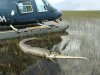
The python was found with the gator's hindquarters protruding from its midsection. Its stomach still surrounded the alligator's head, shoulders, and forelimbs. The remains were discovered and photographed Sept. 26 by helicopter pilot and wildlife researcher Michael Barron.
The incident has alerted biologists to new potential dangers from Burmese pythons in the Everglades.
``Clearly, if they can kill an alligator they can kill other species,'' Mazzotti said. ``There had been some hope that alligators can control Burmese pythons. ... This indicates to me it's going to be an even draw. Sometimes alligators are going to win and sometimes the python will win.
``It means nothing in the Everglades is safe from pythons, a top down predator,'' Mazzotti said.
Not only can the python kill other reptiles, the snakes will also eat otters, squirrels, endangered woodstorks and sparrows.
While there are thousands of alligators in the Everglades, Joe Wasilewski, a wildlife biologist and crocodile tracker, said its unknown how many pythons there are.
``We need to set traps and do a proper survey,'' of the snakes, he said. At least 150 have been captured in the last two years.
The problem arises when people buy pets they are not prepared to care for.
``People will buy these tiny little snakes and if you do everything right, they're six-feet tall in one year. They lose their appeal, or the owner becomes afraid of it. There's no zoo or attraction that will take it,'' so they release the snakes into the Everglades.
A reproducing snake can have as many as 100 hatchlings, which explains why the snake population has soared, Wasilewski said.
The Burmese snake problem is just part of a larger issue of nonnative animal populations in South Florida, he said. So many iguanas have been discarded in the region that they are gobbling tropical flowers and causing problems for botanists, Wasilewski said.
A 10- or 20-foot python is also large enough to pose a risk to an unwary human, especially a small child, he added.
``I don't think this is an imminent threat. This is not a 'Be afraid, be very afraid situation.'''
----------------------------------------------------------------------------------------------------
Nile monitor lizards to spread in state
By Melissa Saenz
Alligator Contributing Writer
UF scientists are working on slowing down or stopping the spread of hundreds or possibly thousands of giant lizards that are invading parts of Florida.
A more precise estimate of the number of Nile monitor lizards which grow up to 7 feet is still not known, said Gregg Klowden, Ph.D. candidate at UFs Department of Wildlife, Ecology and Conservation.
There is evidence that the species has started to expand its range, said Kenneth Krysco, of the Department of Herpetology at the Florida Museum of Natural History at UF.
They have already crossed the salt water Matlacha Pass and the Caloosahatchee River, said Krysco, who has been monitoring the carnivorous lizards for almost three years with Todd Campbell, assistant professor of biology at the University of Tampa.
Caloosahatchee River is near Fort Myers. A few lizards have already been found in Punta Rassa, a town in Fort Myers, he said.
These lizards, which are native to Africa, were first reported in Cape Coral in 1990.
The city has received more than 145 reported sightings since then.
If they are not stopped, who knows how far they can expand, Krysco said. Klowden, who joined the project as lead field biologist about a month ago, said it is possible for them to spread westward, southward and northward.
Thats what we are fearful of, he said.
Krysco said relocating these lizards is not an option.
We are setting up live traps to collect them and euthanize them, he said.
Krysco, Klowden and Campbell have only been able to trap a few, which they have taken to local veterinarians to have euthanized.
Klowden said that people must consider how these lizards will affect native species.
Unfortunately, there is no other alternative, he said. If we dont do this, many other species will suffer or go extinct.
Burrowing owls are a prime example of a protected species of Florida that will become threatened by the continuous spread of these lizards.
They eat anything, Krysco said.
-------------------------------------------------------------------------------------------
DELTONA -- The giant lizard dines on stray cats. It menaces people with its hiss, and, with each sighting, the mystery around it grows.
At least, that's what the neighbors say.
The mini-Godzilla -- a Nile monitor lizard -- has been lurking around their Opal Court cul-de-sac for months, possibly years. They have enough grainy photos of the African predator to prove it.
"Interested?" one man asks from a door that he has cracked open just far enough to pop out his head.
He briefly disappears inside with a terse, "Stay right where you are." He then returns with a fuzzy printout of his next-door neighbor's fence. The nearly 3-foot lizard is a brown streak that blends into the fence.
The man said he has seen the monitor once. His wife has seen it twice.
"Animal control didn't really want to talk about it," the man says. "It was April 8."
Kristen Hathaway remembers that day well. The 20-year-old was the first to spot the monitor while looking for her Chihuahua pup.
"I was like 'Kiwi, come here,' " Hathaway said. She didn't have her glasses on and mistook the lizard for her dog. Then she got closer.
"I was like, OK, that's not my dog," Hathaway said. Then she ran -- for a camera.
"No one is going to believe that this thing is in my cul-de-sac, so that's why I took pictures," she said.
Hathaway and her neighbors went public about the sighting after Hathaway's friends read a recent news story about the fleet-footed, raptorlike predators.
The lizards have invaded Cape Coral -- the estimated monitor population is 1,000 -- and officials in nearby Sanibel, where a resident recently photographed a monitor lizard in her backyard, are worried that they too will be invaded.
Though the lizards are definitely out of place in Deltona's bedroom community, this is not the first time a monitor has been spotted in the area, officials said.
"It's not unusual for [Deltona] animal control to pick up monitor lizards," said city spokeswoman Jeannine Gage.
Local animal-control officers usually find two or three of the lizards a year. Officials said they bagged a monitor somewhere in the city Thursday.
The giant lizards -- which experts say can grow to lengths of 7 feet and lay as many as 84 eggs at a time -- are often kept as exotic pets, Gage said, and when they get too big their owners let them go.
The neighbors on Opal Court think their monitor, which some have nicknamed Montey, is an escapee.
Hathaway said a neighbor told her that another resident used to keep the lizard as a pet, but one day it got out.
"He said it's been in the woods, running in between the houses for a few years now," Hathaway said. "And they [neighbors who see it] always call animal control, but animal control says it's too fast, and they can never catch it."
-------------------------------------------------------------------------------------
MIAMI -- Alligators have clashed with non-native pythons before in Everglades National Park. But when a 6-foot gator tangled with a 13-foot python recently, the result wasn't pretty.
The snake apparently tried to swallow the gator whole -- and then exploded. Scientists stumbled upon the gory remains last week.
The species have battled with increasing frequency -- scientists have documented four encounters in the last three years. The encroachment of Burmese pythons into the Everglades could threaten an $8 billion restoration project and endanger smaller species, said Frank Mazzotti, a University of Florida wildlife professor.
The gators have had to share their territory with a python population that has swelled over the past 20 years after owners dropped off pythons they no longer wanted in the Everglades. The Asian snakes have thrived in the wet, hot climate.
``Encounters like that are almost never seen in the wild. ... And we here are, it's happened for the fourth time,'' Mazzotti said. In the other cases, the alligator won or the battle was an apparent draw.
``They were probably evenly matched in size,'' Mazzotti said of the latest battle. ``If the python got a good grip on the alligator before the alligator got a good grip on him, he could win.''
While the gator may have been injured before the battle began -- wounds were found on it that apparently were not caused by python bites -- Mazzotti believes it was alive when the battle began. And it may have clawed at the python's stomach as the snake tried to digest it, leading to the blow up.
The python was found with the gator's hindquarters protruding from its midsection. Its stomach still surrounded the alligator's head, shoulders, and forelimbs. The remains were discovered and photographed Sept. 26 by helicopter pilot and wildlife researcher Michael Barron.
The incident has alerted biologists to new potential dangers from Burmese pythons in the Everglades.
``Clearly, if they can kill an alligator they can kill other species,'' Mazzotti said. ``There had been some hope that alligators can control Burmese pythons. ... This indicates to me it's going to be an even draw. Sometimes alligators are going to win and sometimes the python will win.
``It means nothing in the Everglades is safe from pythons, a top down predator,'' Mazzotti said.
Not only can the python kill other reptiles, the snakes will also eat otters, squirrels, endangered woodstorks and sparrows.
While there are thousands of alligators in the Everglades, Joe Wasilewski, a wildlife biologist and crocodile tracker, said its unknown how many pythons there are.
``We need to set traps and do a proper survey,'' of the snakes, he said. At least 150 have been captured in the last two years.
The problem arises when people buy pets they are not prepared to care for.
``People will buy these tiny little snakes and if you do everything right, they're six-feet tall in one year. They lose their appeal, or the owner becomes afraid of it. There's no zoo or attraction that will take it,'' so they release the snakes into the Everglades.
A reproducing snake can have as many as 100 hatchlings, which explains why the snake population has soared, Wasilewski said.
The Burmese snake problem is just part of a larger issue of nonnative animal populations in South Florida, he said. So many iguanas have been discarded in the region that they are gobbling tropical flowers and causing problems for botanists, Wasilewski said.
A 10- or 20-foot python is also large enough to pose a risk to an unwary human, especially a small child, he added.
``I don't think this is an imminent threat. This is not a 'Be afraid, be very afraid situation.'''
----------------------------------------------------------------------------------------------------
Nile monitor lizards to spread in state
By Melissa Saenz
Alligator Contributing Writer
UF scientists are working on slowing down or stopping the spread of hundreds or possibly thousands of giant lizards that are invading parts of Florida.
A more precise estimate of the number of Nile monitor lizards which grow up to 7 feet is still not known, said Gregg Klowden, Ph.D. candidate at UFs Department of Wildlife, Ecology and Conservation.
There is evidence that the species has started to expand its range, said Kenneth Krysco, of the Department of Herpetology at the Florida Museum of Natural History at UF.
They have already crossed the salt water Matlacha Pass and the Caloosahatchee River, said Krysco, who has been monitoring the carnivorous lizards for almost three years with Todd Campbell, assistant professor of biology at the University of Tampa.
Caloosahatchee River is near Fort Myers. A few lizards have already been found in Punta Rassa, a town in Fort Myers, he said.
These lizards, which are native to Africa, were first reported in Cape Coral in 1990.
The city has received more than 145 reported sightings since then.
If they are not stopped, who knows how far they can expand, Krysco said. Klowden, who joined the project as lead field biologist about a month ago, said it is possible for them to spread westward, southward and northward.
Thats what we are fearful of, he said.
Krysco said relocating these lizards is not an option.
We are setting up live traps to collect them and euthanize them, he said.
Krysco, Klowden and Campbell have only been able to trap a few, which they have taken to local veterinarians to have euthanized.
Klowden said that people must consider how these lizards will affect native species.
Unfortunately, there is no other alternative, he said. If we dont do this, many other species will suffer or go extinct.
Burrowing owls are a prime example of a protected species of Florida that will become threatened by the continuous spread of these lizards.
They eat anything, Krysco said.
-------------------------------------------------------------------------------------------
DELTONA -- The giant lizard dines on stray cats. It menaces people with its hiss, and, with each sighting, the mystery around it grows.
At least, that's what the neighbors say.
The mini-Godzilla -- a Nile monitor lizard -- has been lurking around their Opal Court cul-de-sac for months, possibly years. They have enough grainy photos of the African predator to prove it.
"Interested?" one man asks from a door that he has cracked open just far enough to pop out his head.
He briefly disappears inside with a terse, "Stay right where you are." He then returns with a fuzzy printout of his next-door neighbor's fence. The nearly 3-foot lizard is a brown streak that blends into the fence.
The man said he has seen the monitor once. His wife has seen it twice.
"Animal control didn't really want to talk about it," the man says. "It was April 8."
Kristen Hathaway remembers that day well. The 20-year-old was the first to spot the monitor while looking for her Chihuahua pup.
"I was like 'Kiwi, come here,' " Hathaway said. She didn't have her glasses on and mistook the lizard for her dog. Then she got closer.
"I was like, OK, that's not my dog," Hathaway said. Then she ran -- for a camera.
"No one is going to believe that this thing is in my cul-de-sac, so that's why I took pictures," she said.
Hathaway and her neighbors went public about the sighting after Hathaway's friends read a recent news story about the fleet-footed, raptorlike predators.
The lizards have invaded Cape Coral -- the estimated monitor population is 1,000 -- and officials in nearby Sanibel, where a resident recently photographed a monitor lizard in her backyard, are worried that they too will be invaded.
Though the lizards are definitely out of place in Deltona's bedroom community, this is not the first time a monitor has been spotted in the area, officials said.
"It's not unusual for [Deltona] animal control to pick up monitor lizards," said city spokeswoman Jeannine Gage.
Local animal-control officers usually find two or three of the lizards a year. Officials said they bagged a monitor somewhere in the city Thursday.
The giant lizards -- which experts say can grow to lengths of 7 feet and lay as many as 84 eggs at a time -- are often kept as exotic pets, Gage said, and when they get too big their owners let them go.
The neighbors on Opal Court think their monitor, which some have nicknamed Montey, is an escapee.
Hathaway said a neighbor told her that another resident used to keep the lizard as a pet, but one day it got out.
"He said it's been in the woods, running in between the houses for a few years now," Hathaway said. "And they [neighbors who see it] always call animal control, but animal control says it's too fast, and they can never catch it."


