Freshwater Nitrate Monitor?

  • We are currently upgrading MFK. thanks! -neo
I’ve done some searching but haven’t found one. Nitrate is the key element to watch in monster tanks, so why isn’t there a 24/7 monitor out there so I can check nitrates everytime I check on my tank?!

Ideas?

duanes duanes
Drstrangelove Drstrangelove
S skjl47
 
I’ve done some searching but haven’t found one. Nitrate is the key element to watch in monster tanks, so why isn’t there a 24/7 monitor out there so I can check nitrates everytime I check on my tank?!

Ideas?

This is a great question.

https://americanmarineusa.com/products/pinpoint-nitrate-monitor

Here's one for $269+. It sure doesn't sound like 24/7, but it sounds like you can use it as often as you want, as in, whenever you check your tank.

I have no idea of the accuracy, maintenance costs, etc. I am not a chemist, don't work in a lab, only took the basic HS course. I would really expect that this type of device is inadequate for scientific use from a precision standpoint, and it's obviously cheaper once you remove the 24/7 requirement. It likely also lacks other features that scientific equipment might have like corrosion resistance, temperature resistance, etc.

Why do you want a 24/7 measure? I can understand why scientists want it, but I can't think of how this would be a requirement?
 
Last edited:
  • Like
Reactions: tlindsey
I had a ORP, meter calibrated, and real time monitored, nitrate on a anaerobic denitrator.
 
This is a great question.

https://americanmarineusa.com/products/pinpoint-nitrate-monitor

Here's one for $269+. It sure doesn't sound like 24/7, but it sounds like you can use it as often as you want, as in, whenever you check your tank.

I have no idea of the accuracy, maintenance costs, etc. I am not a chemist, don't work in a lab, only took the basic HS course. I would really expect that this type of device is inadequate for scientific use from a precision standpoint, and it's obviously cheaper once you remove the 24/7 requirement. It likely also lacks other features that scientific equipment might have like corrosion resistance, temperature resistance, etc.

Why do you want a 24/7 measure? I can understand why scientists want it, but I can't think of how this would be a requirement?

Going to comment since I am an analytical chemist..

You're completely right that this device probably isn't very precise or accurate at all. The easiest way to reliably and accurately measure nitrate is probably by absorption spectroscopy using a colorimetric assay. This would require a spectrophotometer and regular preparation and measurement of calibration standards, which would probably cost a thousand dollars at the cheapest possible end–for a spectrometer, you'll need a light source , detector (PMT) and data processing source. Even with a state of the art spectrometer you probably won't see precision better than 5% RSD. The only way to know for sure would be to test this device alongside a lab spectrometer and compare the results.

If anyone has some chemistry background (few semesters college chemistry) and is interested I can send them some scientific articles that explain how an analytical chemist would measure nitrate. The "classic" assay that I've used in environmental labs uses solid cadmium to reduce nitrate to nitrite which is then reacted with a colorimetric assay. I do a lot of research in a technique called flow injection which is used for automation and in situ monitoring, i.e., would be perfect for a 24 hr nitrate monitor.

In short, yes its possible, but its not something thats been commercialized for aquariums because of cost and operating knowledge.
 
Last edited:
It would be nice to have a little monitor rigged up to underwater probes that test all parameters. Just punch in some pre set values of each element you're testing for and if one of the pre set values is reached a little alarm goes off so you can remedy it.

Some also might say that if you are totally familiar with your system and your stock remains the same, you feed the same amount, you do your weekly maintainance and the water authorities dont mess with your water, then you never really need to test for anything.

Saying that though if ever such a gadget came on the market i know what i'd be asking the wife to get me for xmas.
 
  • Like
Reactions: knobhill
20170812_180721.jpg
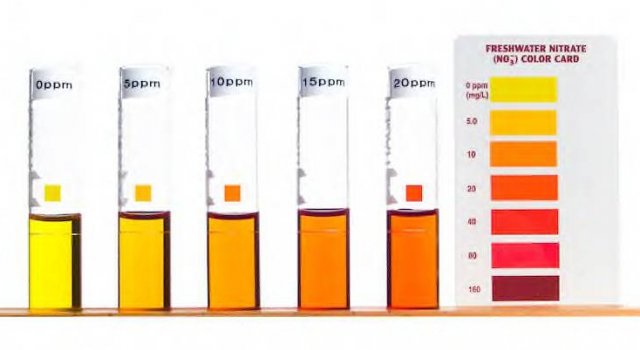
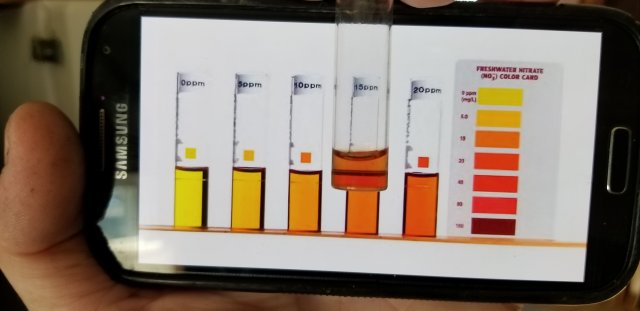
My rather primitive spectrometer. API TEST interpretation with a test tube compared to a laminated color test card. Was vague.
With a actual test tube samples, as a backlight screen on a smart phone, I can tell the difference between 20 ppm and 25 ppm. Within perhaps 2ppm+/-.
The screen has to be on the same setting of brightness.
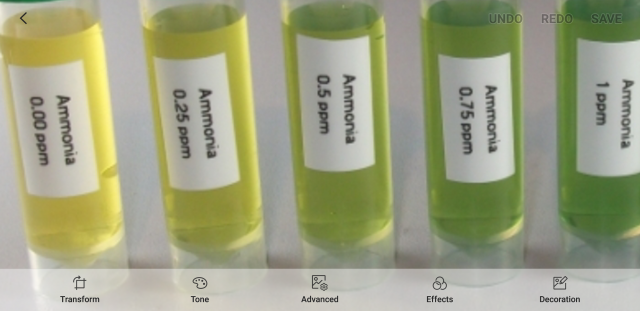
I have used this with ammonia also.20171110_175444.jpg Screenshot_20171219-120725.png
 
  • Like
Reactions: knobhill
I had a ORP, meter calibrated, and real time monitored, nitrate on a anaerobic denitrator.

I have seen someone use an ORP and pH monitor on a freshwater tank and basically used those readings to do water changes. Can you explain more about this?
 
If your pH drops drastically a day or two after a water change, it means your tank water is acidifying and becoming mostly fish urine (the make up water not able to neutralize the acids). Because fresh water fish constantly take in water to breath, they constantly urinate.
If you pH (for example) is 7 the day of a water change and remains at 7 a few days later it means the buffering capacity of the replacement water to neutralize fish urine is strong, and you may not need as frequent water changes. The faster the pH drops, the more frequent, and more water changes you need to perform to dilute the urine, and other metabolism by-products.
If the buffering capacity (alkalinity) of tap water is weak (and has an already low pH), and pH always drops even more, you may need lots of frequent water changes to dilute the fish urine forever.
 
MonsterFishKeepers.com