

Help with geo gender
- Thread starter Theos.dad
- Start date
You are using an out of date browser. It may not display this or other websites correctly.
You should upgrade or use an alternative browser.
You should upgrade or use an alternative browser.




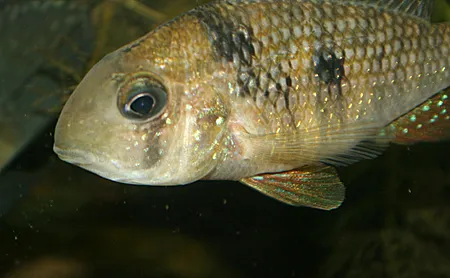
When young (like the one in your pic) it is very difficult to determine gender, because few of the clues are apparent.
Males have steeper profiles, longer fin trailers, and sometimes more dramatic color (especially in the fins).
Below an example of a male from the Geophagus "altifrons" complex.

Above, he is about 1o+".
But these traits carry over into most of tribe Geophagini, below a male Gymnogeophagus quilero (note the head profile, and color)

and tapering of unpaired fin ends

now below a couple shots of females
above carrying fry, below in front of a male

above, it is most obvious in her lack of color (spots), in the fins, and slope of the head when in the company of a male.
another example below, Gymnogeophagus sp. Paso Pache.

Male in front, female behind
below another shot of a male sp. Paso Pache

Males have steeper profiles, longer fin trailers, and sometimes more dramatic color (especially in the fins).
Below an example of a male from the Geophagus "altifrons" complex.
Above, he is about 1o+".
But these traits carry over into most of tribe Geophagini, below a male Gymnogeophagus quilero (note the head profile, and color)
and tapering of unpaired fin ends
now below a couple shots of females
above carrying fry, below in front of a male
above, it is most obvious in her lack of color (spots), in the fins, and slope of the head when in the company of a male.
another example below, Gymnogeophagus sp. Paso Pache.
Male in front, female behind
below another shot of a male sp. Paso Pache


RHT right? I don't consider myself an expert but I think it may be a bit too early to fully tell.
It was around the 4 inch mark (and 1 year) that my bunch really started to show sexual dimorphism. I have 4 males and 2 females, some things to look for in males are small nuchal humps, and trailers forming on fins, specifically the dorsal and caudal fin.
It was around the 4 inch mark (and 1 year) that my bunch really started to show sexual dimorphism. I have 4 males and 2 females, some things to look for in males are small nuchal humps, and trailers forming on fins, specifically the dorsal and caudal fin.

How many total? Assuming a decent sized group and that all started at the same age, at that size range it's a good educated guess that the largest are probably male, the smallest female, and those in between may go either way. The photos are a bit ambiguous for making proclamations, but well conditioned males at 4 inches should at least be showing hints in terms of color, fins, etc.

Thank you for the detailed explanation. This is exactly what I joined this forum for. I've raised several fish and know the signs typically of a south or Central american but this is the first time I've had any of the geophagus family (or earteaters in general) the reason I asked is my fish are at the size I'd normally be able to see distinctive traits to show male and female. I do have 2 fish that are much larger than the other 2. 1 of the 2 smaller ones is much smaller and showing less coloration throughout compared to the 2 larger so I assume it's female. They all are also showing trailers from the pectoral fins. The pics I posted are actually a couple weeks old. With a 19 month old that constantly wants mom and dad's attention it's hard to snap pics of these lightning quick rascals. I'll try to take some video tonight and take screen grabs from those for better pics.When young (like the one in your pic) it is very difficult to determine gender, because few of the clues are apparent.
Males have steeper profiles, longer fin trailers, and sometimes more dramatic color (especially in the fins).
Below an example of a male from the Geophagus "altifrons" complex.
View attachment 1472548
Above, he is about 1o+".
But these traits carry over into most of tribe Geophagini, below a male Gymnogeophagus quilero (note the head profile, and color)
View attachment 1472549
and tapering of unpaired fin ends
View attachment 1472550
now below a couple shots of females
View attachment 1472551
above carrying fry, below in front of a male
View attachment 1472552
above, it is most obvious in her lack of color (spots), in the fins, and slope of the head when in the company of a male.
another example below, Gymnogeophagus sp. Paso Pache.
View attachment 1472553
Male in front, female behind
below another shot of a male sp. Paso Pache
View attachment 1472554
I Ingrid right I had 2 males and 2 females but after looking at pics of grown specimens and seeing the trailers on the dorsals of the males ( and my 2 larger fishes dorsal are rounded still) I started second guessing myself.
Again. THANK YOU! This has been extremely helpful. You guys rock
I agree that it may be early for mine. theres 2 that are at that 4 inch mark that have quickly outgrown the others. I'll get better pics tonight. Thank you!RHT right? I don't consider myself an expert but I think it may be a bit too early to fully tell.
It was around the 4 inch mark (and 1 year) that my bunch really started to show sexual dimorphism. I have 4 males and 2 females, some things to look for in males are small nuchal humps, and trailers forming on fins, specifically the dorsal and caudal fin.
Theyre are the same age from the same brood. I only have a small group unfortunately (4) but am trying to buy a male and at least 2 females to go with them. The 4 are in a 55 right now and will be going into 125 with a 4" male gold sev, 4.5" male jack dempsey, and an unsexed 3" vieja synspilum/melanura (not sure of catch location but it's already showing lots of blue freckling for the size)How many total? Assuming a decent sized group and that all started at the same age, at that size range it's a good educated guess that the largest are probably male, the smallest female, and those in between may go either way. The photos are a bit ambiguous for making proclamations, but well conditioned males at 4 inches should at least be showing hints in terms of color, fins, etc.
As far as size, I have 2 much larger than the others. 1 much smaller one and 1 in between.
So maybe 2 males , 1 female and 1 that could go either way.
The 1 that could either way has been going thru periods of being pinned behind the heater by 1 of the larger "males?" Which to me seems like mating tactics. I've had many males pin their mates at the top til ready for spawning. At the same time though I've seen plenty of non dominant males get stuck in a top corner also lol. It's a coin toss at this point.
Much appreciated ? you guys have all been very helpful.