Is there guide line for stocking multiple cichlids?

  • We are currently upgrading MFK. thanks! -neo

Michiba54

Feeder Fish
MFK Member
Jun 27, 2010
290
0
0
Florida
Stocking cichlids is something that has always been of interest to me, it seems like every day there is a new post and the answer are all over the place. Most people can figure out if there tank is the right size for 1 fish or even a pair, but what do you guys do in determine how to stock a "cichlid community"? I am mostly talking about tank space and compatibility, obviously if your nitrates are too high to controller you have too many fish or you wouldn't put a convict in with a bunch of 12-16" fish and be surprised to find him in pieces.

I have kept small cichlids in the 6" range, an a few dwarfs. I feel confident in putting them in an a tank that would be defined as "overstocked", but anything past that is unknown to me. I see a lot of people with larger tanks that say they will remove some fish as they get bigger... why do they put them in there to begin with? Aside from growing them out for an even larger tank, I don't really see the point. Are they simply hoping that it will work? Did they order fish online and plan to trade them in for credit at the LFS? Are they just irresponsible?

I am curious to hear what other people have to say. I have no idea, if you hadn't noticed, but I plan to get a 5ft 120 tomorrow and someday put a Midas or some other wetpet in it. The point of my novel above is to find out what others would do but more importantly how they would do it? I don't see a solo fishing as a bad thing, but I definitely think more is better, with in reason.

All in all I would like to know how more experienced fish keepers deiced what and how much gets placed in a glass box?

 
I can't speak for others, but in my experience with cichlids and sunfish it can be a trial and error type of method as to what works together within a certain space. That's not to say you just throw a bunch of different fish in a tank and see if it works though. Take two Firemouth cichlids and one may be a peaceful fish and the other may be the devil incarnate. That being said, I always have an idea of what should or could work in a given space and that's what I go for, but I always have plans for that fish that may have to go, just in case. For fish I'm not intimately familiar with, I always try to learn as much as I can about a fish. How big does it get, which layer of the tank does it inhabit the most, what does it eat, etc. Luckily for us we have this awesome forum to rely on for first hand experience and knowledge of almost any fish you can think of.
 
In nature, (when thinking Central Amer and Mex.)you seldom (with a few exceptions) see 2 of the same genus in the same area. Perhaps because those of the same genus are competitors.
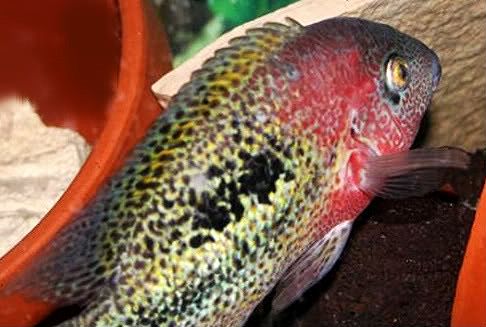
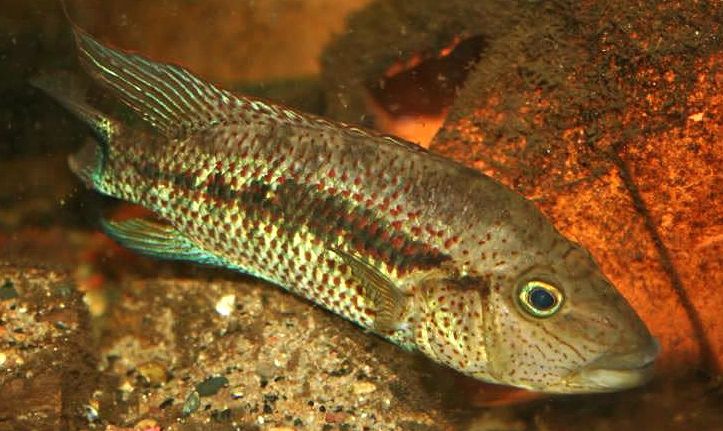
According to Staeck & Linke, in nature, they found Vieja bifasciata with Petenia splendida, Theraps rheophilus, Chuco intermedia, Parapetenia salvini and Thorichthys helleri.
I try to follow this model when putting cichlids together, in a way.
Note the above all have relatively different body shapes, or if the body is similar, the color very different.
Each suggest a different feeding strategy, or micro habitat.
This does not mean there will be no aggression, it just gives you a slight chance.
If you put 2 Vieja together in a tank the size of a puddle, ie 50 gals, or even the size of a small drainage ditch, ie 200 gals, I would expect them to perceive the other as a threat to survival in that kind of small space. 2 of separate genus might see it a bit differently.
frankshouse021.jpg

blackhead021-1.jpg

Another example could be Vieja hartwegi, found with xCichlasoma grammodes, killifish, Rhamdia catfish, Poecilia and Astynax.
The 2 cichlids are very different trophically.
014.jpg

If you put V bifas w hartwegi, I would expect either aggression if you had a pair of each, or if 1 of each of the opposite sex, hybridization. I would not choose either option.
 
So it sounds like different genus, shape, size, and color are about the most common answer I have been reading... Which is still vague, but makes sense. I think I will keep my new tank as a single wet pet in the future and play around with it a little while it's in the temp location.

I appreciate the advice, and if anyone has anything else to add I am all ears. :)
 
I found the bigger the tank the easier it was to lessen aggression. I had a 5ft 120g with a large male midas, silver dollars as dithers along with a few small cichlids growing out. My midas was pretty easy going and peaceful as far a midas are concerned but he would chase the silver dollars around quite a bit. I took these same fish and moved them into my 210g and the midas stopped chasing the silver dollars all together. Also raising all the fish you plan on keeping as adults together as young has proved successful for me also.
 
That is some great advice. I was anxious to see what people would suggest as well since I too want a community in my 125 g tall.
 
A lot of people grow the fish out together. The thought is that if they grow up together, they won't mind eachother so much.

If they are grown out together, you stand a greater percentage chance of 2 fish coexisting in a single tank. However, there is still a chance that the 2 fish will eventually kill one or the other once they get to a certain size.

You can never know which are going to work with the group when you are buying fry/juvies. For that reason, a lot of people get more than they plan to keep long term. This way, they can trade/sell/donate the ones that either don't work with the group, don't look as nice, or they flat out don't like. Once the fish start to get bigger and define their territories, it's much harder to introduce a new largeish fish than it would have been to have a few juvies when all of the fish were young.

Also, if you have say a 200 gallon tank that you plan long term to have a group of 6 fish in, it's just no fun to have only six 1 inch fish in it. Plus juveniles are cheap, so it's not much more money to get a few more to grow out until they are too big.

In the end, starting with more juvies/fry will give you better looking stock and your fish will likely get along better in a community from you weeding out the bullies as they grow.
 
The problem I find with tall tanks (ie 125 high as opposed to 125 long), is it shrinks territory. Cichlids usually don't recognize territory boundary lines up and down, they recognize length and width. I wouldn't house as many in 60 high as a 60 long. I would think of the high tank, as a single species tank, maybe even just 1 adult fish.
 
Another reason for moving a growing fish from tank to tank is so the fish can find the food when you feed it. Makes no sense to put 6 1" fish in a 200 gallon and expect them to find the food in such a vast expanse of territory. Hopefully that answers the question of why do people move fish from tank to tank. +1 to all other comments
 
MonsterFishKeepers.com