

Isthmoheros tuyrensis

  • We are currently upgrading MFK. thanks! -neo

duanes

MFK Moderators
Staff member
Moderator
MFK Member
Jun 7, 2007
22,622
29,681
2,910
Isla Taboga Panama via Milwaukee
While collecting the Chepo/Mamoni river the other day in eastern Panama, a number of yellowish cichlids were netted, all appearing at least superficiously, to be Darienheros.
After waiting overnight for the cichlids to get comfortable, I started taking pics, and while viewing them, (deciding what to keep and what to delete), I came across this one, where the mouth structure on the left, its difference alone, suggest they are not the same species..
IMG_6959.jpeg
It's totally obvious on the photo they are not the same species, Darienheros is on the right, but one on the left, but is too dark to present a reasonable ID..
So today, became a marathon photo session, trying to get a good enough shot to help determine what species it is. Of 200+ photos taken, only 5 or 6 were useable.
IMG_7056.jpeg
It is 3 to 4 " TL. so probably not mature enough to present true colors as yet.
To my way of thinking there re really only 2 choices,
Amphilophus lyonsi (similar sized individual below) or Isthmoheros tuyrensis.
The A . Lyonsi distribution is from Costa Rica to western Panama.
1689884334642.png
Where this one was caught, in the Chepo/Mamoni river, is in eastern Panama , part of the drainage of the Lago Bayano, the Tuira river system, so by geography along, I'm leaning toward, Isthmoheros. Most species from western Panama, are not found in eastern Panama, because the rivers don't connect. The only cichlid common to both areas, is Andinoacara coerleopunctatus, whose ancestors may have migrated 10 or more million years before, the Panamanian geography became what it is when the Isthmoheros migration.
Back in 1966 it was suggested Miller that it fell into the sub-genus Amphilophus, then in 1998 tStawikowski suggested tuyrensis should be placed in the genus Vieja, but then in 2016, after DNA and other testing was done, Rican decided it was different enough to warrant its own genus Isthmoheros.
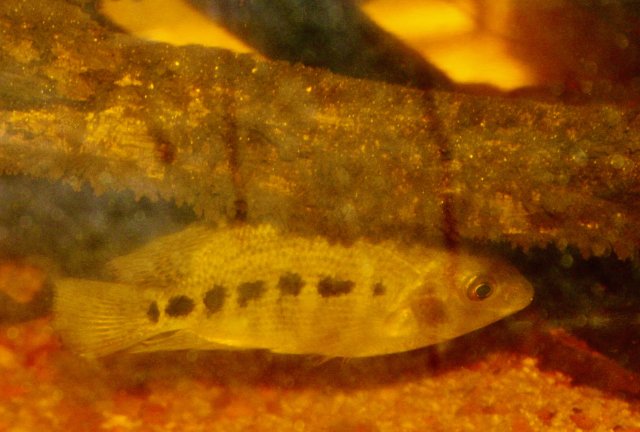
IMG_7064.jpegIMG_7084.jpeg
My tank water is heavily stained with tannins, which may account for the brownish tint.
If anyone has any insight from experience, with the species, I'm very interested in it.

I must admit after this experience, I can see how easily contaminant species show up in large shipments.
 
Last edited:
Duane that’s not fair your collecting the ugly brown fish I wanted for years ha, definitely not a common fish, at the aca convention last week in Madison there was a speaker that spoke on Panama (that was a first)….showing those fish including crassilabrus…here is the info on the speaker he made a few collecting trips there…https://www.aca-convention.org/speakers/thomas-tillman/
 
Thanks for the info.
Other people have also confirmed the Isthmoheros ID.
So now I have to go back and get that same stretch of river again to find a couple more, not a bad thing, I do need to keep Danny my driver/guide, and much better cast netter than I, gainfully employed.
And....to one day find the Panamanian Geo. and of course, that also means buy more tanks, for brown fish.
It's a vicious circle.
IMG_6851.jpegIMG_6847.jpeg
 
Borrowed from he Rican (et.al) study in Invertebrate Zoology

Genus Isthmoheros gen. nov. Říčan & novák


Type species: Cichlasoma tuyrense MeeK & hilDebranD, 1913: 89. Type locality: Rio Tuyra, Boca de Cupe, Panamá. Holotype: FMNH 7599.


Included species. Isthmoheros tuyrensis (MeeK & hilDebranD, 1913)

Diagnosis. A monotypic genus with cranial morphol- ogy of a detritivore and a lentic postcranial morphol- ogy. Isthmoheros was previously classified in the lentic detritivore genus Vieja. Vieja is however a herichthyine genus, while Isthmoheros is an amphilophine, related to other Isthmian amphilophine genera. Diagnosed from its sister-genus Talamancaheros by detritivore cranial mor- phology and lentic postcranial morphology with and ob- scure breeding coloration (vs. scraping cranial and lotic postcranial morphology with a white and black breeding coloration). Diagnosed from other amphilophine detri- tivores (Cryptoheros, Amatitlania, Archocentrus, Pana- mius, Hypsophrys) by much larger body size (250 mm SL vs. < 150 mm SL), by having much fewer anal fin spines (6 – 7 vs. > 8; except for Panamius with 6), by having 14 (vs. 13) abdominal vertebrae, and by having 32 (vs. < 30 except Hypsophrys) scales along lateral line. Further di- agnosed by: second lower lip missing; teeth pointed coni-

cal without second cusp, with tip labiolingually flattened, lateral band L-type coloration ontogeny.

Etymology. Genus name composed from isthmos, mean- ing narrow passage or neck of land, in combination with the old cichlid genus name Heros (meaning hero). Gen- der: masculine. The name is to be understood as the isth- mian hero, as it is the only eastern Isthmian genus that has its sister-genus on the opposite side of the Isthmus in western Panamá-Costa Rica.

Distribution. Isthmoheros is endemic to the pacific slope of eastern Panamá.

Notes. The sister genus of Isthmoheros is Talamancahe- ros and each belong to a different ecological and morpho- logical type (see Notes under Talamancaheros). Isthmo- heros tuyrensis is a high-bodied detritivore-herbivore that inhabits slow-moving waters and was previously placed into Vieja among the herichthyines.
 
Comparisons and distinction, with other species I have kept
1691486408207.png1691486456152.png1691486495399.png
above Vieja breidohri left, V. bifasciata middle, and V.melanurus above right
Talamancaheros sieboldii below
1691486984029.png1691486866971.png
Amphilophines below
1691487109594.png1691487137649.png1691487186212.png
Young and adult A amarillo left and middle, young A flaveolus right
IMG_9846.jpeg
Isthmoheros above and below
IMG_9813.jpeg
 
  • Like
Reactions: tlindsey
Borrowed from he Rican (et.al) study in Invertebrate Zoology

Genus Isthmoheros gen. nov. Říčan & novák


Type species: Cichlasoma tuyrense MeeK & hilDebranD, 1913: 89. Type locality: Rio Tuyra, Boca de Cupe, Panamá. Holotype: FMNH 7599.


Included species. Isthmoheros tuyrensis (MeeK & hilDebranD, 1913)

Diagnosis. A monotypic genus with cranial morphol- ogy of a detritivore and a lentic postcranial morphol- ogy. Isthmoheros was previously classified in the lentic detritivore genus Vieja. Vieja is however a herichthyine genus, while Isthmoheros is an amphilophine, related to other Isthmian amphilophine genera. Diagnosed from its sister-genus Talamancaheros by detritivore cranial mor- phology and lentic postcranial morphology with and ob- scure breeding coloration (vs. scraping cranial and lotic postcranial morphology with a white and black breeding coloration). Diagnosed from other amphilophine detri- tivores (Cryptoheros, Amatitlania, Archocentrus, Pana- mius, Hypsophrys) by much larger body size (250 mm SL vs. < 150 mm SL), by having much fewer anal fin spines (6 – 7 vs. > 8; except for Panamius with 6), by having 14 (vs. 13) abdominal vertebrae, and by having 32 (vs. < 30 except Hypsophrys) scales along lateral line. Further di- agnosed by: second lower lip missing; teeth pointed coni-

cal without second cusp, with tip labiolingually flattened, lateral band L-type coloration ontogeny.

Etymology. Genus name composed from isthmos, mean- ing narrow passage or neck of land, in combination with the old cichlid genus name Heros (meaning hero). Gen- der: masculine. The name is to be understood as the isth- mian hero, as it is the only eastern Isthmian genus that has its sister-genus on the opposite side of the Isthmus in western Panamá-Costa Rica.

Distribution. Isthmoheros is endemic to the pacific slope of eastern Panamá.

Notes. The sister genus of Isthmoheros is Talamancahe- ros and each belong to a different ecological and morpho- logical type (see Notes under Talamancaheros). Isthmo- heros tuyrensis is a high-bodied detritivore-herbivore that inhabits slow-moving waters and was previously placed into Vieja among the herichthyines.
I will say I am not the best at comprehending scientific papers. Is the mtDNA or nDNA more accurate? This is gonna sound stupid, but I'm assuming the nDNA findings were more accurate just because they went ahead and used their newly described genera in that cladogram.
 
I will say I am not the best at comprehending scientific papers. Is the mtDNA or nDNA more accurate? This is gonna sound stupid, but I'm assuming the nDNA findings were more accurate just because they went ahead and used their newly described genera in that cladogram.
I do not know if, or which one is more accurate in this context, way beyond my scope.
 
  • Like
Reactions: Hybridfish7
MonsterFishKeepers.com
