


Here's what I've gotten over the last roughly 6 years of breeding convicts, as well as every other Cryptoheros and Amatitlania with the exception of altoflava and type locality spilurus.
I will start with dominant traits. As one would expect, the wild color (black), is a dominant trait. Black to black will produce black offspring, homozygous black to a visually leucistic individual will produce all black offspring carrying the leucism gene. The purple eyes seen in the nicoya convicts is dominant over the weird multicolored green/orange/white eyes of normal convicts. Blue eyes from other amatitlania however, is dominant over this (epistasis?).
Next is recessive mutations. There are currently only two available in the hobby, but at the very least only two, including one kind of leucism-- as opposed to the 20 or so different melanin reducing genes you'll find in domestic Ancistrus. That said, leucism, as well as the blue gene, are recessive traits. My findings prove my hypothesis that the blue gene in convicts behaves the same way as the "electric blue" genes in Andinoacara pulcher and Rocio octofasciata. This also proves that such a mutation is possible in most cichlids within Therapsini and Cichlasomatini. The electric blue gene in electric blue rams behaves as an incomplete dominant trait, as crossing electric blues to normal colored fish produces intermediaries. The "yellow" gene in the nicoya convicts may also be recessive, but I have not looked into this further.
Just to get this out of the way before we get into the next part-- the "platinum" phenotype is the result of the individual being homozygous for both the blue gene AND the leucism gene. When the individual either has both genes but is heterozygous for the blue gene, or just doesn't have the blue gene at all, the phenotype of the leucistic form of the "wild type" is known as "pink". In the following punnett squares, the wild type gene will be represented by the letter W, and the blue gene will be represented by the letter B. Uppercase W for wild type, lowercase for leucism, uppercase B for wild type again, and lowercase for visual blue.
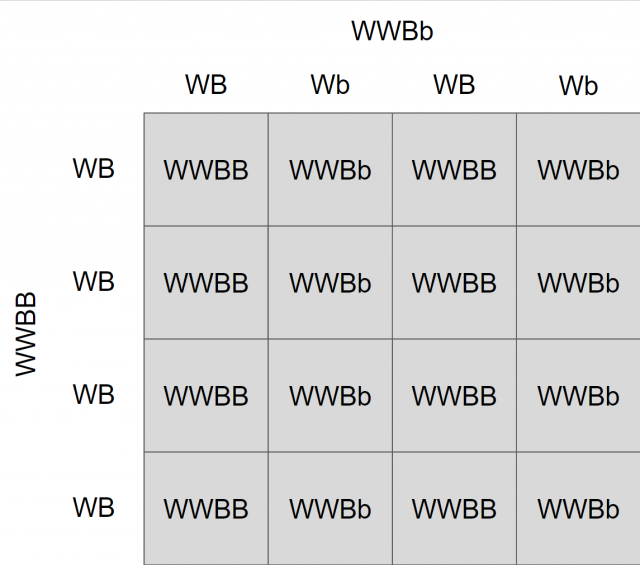
Now onto the wacky interactions between all of these. As I keep mentioning in a lot of my posts, my cross of a visually platinum male to a black female produced a four way split of platinum, pink, blue, and black phenotypes. I originally thought this implied there could be some sort of dominance thing with the blue gene that kept it from being overwritten by the black gene, resulting in a sort of even split between the fry, but I noticed that black to blue crosses often resulted in just black fry, contradicting this thought. It was only when I got blue fry out of a black to black cross that I realized the blue gene was recessive. This checks out, as that implies the original black female was het for BOTH the blue and leucism genes. A 4x4 punnett square fortifies this claim.
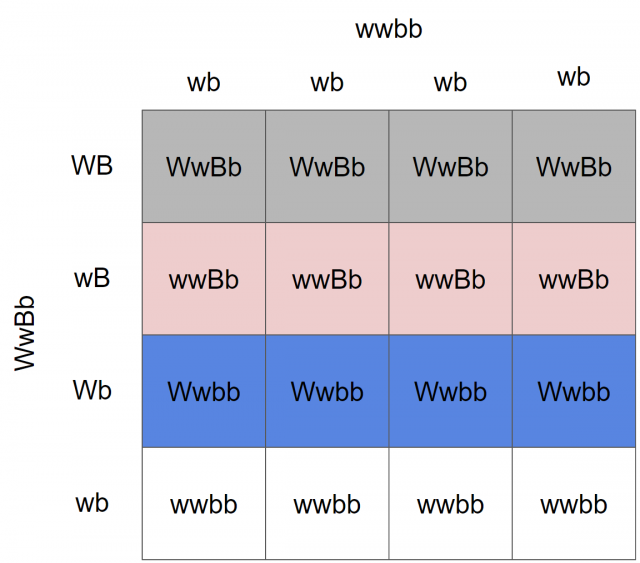
I have colored the squares the color of their corresponding phenotypes to make it easier to read. Now we can take their offspring and do some even crazier stuff. Crossing two of their pink and platinum offspring (blue and non blue) results in a 50/50 split of the pink and platinum phenotypes, because remember, all the fry from the original crossing should be carriers of whatever gene they aren't physically displaying.

I personally haven't done it, but theoretically, if I were to cross two visually black offspring from the original pairing, I'd get this:
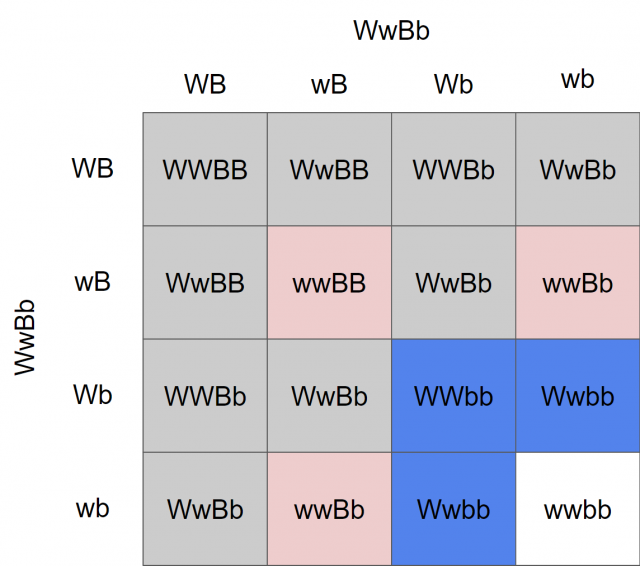
56.25% black fry, 18.75% pink, 18.75% blue, 6.25% platinum. We're getting to the point where we can completely breed out either recessive trait from the genepool. I won't get more into the line breeding for specific traits though, because as long as they've been crossed with a recessive trait at some point, it is entirely possible for a line of visually black individuals to always produce fry that at the very least carry that trait, if the heterozygous fry happen to be the ones that always get to breed. And then of course as long as you're breeding homozygous individuals of a recessive trait together, there is no way to go back to wild coloration wihtout outcrossing. That out of the way, we can go the other way with the hypothetical blue to pink cross, resulting in...
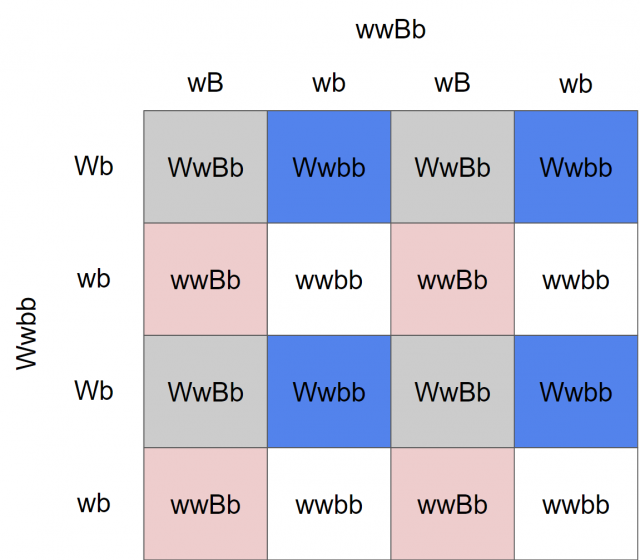
...The exact same results from the first cross, except in a cooler way. Double het crosses out of the way, we can look at single het to single het crosses, like the black het blue cross that produced my blue "lake nicaraguas":
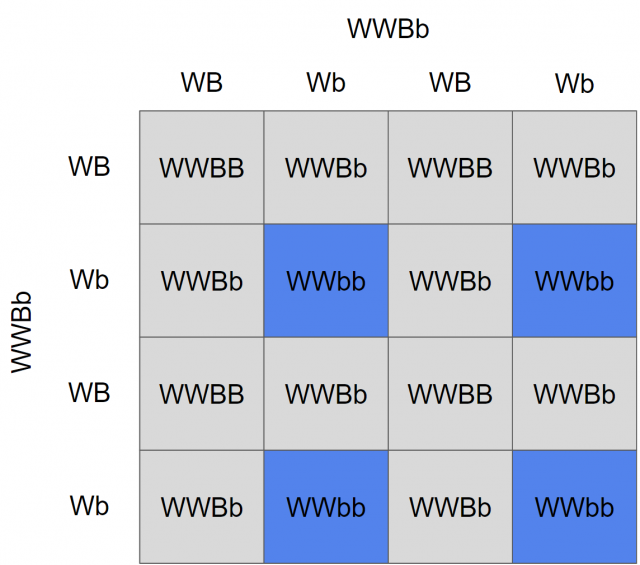
25% blue and the rest black checks out pretty well with what I got out of that spawn. Of course 0 were produced from the spawns with the second female, implying she was not carrying the gene. The likely makeup of that cross can be seen below:
This implies that half of the fry they produced will be able to make blue fry themselves. Of course we can get the leucism crosses and the 2x2 punnett square things out of the way as well just for anyone who wants to know:
(Black x pink, no blue)
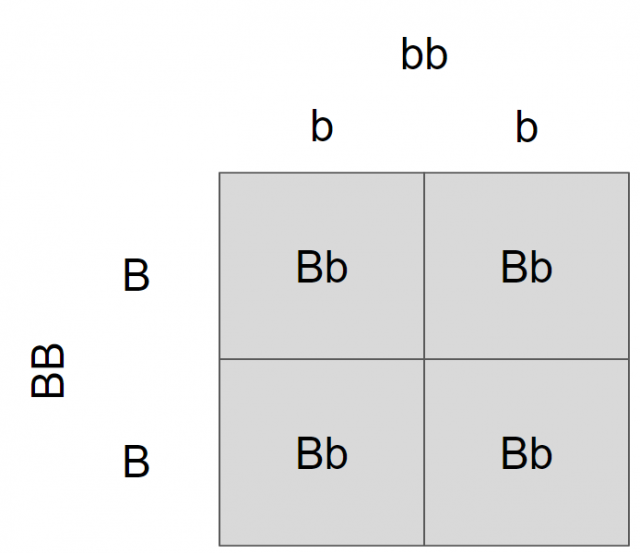
F1 cross from this pairing:
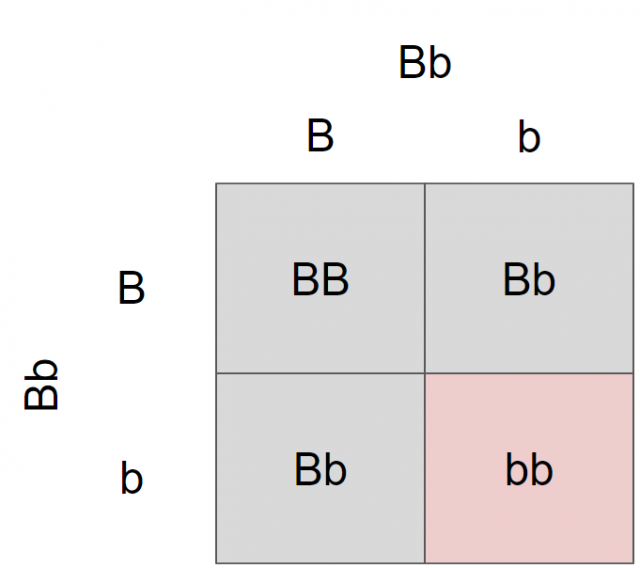
And then of course, pink to pink:
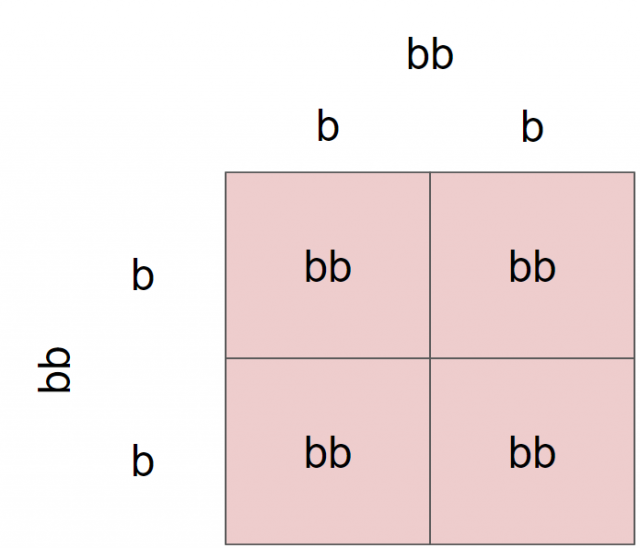
Blue x platinum and platinum x platinum will produce the same proportion of phenotypes as these crosses if all parents involved are homozygous for the blue gene.
Now we get into nicoya crosses. This time no yellow (black) will be represented by Y, and yellow will be represented by y. This is currently hypothetical, as I have not backcrossed nicoya crosses to see if the yellow gene comes back. I crossed a blue gene female to a yellow male and got:
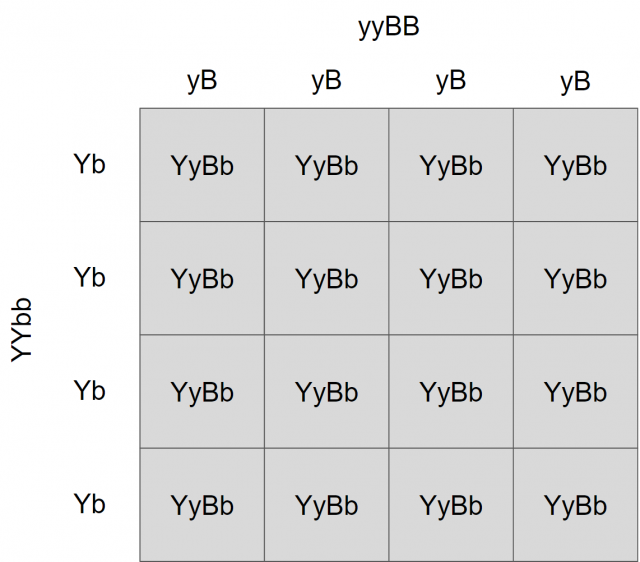
All black offspring. Again hypothetically, the backcross would look something like this:
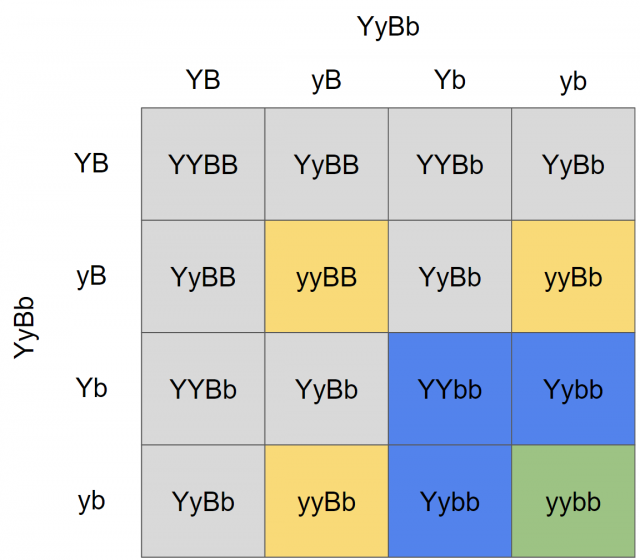
I don't actually know what an individual who is visually blue and yellow would look like, again nor do I even know the behavior of the yellow gene, but the green just represents one that is visually blue and yellow, in this hypothetical scenario.
I also crossed a pink het blue female to a nicoya and just got black fry too. Too lazy to do a 6x6 punnett square though.
That's about it. The marble gene is a weird one but it's on the same locus as the melanin production gene (black or leucistic). I've seen a bit of it in my crosses, as almost all my domestic convicts have at most one copy of the marble gene (producing the "light marble" phenotype when visually leucistic), but I'm too lazy to make more punnett squares for those, given how big they'd need to be and the fact that they've already been done here:

 gregthecrazyfishguy.wordpress.com
...and of course it gets wackier than what's in that blog when you cross the blue gene into it.
gregthecrazyfishguy.wordpress.com
...and of course it gets wackier than what's in that blog when you cross the blue gene into it.
Basically what I'm getting is the blue gene randomly pops up from inbreeding the same way melanin reducing genes do. There allegedly used to be albino septemfasciata, but these have since been lost to time and left in the 20th century. Allegedly the first blue convicts (original Honduran red points) were wild caught blue, so likely that particular localized population had a bit of inbreeding going on that threw blue individuals, the same way Costa Rican rivers occasionally have populations of xanthic cichlids. The rest of the convicts in Rio los almendros are black. Leucism itself seems to pop up pretty quickly, I'd say in about 3-4 generations from the wild collection of a single group of individuals, so you may see leucistic septemfasciata or nicoyas from me pretty soon.
To my knowledge the yellow gene is recessive, but I'm not sure if the convict yellow gene is a bit different from the cryptoheros one, because cutteri HRP hybrids came out yellow.
I'll get pics of everything later, late for class rn.
I will start with dominant traits. As one would expect, the wild color (black), is a dominant trait. Black to black will produce black offspring, homozygous black to a visually leucistic individual will produce all black offspring carrying the leucism gene. The purple eyes seen in the nicoya convicts is dominant over the weird multicolored green/orange/white eyes of normal convicts. Blue eyes from other amatitlania however, is dominant over this (epistasis?).
Next is recessive mutations. There are currently only two available in the hobby, but at the very least only two, including one kind of leucism-- as opposed to the 20 or so different melanin reducing genes you'll find in domestic Ancistrus. That said, leucism, as well as the blue gene, are recessive traits. My findings prove my hypothesis that the blue gene in convicts behaves the same way as the "electric blue" genes in Andinoacara pulcher and Rocio octofasciata. This also proves that such a mutation is possible in most cichlids within Therapsini and Cichlasomatini. The electric blue gene in electric blue rams behaves as an incomplete dominant trait, as crossing electric blues to normal colored fish produces intermediaries. The "yellow" gene in the nicoya convicts may also be recessive, but I have not looked into this further.
Just to get this out of the way before we get into the next part-- the "platinum" phenotype is the result of the individual being homozygous for both the blue gene AND the leucism gene. When the individual either has both genes but is heterozygous for the blue gene, or just doesn't have the blue gene at all, the phenotype of the leucistic form of the "wild type" is known as "pink". In the following punnett squares, the wild type gene will be represented by the letter W, and the blue gene will be represented by the letter B. Uppercase W for wild type, lowercase for leucism, uppercase B for wild type again, and lowercase for visual blue.
Now onto the wacky interactions between all of these. As I keep mentioning in a lot of my posts, my cross of a visually platinum male to a black female produced a four way split of platinum, pink, blue, and black phenotypes. I originally thought this implied there could be some sort of dominance thing with the blue gene that kept it from being overwritten by the black gene, resulting in a sort of even split between the fry, but I noticed that black to blue crosses often resulted in just black fry, contradicting this thought. It was only when I got blue fry out of a black to black cross that I realized the blue gene was recessive. This checks out, as that implies the original black female was het for BOTH the blue and leucism genes. A 4x4 punnett square fortifies this claim.
I have colored the squares the color of their corresponding phenotypes to make it easier to read. Now we can take their offspring and do some even crazier stuff. Crossing two of their pink and platinum offspring (blue and non blue) results in a 50/50 split of the pink and platinum phenotypes, because remember, all the fry from the original crossing should be carriers of whatever gene they aren't physically displaying.
I personally haven't done it, but theoretically, if I were to cross two visually black offspring from the original pairing, I'd get this:
56.25% black fry, 18.75% pink, 18.75% blue, 6.25% platinum. We're getting to the point where we can completely breed out either recessive trait from the genepool. I won't get more into the line breeding for specific traits though, because as long as they've been crossed with a recessive trait at some point, it is entirely possible for a line of visually black individuals to always produce fry that at the very least carry that trait, if the heterozygous fry happen to be the ones that always get to breed. And then of course as long as you're breeding homozygous individuals of a recessive trait together, there is no way to go back to wild coloration wihtout outcrossing. That out of the way, we can go the other way with the hypothetical blue to pink cross, resulting in...
...The exact same results from the first cross, except in a cooler way. Double het crosses out of the way, we can look at single het to single het crosses, like the black het blue cross that produced my blue "lake nicaraguas":
25% blue and the rest black checks out pretty well with what I got out of that spawn. Of course 0 were produced from the spawns with the second female, implying she was not carrying the gene. The likely makeup of that cross can be seen below:
This implies that half of the fry they produced will be able to make blue fry themselves. Of course we can get the leucism crosses and the 2x2 punnett square things out of the way as well just for anyone who wants to know:
(Black x pink, no blue)
F1 cross from this pairing:
And then of course, pink to pink:
Blue x platinum and platinum x platinum will produce the same proportion of phenotypes as these crosses if all parents involved are homozygous for the blue gene.
Now we get into nicoya crosses. This time no yellow (black) will be represented by Y, and yellow will be represented by y. This is currently hypothetical, as I have not backcrossed nicoya crosses to see if the yellow gene comes back. I crossed a blue gene female to a yellow male and got:
All black offspring. Again hypothetically, the backcross would look something like this:
I don't actually know what an individual who is visually blue and yellow would look like, again nor do I even know the behavior of the yellow gene, but the green just represents one that is visually blue and yellow, in this hypothetical scenario.
I also crossed a pink het blue female to a nicoya and just got black fry too. Too lazy to do a 6x6 punnett square though.
That's about it. The marble gene is a weird one but it's on the same locus as the melanin production gene (black or leucistic). I've seen a bit of it in my crosses, as almost all my domestic convicts have at most one copy of the marble gene (producing the "light marble" phenotype when visually leucistic), but I'm too lazy to make more punnett squares for those, given how big they'd need to be and the fact that they've already been done here:
Convict Cichlid Marble Genes
Last updated: 2012-09-17 — Created: 2010-09-08 I’ve been playing with various colour combinations of convict cichlids to apply the theories of genetic inheritance. This post concentrate…
gregthecrazyfishguy.wordpress.com
Basically what I'm getting is the blue gene randomly pops up from inbreeding the same way melanin reducing genes do. There allegedly used to be albino septemfasciata, but these have since been lost to time and left in the 20th century. Allegedly the first blue convicts (original Honduran red points) were wild caught blue, so likely that particular localized population had a bit of inbreeding going on that threw blue individuals, the same way Costa Rican rivers occasionally have populations of xanthic cichlids. The rest of the convicts in Rio los almendros are black. Leucism itself seems to pop up pretty quickly, I'd say in about 3-4 generations from the wild collection of a single group of individuals, so you may see leucistic septemfasciata or nicoyas from me pretty soon.
To my knowledge the yellow gene is recessive, but I'm not sure if the convict yellow gene is a bit different from the cryptoheros one, because cutteri HRP hybrids came out yellow.
I'll get pics of everything later, late for class rn.
Last edited:

