Mixing Rift Lake African with American Cichlids

  • We are currently upgrading MFK. thanks! -neo

Omrit

Piranha
MFK Member
Nov 13, 2015
260
211
76
28
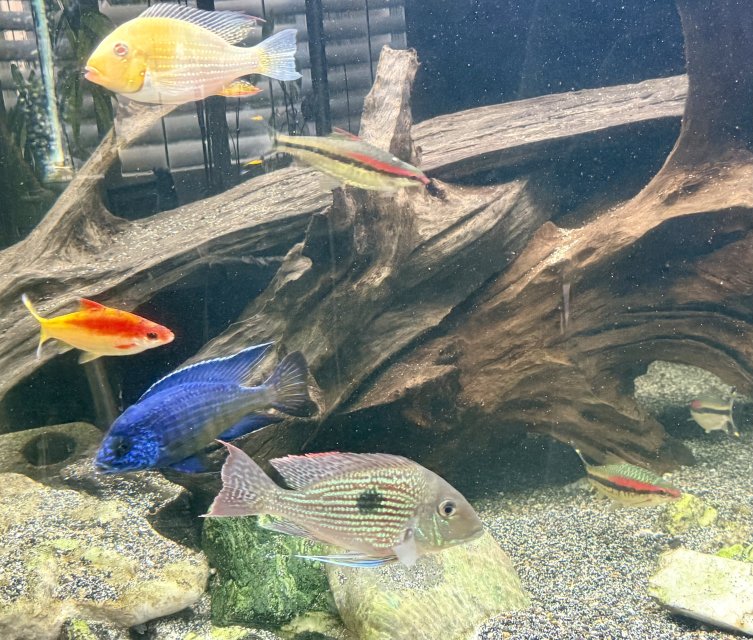
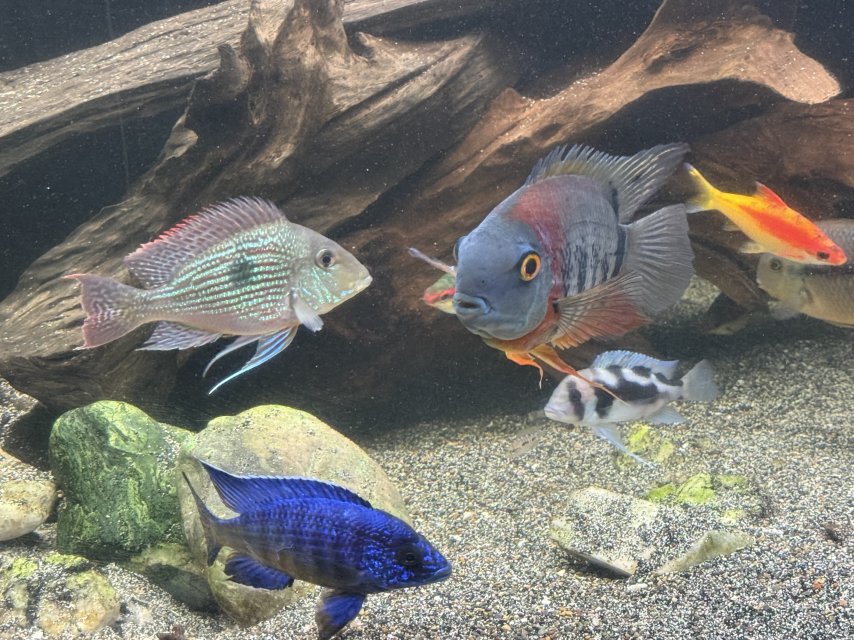
I have been watching every big cichlid tank I can find on youtube to get some inspiration for my upcoming set-up, and I have noticed a fair number of people keep a few africans in with their central/south American cichlid set-ups. You rarely see this discussed online especially not in a positive light, but plenty of people seem to do it especially when you start getting into the huge tank territory.


The most common Africans I see in American set-ups are peacocks, yellow labs, and some of the haps. American cichlids in African tanks are less common, but I have seen convicts and rainbow cichlids in such set-ups. Curious what your experiences are trying stuff like this.


Personally I have had male peacocks, star sapphires, altolamprologus, and a group of julies in non-african only set-ups. The julies and altolamp are with community fish not other cichlids though.


The star sapphires have been moved from tank to tank a few times, but have never bothered anyone cichlid or otherwise.


I attempted a male Convict in my peacock tank, and the convict bullied the peacocks horribly(5 inch peacocks, maybe wouldn't have happened with larger peacocks). This particular convict was a problem no matter what it was with though so maybe not the species fault. I tried two rainbow cichlids after that, but it turned out I had a pair who then processed to bully the peacocks once again. Breaking up the pair caused the remaining rainbow to be an unproblematic citizen.

 
I've successfully kept African Cichlids & New World Cichlids together on a short term basis.
It's really not difficult to keep Central American Cichlids with African Haps and Peacocks, depending on the species. Both groups share water parameter requirements.
IMO. it's just not a good look.
 
It's certainly possible if you consider temperament compatibility and don't ask fish from either continent to adapt to extremes in temperature, pH, etc. So no discus with mbuna, don't expect frontosa to do well in an 86 degree discus tank, or blackwater restricted species to do well in rift lake conditions, rift lake species to do well in soft, acidic water, etc. :WHOA:

But I'm with A201 A201 , I don't really like it aesthetically, nor when people insist on injecting clown loaches into every conceivable mix of fish, lol.
 
People seem to do a lot of things that conflict with the natural order. And as we continue to see on a large scale, , consequences may not be immediate.

On a smaller scale, such as fish keeping, conflict my also" not" be immediate, but results may be slow in becoming obvious, as in chromic disease.

Because I'm anal about biotopes being geographically correct for aesthetica reasons, I won't even mix Mexican cichlids with Panamanians.
But my reasoning goes beyond mire aesthetics.
Cichlids like H carpintus go thru vastly different seasonal temp changes than Panamanians, Mexicans might experience temps into the low 60s in winter, so I provide that seasonal variation by turning off heaters, whereas Panamanian don't face those same changes.

Same goes for some S Americans, it is a very large continent, with vastly different temp zones, and water parameters
For that reason, I wouldn't ever keep Uruguayan cichlids with northern South Americans species.
In Uruguay winter temps drop water temps into the 50s, and these cichlids have evolved to need those seasonal variations to stay healthy.
I northern Brazilian cichlids those temp variation just don't happen, and species from the north could die if those drops in temp were employed.

Beyond temps, S Americans from Amazonia generally live in much softer, mineral poor water parameters, and often much more acidic conditions.
Cichlids of the rift, and Central America, come from hard, mineral rich, high pH water conditions.

Is the water itself, and the higher or lower osmotic pressure capable of killing higher animals like fish?, probably not.
But bacteria are much more sensitive to pH and mineral condition.
Soft water fish have not had to evolve to resist hard water bacteria, and vice versa.

I believe this is the reason we see so many posts in the disease section, showing oscars with HITH disease in hard water aquariums, and the reason we see many Malawi cichlids with the mysterious " bloat".
HITH bacteria thrive in pH condition of @ 7.5 and above, easily overwhelming the immune system of a cichlid evolved to fight off bacteria that live waters of pH 6 and below.
And many Malawians seem to be prone to bloat when kept in lower pH conditions compared to the pH8.2 water they have evolved to live in.

These diseases are often called "mysterious" by the poster....because they aren't always acute, chronic diseases often sneak up unnoticed until too late.

but as a retired, former microbiologist, when water parameters or standard practice is posted, the end results are obvious from my detached viewpoint.
This is why I choose species naturally adapted to my water conditions, and not try to fool, or fight mother nature.
 
Last edited:
  • Like
Reactions: Sinister-Kisses
I’ve kept nice show tanks with mature African & American cichlids for decades in very hard water. Only occasional problem is one fish becoming hyper dominate at some point, needing it to be removed. Doesn’t happen often, but when it does, sometimes it's an African and sometimes an American.
 
I’ve kept nice show tanks with mature African & American cichlids for decades in very hard water. Only occasional problem is one fish becoming hyper dominate at some point, needing it to be removed. Doesn’t happen often, but when it does, sometimes it's an African and sometimes an American.
I am curious what fish have given you problems over the years?
 
Had hyper dominant large male electric blue and a similarly large male Taiwan reef hap. Right now a Nicaraguan cichlid has been aggressive, but keeping an eye on it. Not hurting anyone or causing them to hide, but he is bossy. The Mbenji Island Mbenji male gets a but aggressive when his female is about to spawn but he isn’t hurting any of them as he just wants a clear space. I also once had a very bossy large blood parrot.
 
MonsterFishKeepers.com