


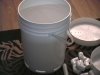
My version of a 225G Diy Overflow & Filter From this Article ! Im Gonna use 2 5g pail's for my filter!! 
I had to use some imagination!!
It will be in construction for a while yet!!!
[SIZE=5]Another DIY wet/dry
by marka-at-SSD.CSD.HARRIS.COM (Mark Ashley)
Date: 25 Sep 92
Newsgroup: rec.aquaria[/SIZE]
Well, I just completed my wet/dry and have been running it for
the past three days with no problems. Thought I might share the
info. A similar previous post convinced me to build my own so
maybe this post will convince another soul.
I welcome suggestions for improvements (thru e-mail, please).
Parts:
15 gallon tank ($15 - pet shop)
"Eheim" 1250 Hobby pump ($65 - That Fish Place)
5/8 inch tubing (60 cents per foot - pet shop)
"Magnum" 200 Outlet Tube with Diffuser ($4 pet shop)
Padding for the pump (reduces glass vibration)
pre-filter ($50 Spectacular Sea Systems)
2 siphon tubes ($7 each pet shop)
flexible 2-inch hose ($7 Spectcular Sea Systems)
2 hose clamps for both ends of flexible hose (Home Depot)
3 dishwashing sponges (3"x4"x0.5") (Target)
1 roll teflon tape ($1 Home Depot)
3.5 gal bucket for crushed coral ($3 Home Depot)
3.5 gal bucket for drip tray ($3 Home Depot)
3.5 gal bucket for trickle filter stand ($3 Home Depot)
3.5 gal bucket for trickle filter ($3 Home Depot)
cover for 3.5 gal bucket ($2 Home Depot)
7.5 gal box Lee's Bio-Pinballs ($60 pet shop)
plastic cable ties (Home Depot)
1-inch 90-degree elbow pipe - slip ends (20 cents - Home Depot)
2 pieces 3/4 inch coupling pipe - slip ends (20 cents each - Home Depot)
1-inch coupling pipe - slip ends (20 cents - Home Depot)
"Oatey" Purple Pipe Primer/Cleaner for cpvc or pvc ($2 - Home Depot)
"Oatey" Heavy Duty Clear Cement fpr pvc ($3 - Home Depot)
Other materials:
screwdriver
3/16 drill bit
Power drill
Steps:
1. Making the drip tray:
I took one of the 3.5 gal buckets and cut off the bottom 3 inches.
This was the initial height. I cut it down a half inch later
when I saw that I could get away with it (i.e. the water level
was pretty low). I drew a 3 inch circle in the middle. This
is the no-hole zone. This is where the water will splash hence
it's better not to have holes. Then I drew 12 lines from
the edge of the tray to the center. All the holes I drilled
were on these lines. The number of holes I drilled were enough
to keep about a half-inch of water in the tray and the rest
dripped through the holes.
2. Making the stand for the trickle filter.
I took one of the 3.5 gal buckets and cut off the bottom
7 inches. Then I drew a line around the bucket, one inch from
the bottom (the open end). I drew another line one inch
below the top (the closed end a.k.a. the bottom of the bucket).
Then I drew eight "windows". Each window is bounded on the
top and the bottom by the 2 lines I already drew. Each
window is about one inch wide. The windows are evenly spaced
from each other along the circumference of the stand.
I cut out the windows.
3. Making the trickle filter (without the cover)
I took one of the 3.5 gal buckets and drew a line around
the bucket, half an inch from the bottom. I drew another
line a half inch above the first line. Then I drew
vertical lines inside the area bounded by the first two
lines. Each vertical line is about two inches apart
along the perimeter of the bucket. Then I cut off each
alternating "piece". The result is the bucket has
little "windows" at the bottom for the water to drain.
I took the stand I made in step 2 and set it down
with the closed end facing up. I set the trickle
filter on top of that. I drilled eight holes at the
bottom so I hit both bucket bottoms. Then I took the
cable ties and strung them through the holes; tightened
them; and they were attached (bottom to bottom).
I took the bio-pinballs and assembled them into a neat
stack as suggested by the box instructions. I put them
in the bucket.
The drip plate went on top of the bio-balls.
4. Making the cover of the trickle filter.
I took the bucket cover and cut a hole in the middle
just enough to accomodate the 3/4 inch coupling pipe.
I cut the 1-inch coupling pipe a bit because it was
too long (you'll understand why, later). The setup is
like so: I took the 1-inch coupling pipe, and slipped in
a 3/4 inch coupling pipe; I slipped the 3/4 inch coupling
pipe through the hole in the bucket cover; I slipped
the 3/4 inch coupling pipe into the elbow; I slipped
the elbow onto the other 3/4 inch coupling pipe.
The flexible hose will fit over this last 3/4 inch
coupling pipe. The 1-inch coupling pipe is the one
"under" the cover when I put the cover on the bucket.
It was hitting my drip plate that's why I had to cut it
a bit.
Well after this rehearsal, I got the purple cleaner
and the glue and did it for real.. I just followed
the instructions on the cans.
5. Connecting the water pump.
The Eheim is a submersible pump so it's perfect for
this DIY wet/dry. The 5/8 inch hose goes on the output
tube with no hassle. I connected The other end to the
"Magnum" 200 Outlet Tube which I then hooked over
the edge of the aquarium. The diffuser can be used
if desired. When power is turned off water siphons
back to the sump through the 5/8 hose but only
until the mouth of the Outlet Tube. In my case,
a gallon of water comes back to the sump.
6. Modifying the pre-filter.
The siphon tube that came with the pre-filter was sufficient
for the job. However, I wanted to use two tubes, one being
a backup tube in case the other one failed.
I bought a siphon tube from the local pet shop and noticed
that this tube had a two inch difference in the lengths of
its ends. On the original siphon tube, one end was only
a half-inch longer than the other. In experimenting with
the pre-filter, I found that the original siphon tube
had a tendency to accumulate bubbles when used with
the pet-shop siphon tube.
To make a long story short, two siphon tubes from the
pet shop worked better for what I wanted.
7. Hooking up the pre-filter
This was the easy part. I attached the flexible hose to the
prefilter and tightened the hose clamp. I put in the
prefilter astride a corner of the tank. I put the 15-gal
tank below the main tank. I put in the trickle filter and
attached the flexible hose to it, tightening another hose
clamp. I put the pump into the 15-gal tank and attached the
5/8 inch hose. I attached the Magnum" 200 Outlet Tube to the
other end of the 5/8 hose and hooked it over the edge of the
main tank. I put water into the 15-gal tank. I put water
into the prefilter and started up the siphons. Then I
powered up the pump.
8. Making the crushed coral tray
I took one of the 3.5 gal buckets and cut off the bottom
two inches and put crushed coral that I already had
in my tank as part of the UGF. This went below the trickle
filter, inside the stand.
9. Making improvements.
After running it for a few minutes, I added some
enhancements.
The prefilter was tilted because it was designed with
a 1.5 inch gap between the prefilter and the toothed box
whereas my aquarium edging is only about 3/4 inch. So on
the outside, between the prefilter and the glass tank, I
put in a couple of dishwashing sponges. So now the prefilter
is level.
On the prefilter side, the flexible hose was a bit heavy
and the bucket cover is too flexible so the elbow pipe was
getting weighted down by the flex and tilting forward.
I put in another sponge on the edge of the bucket to prop
up the flex hose.
Water was also dripping so very slowly out of the
flexible hose on the prefilter side, I took out the
flexible hose, wrapped teflon tape over the tube
coming out of the prefilter, and put back the flexible
hose.
The pump made too much noise because it was vibrating
and it was on glass. I put a sponge under it. This
was a salt water safe sponge which was just lying
around.
The output of the pump was too strong for the water
to simply drop straight down into the gravel - major
clouding. So i used the diffuser that came with the
outlet tube. I put the prefilter box in one corner,
and the outlet tube in the other corner so that
water would circulate. When I pointed the diffuser
towards someplace else other than the prefilter,
the floating protein stuff would not all go into
the prefilter/toothed box. So I made the diffuser
point towards the pre-filter and now all the icky
stuff is in the toothed box.
I ended up with about 7 gals of water in my sump
because the Eheim is a bit tall and to compensate
for water evaporation which is really fast compared
to when I didn't have a wet/dry.
Other considerations:
1. I used a 3.5 gal bucket instead of a 5 gal bucket for the
trickle filter because of the height of my aquarium stand.
When I build my next stand, I'll just replace the 3.5 with
a 5.0 and put more bio balls.
2. The 15 gal tank was my old tank, hence, was available
for use. My current 35 gal tank will be the wet/dry
when I move on to a 65 gal tank. Then I'll have room
for two buckets in the sump. A 100 gal tank also
looks very tempting . . .
3. The bio-balls came in a one-cubic foot box which the
labels claim to contain 7.5 gals of bio-balls. I used
only about 1/4 of it. The rest will be used for when
I change over to dual 5-gal buckets.
4. I had enough room in the sump to include my protein
skimmer and its own pump.
-------------------------------------------------------------------------
Mark Ashley |DISCLAIMER: The opinions expressed
marka-at-gcx1.ssd.csd.harris.com |here are my own; they do not
..!uunet!gcx1!marka |reflect the opinion or policies
|of Harris Corporation.




I had to use some imagination!!
It will be in construction for a while yet!!!
[SIZE=5]Another DIY wet/dry
by marka-at-SSD.CSD.HARRIS.COM (Mark Ashley)
Date: 25 Sep 92
Newsgroup: rec.aquaria[/SIZE]
Well, I just completed my wet/dry and have been running it for
the past three days with no problems. Thought I might share the
info. A similar previous post convinced me to build my own so
maybe this post will convince another soul.
I welcome suggestions for improvements (thru e-mail, please).
Parts:
15 gallon tank ($15 - pet shop)
"Eheim" 1250 Hobby pump ($65 - That Fish Place)
5/8 inch tubing (60 cents per foot - pet shop)
"Magnum" 200 Outlet Tube with Diffuser ($4 pet shop)
Padding for the pump (reduces glass vibration)
pre-filter ($50 Spectacular Sea Systems)
2 siphon tubes ($7 each pet shop)
flexible 2-inch hose ($7 Spectcular Sea Systems)
2 hose clamps for both ends of flexible hose (Home Depot)
3 dishwashing sponges (3"x4"x0.5") (Target)
1 roll teflon tape ($1 Home Depot)
3.5 gal bucket for crushed coral ($3 Home Depot)
3.5 gal bucket for drip tray ($3 Home Depot)
3.5 gal bucket for trickle filter stand ($3 Home Depot)
3.5 gal bucket for trickle filter ($3 Home Depot)
cover for 3.5 gal bucket ($2 Home Depot)
7.5 gal box Lee's Bio-Pinballs ($60 pet shop)
plastic cable ties (Home Depot)
1-inch 90-degree elbow pipe - slip ends (20 cents - Home Depot)
2 pieces 3/4 inch coupling pipe - slip ends (20 cents each - Home Depot)
1-inch coupling pipe - slip ends (20 cents - Home Depot)
"Oatey" Purple Pipe Primer/Cleaner for cpvc or pvc ($2 - Home Depot)
"Oatey" Heavy Duty Clear Cement fpr pvc ($3 - Home Depot)
Other materials:
screwdriver
3/16 drill bit
Power drill
Steps:
1. Making the drip tray:
I took one of the 3.5 gal buckets and cut off the bottom 3 inches.
This was the initial height. I cut it down a half inch later
when I saw that I could get away with it (i.e. the water level
was pretty low). I drew a 3 inch circle in the middle. This
is the no-hole zone. This is where the water will splash hence
it's better not to have holes. Then I drew 12 lines from
the edge of the tray to the center. All the holes I drilled
were on these lines. The number of holes I drilled were enough
to keep about a half-inch of water in the tray and the rest
dripped through the holes.
2. Making the stand for the trickle filter.
I took one of the 3.5 gal buckets and cut off the bottom
7 inches. Then I drew a line around the bucket, one inch from
the bottom (the open end). I drew another line one inch
below the top (the closed end a.k.a. the bottom of the bucket).
Then I drew eight "windows". Each window is bounded on the
top and the bottom by the 2 lines I already drew. Each
window is about one inch wide. The windows are evenly spaced
from each other along the circumference of the stand.
I cut out the windows.
3. Making the trickle filter (without the cover)
I took one of the 3.5 gal buckets and drew a line around
the bucket, half an inch from the bottom. I drew another
line a half inch above the first line. Then I drew
vertical lines inside the area bounded by the first two
lines. Each vertical line is about two inches apart
along the perimeter of the bucket. Then I cut off each
alternating "piece". The result is the bucket has
little "windows" at the bottom for the water to drain.
I took the stand I made in step 2 and set it down
with the closed end facing up. I set the trickle
filter on top of that. I drilled eight holes at the
bottom so I hit both bucket bottoms. Then I took the
cable ties and strung them through the holes; tightened
them; and they were attached (bottom to bottom).
I took the bio-pinballs and assembled them into a neat
stack as suggested by the box instructions. I put them
in the bucket.
The drip plate went on top of the bio-balls.
4. Making the cover of the trickle filter.
I took the bucket cover and cut a hole in the middle
just enough to accomodate the 3/4 inch coupling pipe.
I cut the 1-inch coupling pipe a bit because it was
too long (you'll understand why, later). The setup is
like so: I took the 1-inch coupling pipe, and slipped in
a 3/4 inch coupling pipe; I slipped the 3/4 inch coupling
pipe through the hole in the bucket cover; I slipped
the 3/4 inch coupling pipe into the elbow; I slipped
the elbow onto the other 3/4 inch coupling pipe.
The flexible hose will fit over this last 3/4 inch
coupling pipe. The 1-inch coupling pipe is the one
"under" the cover when I put the cover on the bucket.
It was hitting my drip plate that's why I had to cut it
a bit.
Well after this rehearsal, I got the purple cleaner
and the glue and did it for real.
. I just followedthe instructions on the cans.
5. Connecting the water pump.
The Eheim is a submersible pump so it's perfect for
this DIY wet/dry. The 5/8 inch hose goes on the output
tube with no hassle. I connected The other end to the
"Magnum" 200 Outlet Tube which I then hooked over
the edge of the aquarium. The diffuser can be used
if desired. When power is turned off water siphons
back to the sump through the 5/8 hose but only
until the mouth of the Outlet Tube. In my case,
a gallon of water comes back to the sump.
6. Modifying the pre-filter.
The siphon tube that came with the pre-filter was sufficient
for the job. However, I wanted to use two tubes, one being
a backup tube in case the other one failed.
I bought a siphon tube from the local pet shop and noticed
that this tube had a two inch difference in the lengths of
its ends. On the original siphon tube, one end was only
a half-inch longer than the other. In experimenting with
the pre-filter, I found that the original siphon tube
had a tendency to accumulate bubbles when used with
the pet-shop siphon tube.
To make a long story short, two siphon tubes from the
pet shop worked better for what I wanted.
7. Hooking up the pre-filter
This was the easy part. I attached the flexible hose to the
prefilter and tightened the hose clamp. I put in the
prefilter astride a corner of the tank. I put the 15-gal
tank below the main tank. I put in the trickle filter and
attached the flexible hose to it, tightening another hose
clamp. I put the pump into the 15-gal tank and attached the
5/8 inch hose. I attached the Magnum" 200 Outlet Tube to the
other end of the 5/8 hose and hooked it over the edge of the
main tank. I put water into the 15-gal tank. I put water
into the prefilter and started up the siphons. Then I
powered up the pump.
8. Making the crushed coral tray
I took one of the 3.5 gal buckets and cut off the bottom
two inches and put crushed coral that I already had
in my tank as part of the UGF. This went below the trickle
filter, inside the stand.
9. Making improvements.
After running it for a few minutes, I added some
enhancements.
The prefilter was tilted because it was designed with
a 1.5 inch gap between the prefilter and the toothed box
whereas my aquarium edging is only about 3/4 inch. So on
the outside, between the prefilter and the glass tank, I
put in a couple of dishwashing sponges. So now the prefilter
is level.
On the prefilter side, the flexible hose was a bit heavy
and the bucket cover is too flexible so the elbow pipe was
getting weighted down by the flex and tilting forward.
I put in another sponge on the edge of the bucket to prop
up the flex hose.
Water was also dripping so very slowly out of the
flexible hose on the prefilter side, I took out the
flexible hose, wrapped teflon tape over the tube
coming out of the prefilter, and put back the flexible
hose.
The pump made too much noise because it was vibrating
and it was on glass. I put a sponge under it. This
was a salt water safe sponge which was just lying
around.
The output of the pump was too strong for the water
to simply drop straight down into the gravel - major
clouding. So i used the diffuser that came with the
outlet tube. I put the prefilter box in one corner,
and the outlet tube in the other corner so that
water would circulate. When I pointed the diffuser
towards someplace else other than the prefilter,
the floating protein stuff would not all go into
the prefilter/toothed box. So I made the diffuser
point towards the pre-filter and now all the icky
stuff is in the toothed box.
I ended up with about 7 gals of water in my sump
because the Eheim is a bit tall and to compensate
for water evaporation which is really fast compared
to when I didn't have a wet/dry.
Other considerations:
1. I used a 3.5 gal bucket instead of a 5 gal bucket for the
trickle filter because of the height of my aquarium stand.
When I build my next stand, I'll just replace the 3.5 with
a 5.0 and put more bio balls.
2. The 15 gal tank was my old tank, hence, was available
for use. My current 35 gal tank will be the wet/dry
when I move on to a 65 gal tank. Then I'll have room
for two buckets in the sump. A 100 gal tank also
looks very tempting . . .
3. The bio-balls came in a one-cubic foot box which the
labels claim to contain 7.5 gals of bio-balls. I used
only about 1/4 of it. The rest will be used for when
I change over to dual 5-gal buckets.
4. I had enough room in the sump to include my protein
skimmer and its own pump.
-------------------------------------------------------------------------
Mark Ashley |DISCLAIMER: The opinions expressed
marka-at-gcx1.ssd.csd.harris.com |here are my own; they do not
..!uunet!gcx1!marka |reflect the opinion or policies
|of Harris Corporation.
