Need Help Re-dueing Entire Setup

  • We are currently upgrading MFK. thanks! -neo

Jon M

Polypterus
MFK Member
Dec 18, 2010
1,252
155
96
Port Saint John, FL
Hey guys. I setup my 260 a few months back and all was sorta going well but recently everything except a cat died to velvet fish disease. (Here is my original thread for the velvet incident Velvet Thread) When I originally set this tank up it was sorta done half ass and since I've discovered many better ways to set things up. The tank is currently in a black out state and has been cupramine dosed. I decided to take this opportunity to re-due some of this setup how it should have originally been done. I'm try to list all the important information and at the same time stick to the important details and not ramble on.

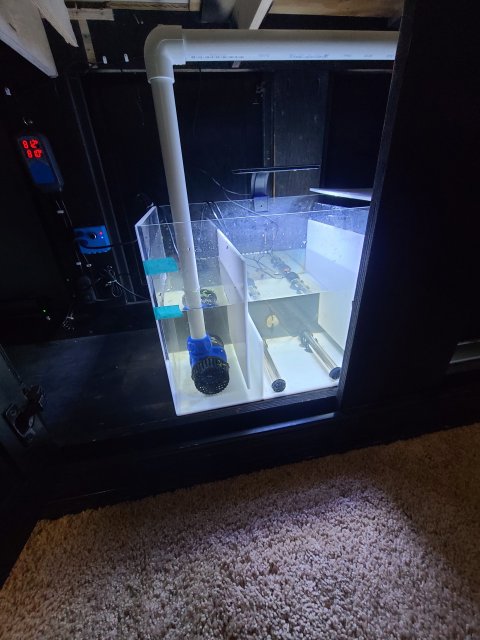
1. I recently got a bucket head and cleaned out the sump. it had all sorts of plants in it and debris, uneaten food etc in the bottom. I don't understand how I'm still getting sorta high nitrate readings when there is literally nothing in this tank but the raph cat. As you can see from todays results, we're looking at around 30ppm nitrates. Also. Where the aquarium drain comes in I have some "egg crate" like filter media with the points facing up. I have no idea if this is right. When the water comes in it seems to splash and can't go threw quick enough and a little comes in the sides. Obviously I feel like this isn't very efficient as some small amounts might not be being mechanically filtered since theyre splashing down the side. I turn the pump lower and lower to avoid this but at some pt it's so low the drain starts to get noisy.

2. The in tank overflow. 1" and 2" holes. The 1" is plumbed to the eflux 6011 pump and back to the tank with loc line at the end. I have a Y piece of loc line coming. The drain is a fat 2" down and under the tank split into 2 1" that come into the sump. Those are the splashy spots. I know other folks from what I read keep these pipes kind of submerged but that's not an option with this design of this sump. (tsunami I believe)

3. I contacted the guy that originally set this up for me and all this pvc is glued. So I'm thinking I need new bulkheads and all. Maybe NOT do all hard plumbing and some soft some hard. I've been reading like a mad man about this but I need some serious help still. With making the durso, size, if I should put ball valves in, where I should go flex, what to use for flex, etc. From what I've read 1 1/4" durso with a reducer at the 2" bulkhead would be ideal?

4. So I noticed the top of my tank looks like identical to other ppls acrylic large tanks. How on earth are ppl cleaning the front angles from the inside where algae builds up? My inside seems to constantly have algae buildup and foggy water and I can't figure out why. Or how people are keeping this so clean? Is there some long ass tool ppl are using to get in onthese angles that I don't know about?

5. How do I know what my gph actually are? There are no actual measurements on this switch connected to the pump. I remember sumps and canisters 4x and hobs 10x does that still hold true? So I should be doing 1040 gph right?

UV Reactor. I realize these are usually SW from what I've read but worth buying one when I replumb? For piece of mind for disease and parasites, plus possibly help w/ water clarity?

20210203_153011.jpg

20210203_153219.jpg

20210203_153234.jpg

20210203_153241.jpg

20210203_153254.jpg

20210203_153321.jpg

20210203_153328.jpg

20210203_153344.jpg

20210203_153405.jpg
 
Nitrates are produced by metabolism, not only converted from ammonia and nitrite from your live or dead fish, but anything that degrades,.
Old fish food, decaying plants, fish feces, all that stuff , that was in the filter.
And the only way to reliably get rid of nitrate is by frequent large, regular water changes.
Your filter does not get rid of nitrate, it produces it.
I admit your nitrate levels do look exceptionally high tho?
Are you rinsing tubes between samples?
I rinse 3 times before taking and measuring the sample I want to analyze, and 3 times after.
Because you are dealing with parts per million, even a small portion of a drop, or some dried on residual from a previous test, can skew results
 
  • Like
Reactions: Nilsafeller
Nitrates are produced by metabolism, not only converted from ammonia and nitrite from your live or dead fish, but anything that degrades,.
Old fish food, decaying plants, fish feces, all that stuff , that was in the filter.
And the only way to reliably get rid of nitrate is by frequent large, regular water changes.
Your filter does not get rid of nitrate, it produces it.
I admit your nitrate levels do look exceptionally high tho?
Are you rinsing tubes between samples?
I rinse 3 times before taking and measuring the sample I want to analyze, and 3 times after.
Because you are dealing with parts per million, even a small portion of a drop, or some dried on residual from a previous test, can skew results

Ya, I definitely rinse them. I rinse after use then when I go to do new test they are completely dry from the previous time. So I can do another test tonight to verify? The only difference is I did remove a lot of the stuff that was in the sump. The thing is, that stuff was damn near impossible to get to. If I did it all over I would not have boughten this sump. I feel like the design is terrible. Most of that gunk and crap from my initial setup and mess up was all under the bioball area, which there literally is no way to get ro besides the little itty bitty slit underneath where the waeter flows into the next chamber where the heaters are. I literally had ot take my w/d shop vac/bucket head hose, ghetto tape another smaller hose onto that hose, then ghetto tape some extra air line from a canister filter onto that! Then slide it down in there, hit the vac, and shove a kitchen spoon down in there and swish it around to stir the stuff up. Now I'm pretty sure I got it all, but what I'm saying is I think the design of this thing sucks because it's all sorta contained and not easily accessible.
 
If you want better access under the Bio area then raise the egg crate. I lift mine to the height I want with scrap PVC. Looks like a good portion of the Bio Balls are submerged anyway. I raise my Bio Balls to where the very bottom of the balls are just at the running sump water level. Then in the space under that I use submerged media like matrix that is in laundry/ media bags so I can removed it or move it around quickly. I also keep my bio balls in bags too. After a few times of picking them out one by one for whatever reason I have moved all my Bio media to coarse laundry bags or pond media bags.
 
Hi, one question how do you replace your padding on your sump? Everything looks to be hard plumb.

Hey. It is all hard plumbed. That padding is in a drawer that pulls out. So you simply pull the drawer out, remove the pad, and put new pad in. Then push the drawer back in.

If you want better access under the Bio area then raise the egg crate. I lift mine to the height I want with scrap PVC. Looks like a good portion of the Bio Balls are submerged anyway. I raise my Bio Balls to where the very bottom of the balls are just at the running sump water level. Then in the space under that I use submerged media like matrix that is in laundry/ media bags so I can removed it or move it around quickly. I also keep my bio balls in bags too. After a few times of picking them out one by one for whatever reason I have moved all my Bio media to coarse laundry bags or pond media bags.

So few things. I don't think (or know how to) the egg crate can simply be moved. This came pre-built by tsunami. Even if it were possible to raise the area the balls sit on, the white wall that is permanently secured and attached to both sump walls goes down to where that said piece sits. So even if I were able to raise the egg crate (don't think you can), the wall would still be the level it is and I'd have to squeeze under that wall. Which is like a 2" opening max. The only way I even see it being possible to get those bio balls out (not that I need to) is by removing the tray and painstakingly squeeze into that opening and pull them out one at a time. Honestly it doesn't seem like this things designed ot access the inside of it at all. Either way, it was like 400$ and it's the one I'm stuck with. I'm certainly not replacing a brand new 400$ tsunami w/d sump at this point.

So I THINK I have the top pieces for the replumb done today. Nothing is glued but I think I have it all put together. I'll attach the pictures. The T piece in the durso seems to extend horizontal a little too wide to be comfortably fit into the overflow so I hacked off some of the elbow and T and think it'll fit better this way. My idea is to glue the pieces from where the T connects at the bottom, to the threaded piece that goes into the bulkhead. This way I'm just dealing with a vertical piece I need to get into the overflow and screw into the bulkhead. Then I can squeeze on the T piece at the top. I don't think I'll have any issues with it not being water tight just hand twisting it on. It's pretty snug. Few questions.

1. I my reducer screws into the bulkhead. Seemed like a good idea so no gluing to bulkheads. The next piece that connects to the top of the reducer then
1.25" pvc also screws. I won't be able to reach down screw the first piece into bulkhead then screw the second piece in the middle of the pipstand on so my thought is I can permanently connect the screw piece in the middle. The question is can I simply pvc glue and screw this piece on to make it permanent?

2. my 2" bulkhead only came with one rubber gasket which I read online goes on the inside of the tank. My 1" came with two. I'm assuming one for each side. Is that normal? Or did my 1" come with an extra piece that I don't need to be using on outside?

So the return pipe. A lot simpler. I have a screw piece going into the bulkhead. I have 24" pvc that I'm going to glue the threaded bottom onto, and not glue the elbow at the top. So again, simply a vertical piece I can slide in and screw into bulkhead. Then hand twist the elbow on and loc line. So I realized I left with a 24" piece of pvc and the bottom of the elbow in the current piece comes to 25.25". So I'm short 1.25". Not sure if this small amount is going to make a difference. If it does here's my thought. Cut the 24" piece a little down, get a coupling, permanently glue the coupling. Then I can adjust the height with a second piece of 1" pvc then had tighten the elbow on. Seem like the best way to go about that? Also that piece of loc line is the old piece I used for fitting. I now have a Y piece in there that I will be using.

So the bottom plumbing. I figure this'll be the next project to get everything together. I'm a bit unsure on the bottom. I'm going to research it after I post this. I notice the 1" bulkhead has threads on the inside on the bottom. The 2" does not. So.... I figure the water return is easy enough. So the water return first. Currently it's setup so I have to make sure when I do water changes or fills, that the backflow created when I turn off the pump doesn't overflow the sump. I want to resolve this backflow. SO, I've researched there are pieces that allow water to only flow one way. So I would plumb one of these into the pump to bulkhead and it would be as simple as that right? I'm thinking I want to get rid of the hard plumbing below the sump and go soft to be easier to work with down there. That being said can I use a check valve piece in soft plumbing? I'm just a little lost as to where to start with the bottom plumbing.

If I did soft I would go 1" (tubing? soft pvc? what material is normally used for this?) at the pump. That's easy enough you unscrew the piece and it goes over the male piece and screws tight. Could I then connect a check valve to the hosing, then when I get to the bottom of the bulkhead I would change to hard plumbing to use the threads inside the bulkhead? Or fit the piece of tubing over the bulkhead ignoring the threads inside and clamping it on the outside? Maybe I'm overthinking this....

So with the drain. 2" bulkhead at the bottom. No threads inside.... So Currently it's glued in pvc to a 2" piece that has 2 1" pieces coming out of the side. I don't want to glue anything to the bulkheads so what would I do here. Some sort of soft line fitted OVER the bulkhead then clamped, with a Y piece spliting into 2 1" hoses and then again, fitting over the 2 1" bulkheads in the sump and clamping outside?....
 
So after some research I have a better idea of what to do. Lmk how this sounds. I believe my eflux 6011 pump already has a 1" barb on it. I'm unsure since it's currently covered with a piece of hard pvc, but pretty sure from looking it up. So, 1" black vinyl to a double 1" barb check valve to 1" black vinyl tubing, to 1" barb x 1" threaded pvc right?....

Drain. From the bulkhead. Glued 2" pvc x 2" barb to 2" black vinyl tubing to 2" barb x 1" barb to 1" black vinyl tubing to a 1" Y piece to 1" black vinyl tubing and again to 1" pvc threaded to 1" barb at each of the bulkheads in the top of the sump?....

This look right?
 
MonsterFishKeepers.com