Nitrate Testing

  • We are currently upgrading MFK. thanks! -neo

pacu mom

Goliath Tigerfish
MFK Member
Jun 8, 2006
3,350
2,221
179
northern CA
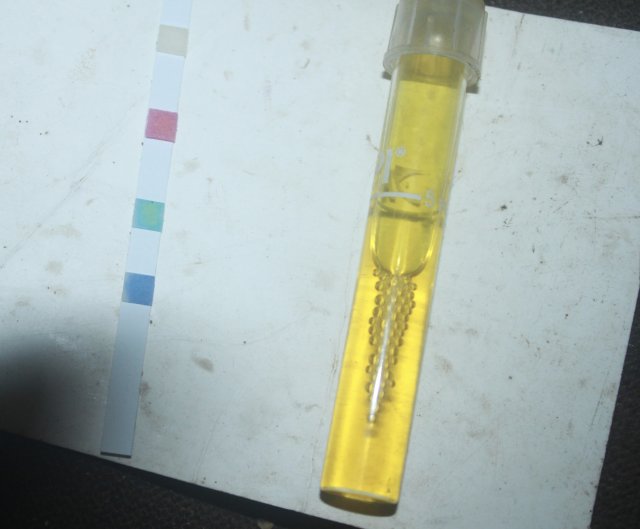
I don't like API's freshwater nitrate test. I have extreme difficulty reading the sample against a color strip. For me, it's a stab in the dark, blind guess at best. I have even compared shade guides and found them to be different. I needed help.

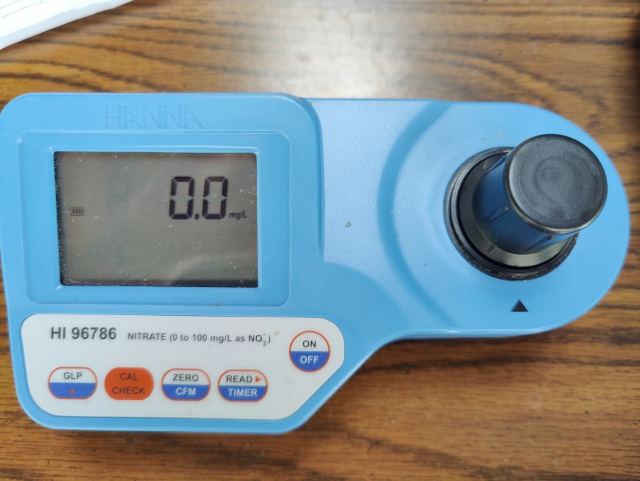
Old nitrate photometer
1648066714996.png

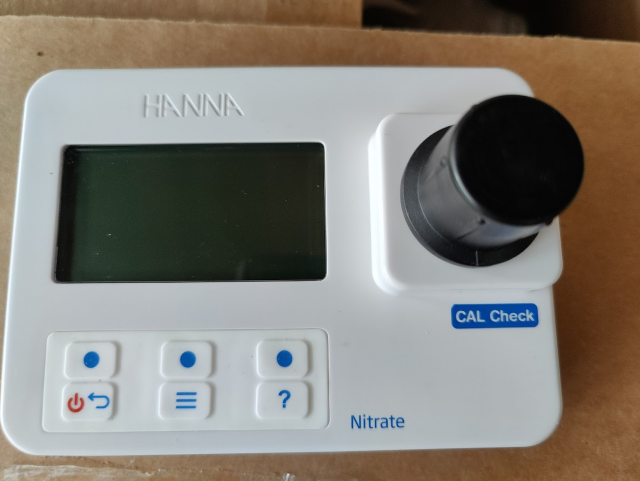
new one I just got
1648066748676.png

the photometers are extremely technique sensitive (but I have experience shaking API's nitrate test tube) and have and accuracy of +/- 5 which is still better than the blind guesses I did before Hanna Instruments came into my life. I have to do a water change now.
 
Hobbyists who use the API liquid kit, which is the vast majority I expect, are all in the same boat. The 10 and 20ppm are the same shade of orange, and the 40 and 80ppm are the same shade of red! It used to infuriate me and at one time I looked at other possible methods of nitrate detection.

But in the end I just settled for a basic orange is acceptable and red isn't mentality, and then the test becomes very easy.

How much are those Hanna kits if you don't mind me asking?


One measures 0 - 100ppm and the other 0 - 30ppm
 
If you really want accuracy, photometers are the way to go.
When I worked in a lab, it was the only trusted method (especially with the varying degrees of color blindness commonly found)
These days I just compare the API ; liquid test with a test strip to get a ball park number.
9DDF8C65-A6BE-4F6A-8435-614B0AD34808_1_201_a.jpeg
Hanna is making some very accurate photometers these days for about $50, very reasonable compared to the ones is was using way back when, running into the hundred$ on up.
 
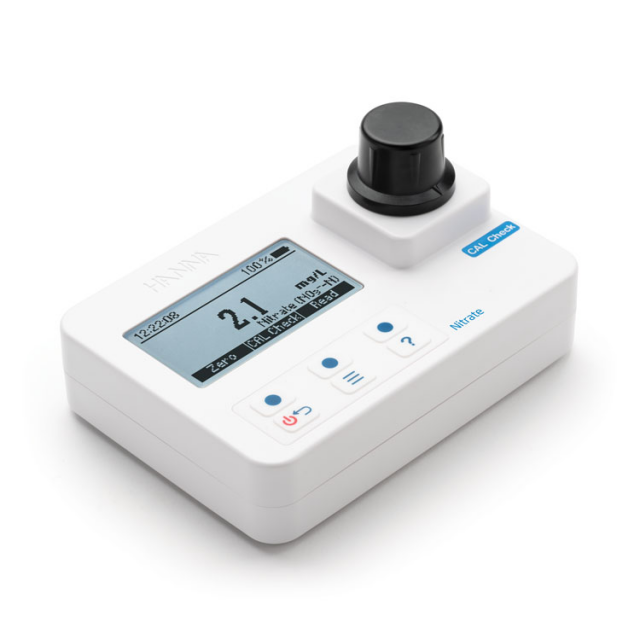
Follow up. I had an issue with my new photometer. It is still an on-going issue.
1651256380290.png

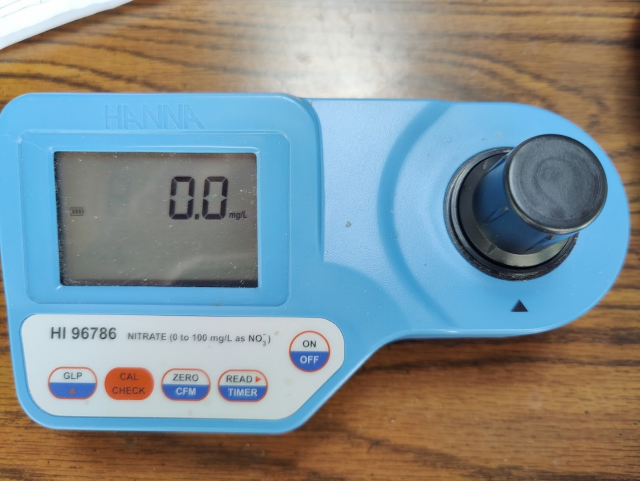
My readings were very low or 0ppm. I made repeated calls to technical support who always turned it back on me - and faulting my technique. How could I get a reading of 19 ppm on the old photometer, and 0ppm on the new one? To vindicate myself, I ordered a second one of these
1651256621365.png

On April 4 I got the second HI9678. I tested using all three photometers and got 10.1 and 10.5 readings (accuracy is +/- 5ppm) and got a 0ppm on the defective HI97728 (accuracy is supposedly .5ppm +/- 10% of the reading). Of course, I called tech support again, and they sent me a label to send it back so they could check it out.

April 15 - received word that they checked the calibration and found no issues with the calibration. Of course, I whined about it. They offered to refund my money, but I want the unit if it works like it is supposed to.

April 22 - tech said he could ask a chemist to make a nitrate standard to check the photometer (why didn't they do it when I sent it back?)

Today - I received word that my photometer and another photometer they checked with the made up nitrate standard "both read the standard lower than expected" DUH...that's what I've been communicating to them for over a month.

A ticket has been generated to report the problem to HANNA's factory in Romania.

If the HI97728 worked properly, it would be a great tool for fish keepers wanting to keep nitrates low. It measures nitrate levels between 1 - 30 ppm with an accuracy of .5ppm +/- 10% of the reading, compared with the HI96786 which measures nitrates from 0 - 100 ppm with a +/- 5ppm accuracy. So a 0ppm reading on both photometers could actually be .5ppm on one photometer, but up to 5ppm on the other one.

They really need to take the units off the market until they find the problem and correct it. After all, what good is a defective photometer that gives a reading of .3ppm when the actual nitrate level is somewhere between 19 - 24 ppm?

 
  • Like
Reactions: deeda
Those two units measure nitrate differently. The top one which reads 100mg/l or less reads total ions. The one thet reads 0 to 30 measures only nitrogen.

The formula for Nitrate is NO3 which is basically a Nitrogen and 3 oxygens.

There are two major ways to describe the concentrations of ammonia, nitrite, and nitrate in water. The "nitrogen" weight of these molecules describes the weight of only the nitrogen atoms within them. On the other hand, the "ion" weight of these molecules describes the weight of the entire molecule.

For example, the term nitrate-nitrogen (NO3-N) refers to the weight of only the nitrogen atom within the nitrate molecule; as opposed to nitrate-ion (NO3), which describes the weight of the entire nitrate molecule. Note that a given nitrate-nitrogen value will always be lower than the associated nitrate-ion value. Conversion between the two forms is as simple as applying a constant (see graph below).

Scientific literature often uses the "nitrogen" form rather than the "ion" form to describe the concentration for these molecules. The "nitrogen" form is more appropriate when discussing nitrification/denitrification cycles, as it simplifies various equations and flow-charts. For example, it is easy to see that 100 ppm of nitrite-nitrogen (NO2-N) can go on to form 100 ppm of nitrate-nitrogen (NO3-N). Using the "ion" form here would be more cumbersome; 100 ppm of nitrite (NO2) goes on to form approximately 135 ppm of nitrate (NO3).


NH3 = NH3-N * 1.21589
NH4 = NH4-N * 1.28786
NO2 = NO2-N * 3.28443
NO3 = NO3-N * 4.42664
from https://www.hamzasreef.com/Contents/Calculators/NitrogenIonConversion.php

Now lets consider your two results and their accuracy factor. The readings were 10.1 and 10.5. If we just look at the idea that they were too high by 5 ppm that means they were really 5.1 and 5.5 ppm on the total ion scale. Divide that by the conversion factor of 4.42664 and that tanslates to 1.15 or 1.24. If the second unit was accurate with .5 ppm +/- 10% of the reading or .11 or .12, I can see it reading close to zero.
 
Those two units measure nitrate differently. The top one which reads 100mg/l or less reads total ions. The one thet reads 0 to 30 measures only nitrogen.

The formula for Nitrate is NO3 which is basically a Nitrogen and 3 oxygens.


from https://www.hamzasreef.com/Contents/Calculators/NitrogenIonConversion.php

Now lets consider your two results and their accuracy factor. The readings were 10.1 and 10.5. If we just look at the idea that they were too high by 5 ppm that means they were really 5.1 and 5.5 ppm on the total ion scale. Divide that by the conversion factor of 4.42664 and that tanslates to 1.15 or 1.24. If the second unit was accurate with .5 ppm +/- 10% of the reading or .11 or .12, I can see it reading close to zero.
Not quite. The photometer can be switched to read nitrate mg/L. You can be sure that was the first thing I checked. The company has admitted that my photometer and another one they have that is the same model are both giving low readings. So on April 4th the 10.5 could have been as low as 5.5 while the zero reading I got could have possibly been a .5

On another day I had an 18.4 reading on one photometer and a 3.8 on the defective one. Using the accuracy factor, the readings could have actually been 15.4 or 4.68. it was very obvious that one photometer had to be off.

I have kept daily logs of initial nitrate readings and how many water changes I have done. Sometimes I have taken readings after water changes.

At least the company now acknowledges that there is a problem with the unit. I hope they can fix the issue

BTW, thank you for your explanation of what NO3 stands for, although it wasn't necessary. While I majored in Biology, I probably had the max amount of chemistry classes for some one not majoring in chemistry -general chem, organic chem, inorganic chem, quantative analysis, etc., etc.
 
After nearly five months, I finally got the new HI97728 photometer back. Actually, I think they issued me a new one. They updated the software to correct the problem. While it can measure nitrogen ions, it also can measure NO3 from 0 - 30 ppm and has an accuracy of +/- .5 + 10% of the reading, as opposed to the HI96786 which measures 0 - 100 ppm with an accuracy of +/- 5

I have been gone and the tank went 6 days without water changes.

Initial readings were new photometer 18.7 (21.07 max)
old photometer 17.5 (22.5 max)

After multiple water changes:
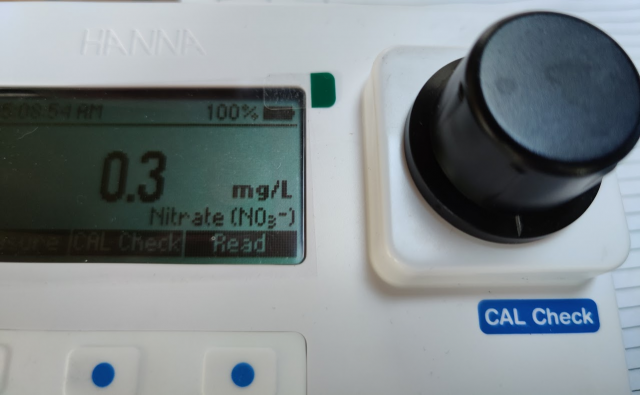
new photometer .3 (accuracy 0 -.8)
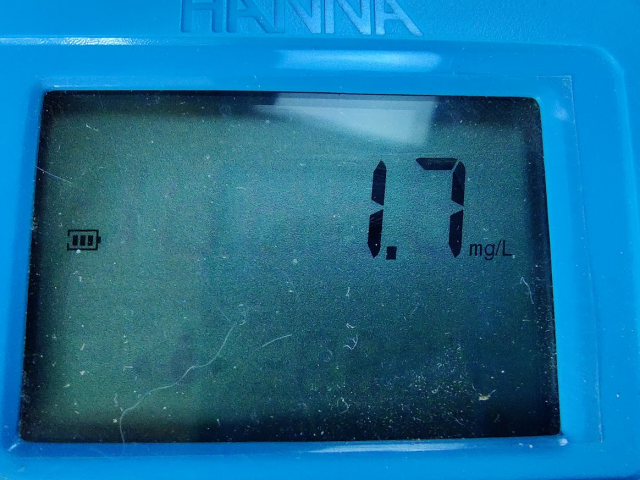
old photometer 1.7 (accuracy 0 -6.7), so if the new photometer is working properly, the actual value is .8 or less and the reading on the old photometer falls in that range.

1660878809720.png


1660878749518.png


Will test with both photometers for a few days until the new one wins my trust. Since the goal is to keep nitrates 5 or less, the new photometer will make it easier to know the nitrate level in the tank.
 
  • Wow
Reactions: tlindsey
MonsterFishKeepers.com