

Severum sexing question

  • We are currently upgrading MFK. thanks! -neo

Vikingfish

Feeder Fish
MFK Member
Nov 18, 2017
14
10
8
44
I want to know if my green severum is a male or just a female who acts like a male. Whats throwing me off is there is no worming on the face but in every other way it acts like other male sevs. I know the smaller one on the left is a female because shes laod eggs with a different male before. This new one tho is always chasing her around. It does that spastic shaking thing and it keeps biting drift wood and flinging it around the tank like a maniac also the fins are soooo long but it doesnt have worming on the face. Can the worming come at a later age? It has a 4 to 5 inch body at the moment.

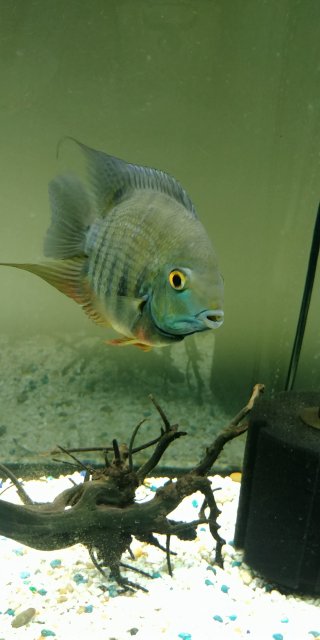
20200122_184415.jpg

20200122_184433.jpg

20200122_184521.jpg

20200122_185757.jpg

20200122_185800.jpg
 
Agree, Female due to missing lines in face. Males that I have raised from 1" started to show worming in face around 3" TL.
 
I would agree with the others.
The activitie you are seeing is probably all about establishing a space to spawn.
If you look closely you can just make out the ovipositor.
She’s probably ready to go in a few days I would say.
51C4C6A7-BD0A-4232-A0F7-FCA3F17BC343.jpeg
 
Those colors, coupled with the behavior, means spawning is coming. Do you have males in the tank? If not she'll likely spawn with that smaller female, which is common.

Let this also dispel the myth that males are the only ones with long dorsal and anal fins. :D I keep trying to tell people that's not an accurate way to sex most cichlids, but it's one of those old wives' tales that lingers.
 
  • Like
Reactions: BIG-G
Let this also dispel the myth that males are the only ones with long dorsal and anal fins. :D I keep trying to tell people that's not an accurate way to sex most cichlids, but it's one of those old wives' tales that lingers.
It's not a myth for many cichlid species, many African cichlids for example, such as Malawi haps and peacocks and quite a few Lake Tanganyika species-- spectacularly so for some of them. For some acara types I've found it a reasonable predictor, sometimes even as larger juvies. But, yes, there's also a good number of cichlids for which it's ambiguous, unreliable, or meaningless.
 
It's not a myth for many cichlid species, many African cichlids for example, such as Malawi haps and peacocks and quite a few Lake Tanganyika species-- spectacularly so for some of them. For some acara types I've found it a reasonable predictor, sometimes even as larger juvies. But, yes, there's also a good number of cichlids for which it's ambiguous, unreliable, or meaningless.

I’m speaking mostly of SA cichlids since we’re in that sub-forum. I don’t know much about Africans beyond a few west African species I’ve kept.

But in addition to Heros, there are Hoplarchus, Hypselecara, Geos, discus, Uaru, etc. Over the years I’ve seen people say things like “if the dorsal reaches past the tail they’re males” and whatnot. While males may have more dramatic finnage in some instances, it’s really not accurate that female Heroini/Cichlasomines always have short, rounded fins. It still persists in literature and on some of the big general aquaria sites.

Maybe someday I’ll dip into the African cichlid scene but I’m still working my way through SA. ;)
 
  • Like
Reactions: neutrino
I’m speaking mostly of SA cichlids since we’re in that sub-forum. I don’t know much about Africans beyond a few west African species I’ve kept
I thought that may have been your intention, but for the sake of clarity to readers I wanted to keep the record straight. :)

Not counting what I kept as a kid, I'd always done primarily SAs and discus, then I took about a 15 yr detour into Africans, though I always kept at least a few new worlds, such as A. rivulatus and Heros. Then back primarily to SAs about a dozen years ago, except for holding on to the C. gibberosa kapampa.

Now I feel like so many geos, so little time-- not to mention local Heros populations and a few other types that interest me now... :)
 
MonsterFishKeepers.com
