


Personally I’m not sure, but hope to get some valuable input from others on MFK... To be certain I’m really not the bio-engineer type, nor am I trying to come across as such, just sharing what I’ve learned from others more knowledgeable and as it applies to my own tank/situation.
So here are my current tank conditions upon making & installing these (hopeful) denitrification aids:
-- 300L (~80g), mostly bare bottom, w/ internal corner filter (media= coarse & fine filter pads + Eheim Bio-Mech + Eheim Substrat Pro) – been set up (with established media) ~4 mo.
-- 1 X 8” MP Kamfa Flowerhorn fed twice a day, he wolfs down every last pellet, prawn or krill, no leftovers in tank, no overfeeding.
-- ~45% Water change every 5-6 days, it’s generally crystal clear with very little detritus (just a bit of algae flakes that come off air tubes etc.) I use a battery powered gravel cleaner to suck out any logs he lays – his tank is right next to my desk/workstation so I don’t let any turds sit around or dissolve too much.
-- Ammonia & Nitrites: consistent 0 since setting up the tank with lots of established filter bio media, rocks & gravel, etc.
-- Nitrates: pretty consistent 25-30 mg/l -- (approx. 10 mg/l of which are coming from the filtered/UV sterilized well water I bring in for water changes).
I know that especially in the absence of nitrite, 25-30 mg/l nitrates isn’t really super bad for my fish – and that many others with decorated freshwater tanks and/or more fish load likely face a harder challenge when it comes to nitrates.
Nonetheless, I would like to at least make a good effort to get as close to 10 mg/l as I can -- with this little DIY denitrator system considered to be a hopeful aid in this process, not a complete solution. Maybe it (or a similar rendition) will help you, maybe it won’t J.
Let me also say that certainly none of the principles of my construct are new or innovative – many others have utilized them in one way or another for a long time. I also know that some use coil-type denitrators or anoxic filters to tackle nitrates, but I don’t want to go those routes at this time (though I may try an algae scrubber next if this isn't effective).
My situation is that I had 3 watertight glass jars filled with just blue & white gravel, which functioned mainly as a shelter wall for my fish, where he’s happy to sleep most nights. The use of blue & white gravel was to give him at least some color stimulation in a mostly bare bottom tank.
But after watching many filtration related videos on YouTube I got to thinking, why not try to put his housing to work – as a (possible) denitrator?
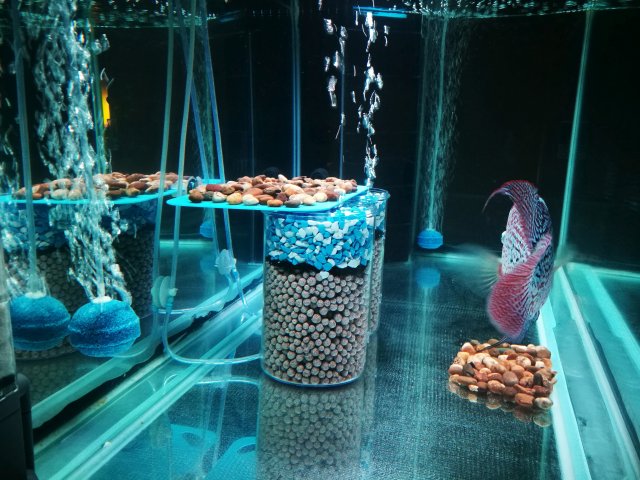
So here’s what I did if you care to read (sorry no pix of construction but it's pretty easy to see from the video or pic):
-- Bought 2 X 2L quality plastic canisters, about 8 in. high.
-- Drilled 1/4 in. holes at the bottom/back for air hose entry.
-- Drilled about 12 X 1/4 in. holes on sides and bottom of each canister, to facilitate hopefully some water exchange, but not create a high flow situation (which is kind of unavoidable in my main filter).
-- Put an air tube through the hole at the back of the canister, going up the center of the canister and ending in a small air stone just below the top of the canister. This is meant to draw water inside of the canister for some – but hopefully not too much – water flow/exchange. With the air stone being at the top of the canister it hopefully shouldn’t affect the anaerobic conditions at the very bottom of each unit.
-- Each air tube has an adjustable valve check on it near the air pump so I can minimize the bubbles (and thus water flow through the canisters).
-- Next I filled each canister with 1.5L (about 6”) – of Eheim Subtrat Pro (I know there are better bio media for anaerobic bacteria, like Matrix & Biohome but I can’t easily get those where I live), and also .5L (about 2”) of gravel on top mainly for decorative purposes and bit of color stimulation for my fish (if some aerobic bacteria grow near the top then all the better). The gravel barely covers the air stone. In any case I’m pretty sure that I have a small but good anoxic zone in approx. the bottom half of each canister.
-- Finally, and I’m not sure but I think this is pretty crucial step, for 4 days (plus most every water change since), I dosed each canister with a PSB (photosynthetic bacterial) solution – specifically Rhodospirillaceae, a purple, non-sulphur bacteria – which is a particularly amazing little microbe, and in fact one of the first that originally helped life on earth to evolve.
This bacteria has been used for a while especially by waste water treatment facilities, in aquaculture farming, and also by some aquarium hobbyists, though to what degree I really don’t know (just like I don’t know if Seachem Stability or similar products contain Rhodospirillaceae).
But the interesting aspects of this bacteria, according to info I learned from a Malaysian Microbiologist on his website Little Microbes: (https://littlemicrobes.wordpress.com/bmm-usage/phototropic-bacteria-purple-non-sulfur-bacteria/) are that…
“These bacteria possess a diversified metabolism, which means that in order to survive, they can adapt themselves to become: phototropic, photoheterotrophic, chemotropic and chemoheterotrophic. Also, these bacteria can grow with or without oxygen, grow in the sunlight, [consume] inorganic compounds or organic compounds for energy; [they] can acquire carbon sources from either carbon dioxide fixation or complicated organic compounds. Such amazing, superior microbes!!”
So basically I’m hoping these super microbes will take up home in about half of each canister, then chomp away on my nitrates.
I think one of the main factors in whether or not these DIY denitrators are effective is the amount of water flow created by the air stones….do I have too much or too little flow to properly exchange the water without disturbing the bacteria? Should I run the air/water flow 24 hr. or just a few hours each day? These are key questions I really don’t know the answer too…
Another question is even if the canisters do create a reasonably good anaerobic bacterial community, is it enough surface area/bacteria to really make a noticeable dent in the tank’s nitrates?
So it’ll of course take some time for these bacteria to (hopefully) really get going and do their job, I’ll update later and in the meantime welcome any opinions, critiques or queries. If you’re still with me thanks for reading this long post J and hope that in some way or another it (or possibly the input from others) help you.
So here are my current tank conditions upon making & installing these (hopeful) denitrification aids:
-- 300L (~80g), mostly bare bottom, w/ internal corner filter (media= coarse & fine filter pads + Eheim Bio-Mech + Eheim Substrat Pro) – been set up (with established media) ~4 mo.
-- 1 X 8” MP Kamfa Flowerhorn fed twice a day, he wolfs down every last pellet, prawn or krill, no leftovers in tank, no overfeeding.
-- ~45% Water change every 5-6 days, it’s generally crystal clear with very little detritus (just a bit of algae flakes that come off air tubes etc.) I use a battery powered gravel cleaner to suck out any logs he lays – his tank is right next to my desk/workstation so I don’t let any turds sit around or dissolve too much.
-- Ammonia & Nitrites: consistent 0 since setting up the tank with lots of established filter bio media, rocks & gravel, etc.
-- Nitrates: pretty consistent 25-30 mg/l -- (approx. 10 mg/l of which are coming from the filtered/UV sterilized well water I bring in for water changes).
I know that especially in the absence of nitrite, 25-30 mg/l nitrates isn’t really super bad for my fish – and that many others with decorated freshwater tanks and/or more fish load likely face a harder challenge when it comes to nitrates.
Nonetheless, I would like to at least make a good effort to get as close to 10 mg/l as I can -- with this little DIY denitrator system considered to be a hopeful aid in this process, not a complete solution. Maybe it (or a similar rendition) will help you, maybe it won’t J.
Let me also say that certainly none of the principles of my construct are new or innovative – many others have utilized them in one way or another for a long time. I also know that some use coil-type denitrators or anoxic filters to tackle nitrates, but I don’t want to go those routes at this time (though I may try an algae scrubber next if this isn't effective).
My situation is that I had 3 watertight glass jars filled with just blue & white gravel, which functioned mainly as a shelter wall for my fish, where he’s happy to sleep most nights. The use of blue & white gravel was to give him at least some color stimulation in a mostly bare bottom tank.
But after watching many filtration related videos on YouTube I got to thinking, why not try to put his housing to work – as a (possible) denitrator?
So here’s what I did if you care to read (sorry no pix of construction but it's pretty easy to see from the video or pic):
-- Bought 2 X 2L quality plastic canisters, about 8 in. high.
-- Drilled 1/4 in. holes at the bottom/back for air hose entry.
-- Drilled about 12 X 1/4 in. holes on sides and bottom of each canister, to facilitate hopefully some water exchange, but not create a high flow situation (which is kind of unavoidable in my main filter).
-- Put an air tube through the hole at the back of the canister, going up the center of the canister and ending in a small air stone just below the top of the canister. This is meant to draw water inside of the canister for some – but hopefully not too much – water flow/exchange. With the air stone being at the top of the canister it hopefully shouldn’t affect the anaerobic conditions at the very bottom of each unit.
-- Each air tube has an adjustable valve check on it near the air pump so I can minimize the bubbles (and thus water flow through the canisters).
-- Next I filled each canister with 1.5L (about 6”) – of Eheim Subtrat Pro (I know there are better bio media for anaerobic bacteria, like Matrix & Biohome but I can’t easily get those where I live), and also .5L (about 2”) of gravel on top mainly for decorative purposes and bit of color stimulation for my fish (if some aerobic bacteria grow near the top then all the better). The gravel barely covers the air stone. In any case I’m pretty sure that I have a small but good anoxic zone in approx. the bottom half of each canister.
-- Finally, and I’m not sure but I think this is pretty crucial step, for 4 days (plus most every water change since), I dosed each canister with a PSB (photosynthetic bacterial) solution – specifically Rhodospirillaceae, a purple, non-sulphur bacteria – which is a particularly amazing little microbe, and in fact one of the first that originally helped life on earth to evolve.
This bacteria has been used for a while especially by waste water treatment facilities, in aquaculture farming, and also by some aquarium hobbyists, though to what degree I really don’t know (just like I don’t know if Seachem Stability or similar products contain Rhodospirillaceae).
But the interesting aspects of this bacteria, according to info I learned from a Malaysian Microbiologist on his website Little Microbes: (https://littlemicrobes.wordpress.com/bmm-usage/phototropic-bacteria-purple-non-sulfur-bacteria/) are that…
“These bacteria possess a diversified metabolism, which means that in order to survive, they can adapt themselves to become: phototropic, photoheterotrophic, chemotropic and chemoheterotrophic. Also, these bacteria can grow with or without oxygen, grow in the sunlight, [consume] inorganic compounds or organic compounds for energy; [they] can acquire carbon sources from either carbon dioxide fixation or complicated organic compounds. Such amazing, superior microbes!!”
So basically I’m hoping these super microbes will take up home in about half of each canister, then chomp away on my nitrates.
I think one of the main factors in whether or not these DIY denitrators are effective is the amount of water flow created by the air stones….do I have too much or too little flow to properly exchange the water without disturbing the bacteria? Should I run the air/water flow 24 hr. or just a few hours each day? These are key questions I really don’t know the answer too…
Another question is even if the canisters do create a reasonably good anaerobic bacterial community, is it enough surface area/bacteria to really make a noticeable dent in the tank’s nitrates?
So it’ll of course take some time for these bacteria to (hopefully) really get going and do their job, I’ll update later and in the meantime welcome any opinions, critiques or queries. If you’re still with me thanks for reading this long post J and hope that in some way or another it (or possibly the input from others) help you.


