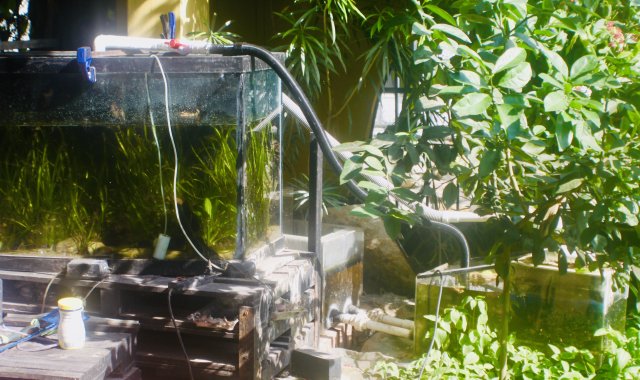
I have two sumps (boxes) on one tank, they are linked by two 1" lines and although they both hold filter material, only one box holds the pump (the one in the fore ground. The tank is to the left)
View attachment 1383904
There are two over flows on the tank, with one feeding one sump box, one the other, the two 1"PVC connections between end up sharing the water. You will notice I use Union connections to make maintenance ,and taking them apart easier.
View attachment 1383905
Below is one of the 2 drilled overflows on the tank back, that send water to the sumps
View attachment 1383906
You may have noticed, the one sump box (the one with the pump) is not directly below the tank, it is a few feet off set to the side. There is no rule that says a sump needs to be directly below the tank itself, as long as gravity is taken into account.
It is because this is the one part of the sump (the part with pump), that will call for most maintenance, things like pump cleaning, sponge rinsing, occasionally the tightening of hoses and connections,etc etc.
I hate to be being cramped and restricted when doing maintenance, and this is one of the reasons I tossed the cabinet that came with the tank, trying to maneuver in the confined space of a cabinet to me is way to restrictive when doing required regular sump maintenance.
As you can see below, the sump is open to where I can easily reach in to get at anything.
View attachment 1383907
I also like to put sumps somewhere, where in case of a mishap, overflowing water is not a problem.
In the states my sumps were almost always on the basement floor, near the floor drain.
Where I live now, they are in the garden.
A sump doesn't need to be in the same room with the tank, it can be in a storage room, behind a wall, even on a lower floor (like a basement)