Test results

  • We are currently upgrading MFK. thanks! -neo

sbrady5pts

Plecostomus
MFK Member
Jun 7, 2008
416
63
61
long island
hi guys, I just tested the water in one of my tanks and I wanted some feedback on what you think of the ammonia and nitrates. Does the ammonia test ever come back solid yellow? Below are pictures of my tank and the tap water.
The ammonia is pretty high out of the tap, not sure how concerning that is.

F14C76C1-5DD0-4397-B329-0D1865A5FEF2.jpeg

FA24F1A0-21E6-43F5-ACA2-4B2CD4717184.jpeg
 
hi guys, I just tested the water in one of my tanks and I wanted some feedback on what you think of the ammonia and nitrates. Does the ammonia test ever come back solid yellow? Below are pictures of my tank and the tap water.
The ammonia is pretty high out of the tap, not sure how concerning that is.

View attachment 1291090

View attachment 1291091


Drstrangelove Drstrangelove
S skjl47
duanes duanes
 
Are the tubes on the left tap water, and tubes on the right tank water in both pics?
How long have you been using the kit? How old is it?
Do you rinse in between tests with Di water to assure there is no carry over residual from previous tests?
 
Left(light green and reddish) are tank water. The kit is probably 3 years old. I don’t even know what di water is. I rinse with regular water in between use
 
Any ammonia at all in an established aquarium is concerning. With enough beneficial bacteria, it should come back at 0. there is some coming from your tap, which is not great, but at .25 coming from your tank it should be converted to 0 within 24 hours. Your nitrate also coming back at 0 in your tank tells me that the cycle is not working as it should. Normally the ammonia would be converted to nitrite and finally to nitrate. How long has the tank been established? How are the fish behaving?
 
DI water is water, with all chemicals and contaminants removed, it can usually bought at the grocery store.
When I worked as a chemist I rinsed all sample tubes 3 times in between tests with DI, to remove any residual. Without those rinses, any tests performed were considered invalid.
Because you are dealing in Parts per Million, and using only tiny amounts of sample, any residual carry over can effect numbers big time.
If your water provider uses chloramine as a disinfectant, ammonia with show up in low levels as "noise" in a test. If you rinse with that same tap water, it may skew your results.
At 3 years have your regents expired, if so toss them and get fresh.
In the lab we always run a DI sample, a known standard (2ppm) and the real sample (in the photo below my tank water) DI is yellow, tank is little darker yellow, the green is a known 2ppm standard
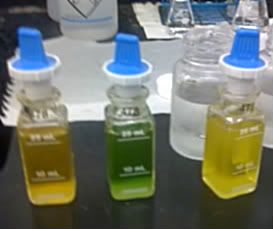
 
My nitrates are definitely there. Somewhere between 10-40?? There are no nitrates in the tap.

The ammonia in the tap look like it’s close to 2?

So the what would you read the ammonia in my tank ( the light green)?

Why would I have nitrates and ammonia? Tank is really well filtered with minimal stock right now.

Is it bad that my tap water is so high in ammonia?
 
Normal bottled water is not DI, your average bottled water is basically somebodies tap water from an industrial tap down the street.
If the bottled water you buy, is bottled in your city, it is probably the same as your tap water.The only difference is you pay 10 times more in the bottle.
DI water is run thru nearly impermeable membranes that remove minerals and impurities, or boiled, and the steam reconstituted, so nothing is left except pure H2O.
Another name for DI is demineralized water.
By the way DI water is not necessarily good for you to drink.
 
  • Like
Reactions: tlindsey
MonsterFishKeepers.com


