Tonster;2485586; said:
Hi All. Tonster here and I'm having a problem well it's not a physical problem. It's a mistunderstood problem, becasue what is a sump tank and how would it benifit us. Also what are over flow boxes and thier use. Sorry for these stupid questions, but I'm just curious. Please and Thank You.
Pics would be good too..............Thanks, Again
P.S. These questions were asked because throughout the forums it talks about these.

There are basically three kinds of filtration--mechanical, biological and chemical. Mechanical filtration removes solid waste from the tank water. Biological filtration is important in the nitrogen cycle where ammonia waste is converted to nitrite and then to nitrates. In biological filtration, there is enough beneficial bacteria in the filtration system to convert all the ammonia and resulting nitrites into nitrates. When a tank is cycled, there is no measurable ammonia or nitrite in the tank, because the beneficial bacteria is consuming it all. HOB (hang on the back) filters are great mechanical filters. They are great for smaller tanks. Canister filters can provide both mechanical and biological filtration. With really large tanks, more biological filtration is needed than can be provided in HOB and canister filters. Wet/dry filters (a type of sump) are great biological filters where you can have enough biological media to house plenty of beneficial bacteria. While there are different types of sumps such as planted sumps, the most common type of sump would be a wet/dry trickle filter. These are fairly easy to make, and can be made with a mechanical component in addition to the biological filtration. A wet/dry filter is a great way to go for biological filtration on tanks of several hundred gallons or more.
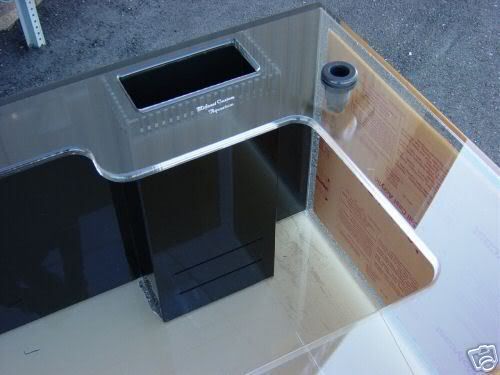
Overflow boxes are usually found in larger tanks. Here is a picture of a tank just like my tank.
The water enters the overflow box through the slots on the top of the overflow box. At the bottom of the overflow box is a drain hole leading to the wet/dry filter. There is a pump in the wet/dry filter that pumps the water back into the tank. There are actually two holes at the bottom of the overflow box. The first drains to the wet/dry filter. A return pipe comes up through the 2nd hole and comes up through the overflow box, out the top of the tank, then bends and enters the black hole on the top of the tank on the far right. This is the return line from the filter.
We have a lot of extra lines and filters on our tank, but in this picture, in the very front on the left, you can see the return pipe coming out of the overflow box and then reentering the tank. (it is actually the return line from our mechanical filtration)
The beauty of an overflow box, is that the water level has to be high for the water to enter the overflow box. There is no way that all the water can drain out of the tank through the overflow box. The other great thing about overflow boxes is that all the plumbing can be hidden in the overflow box and under the canopy. Here is a picture from the gallery of my tank manufacturer, Midwest Custom Aquariums.
http://www.midwestcustomaquariums.com/gallery.html
Unless you have a tank of at least a couple hundred gallons, you really don't have to deal with wet/drys and overflow boxes, as you can easily get all the biological filtration you need with canister filters in combination with HOB filters.