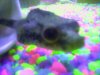
Unidentified Puffer......

  • We are currently upgrading MFK. thanks! -neo

puffer_girl

Feeder Fish
MFK Member
Dec 31, 2005
528
1
0
47
United States
I am new to this forum as of today. Have recently purchased a puffer that I was led to believe was a red-eye. I now know this not to be true. He has grown rapidly and I have been unable to find consistent info online regarding him.

Can anyone help me out?

I have attacted three pictures of the little guy........

Jimjab the Puffer.jpg

Jimjab playing hide and seek.jpg

Puffer swimming.jpg
 
I may be wrong but it looks like a skinny Tetraodon suvattii to me.
Tesuv_u1.jpg

http://filaman.ifm-geomar.de/Summary/SpeciesSummary.php?id=50301
 
Came across humpback puffer, dragon puffer, king kong puffer and palembangenesis puffer........ All of which cave different sizes (one of which was really large........) Thought about the arrowhead but I heard that they are extremely aggressive. Mine is rather mellow and laid back. Would really like to know what I am dealing with, especially size wise. Also heard the palembangenesis are rare.......
 
Welcome to MFK!!!

These puffers aren't rare but, seasonally imported.


Tetraodon palembangensis
[T. palembangensis]
**************


Common Names: Palembang Puffer Also Known As: Humpback Puffer, Dragon Puffer

Synonyms: Tetrodon palembangensis, Tetraodon pinguis Family: Tetraodontidae

Origin: Asia; Laos, Thailand, Malaysia, and Indonesia Main Ecosystem: River

Salinity: Freshwater Temperament: Aggressive

PH: 6.8-7.6 Temperature: 76-84F (24-28C)

Maximum Size: 8 inches (20cm) Minimum Tank: 30 Gallons (US)

Activity: Lurker/predator Lifespan: 10

Gender: No sexual dimorphism Breeding: Unknown

Diet: They should be fed krill, shell on shrimp, crab legs, crayfish, live or frozen mussels, live or frozen clams, live crabs, live ghost shrimp. Feeder fish should not be fed, but if they are fed, they should first be quarantined to guarantee the health of the fish.

Care: These fish do well with either a gravel or sand substrate. As with all other puffers, this species should only be introduced into a fully cycled tank as they are very sensitive to ammonia and nitrites. They should be kept alone or with conspecifics. If more than one is going to be kept, the tank should be heavily planted and/or decorated to break line of sight. Because they are very messy eaters, 50% water changes should be done once a week as well as substantial filtration to prevent biological overload.

Notes: It it vital to train this fish to eat dead meaty foods in the place of feeders. This can be accomplished by dangling a piece of food, a shrimp for example, from a string in front of the fish and bouncing it lightly to simulate movement. Once this is accomplished, the fish will readily accept most frozen or dead foods. They will eat very large amounts of food at a time and because of this they should only be fed every other day while small, reduced to every 2-3 days around 2 inches, reduce to every 3-4 days around 4 inches, and then once a week around 6 inches. They have been kept successfully with T. suvatii in large, heavily decorated aquariums.

 
Thanks alot. Hard to tell with him puffed. Are you CERTAIN that is the kind of puffer that he is? Seem to be getting the run around alot. Apparently there are alot of inconsistencies when it comes to puffers. Happen to know of any good sites to check out?
 
I would 99.9% agree with Palembang's Puffer.. which also sometimes hosts the common name Dragon Puffer or Humpback Puffer..

Check out Oddball's Avatar.. he is definately a puffer enthusiest.. As am I. I was going to say Palembang's as well, until Oddball stepped in. Check out **************.com for some great info.

The problem with the Palembangs and the many other puffers that are confused with it, is that people have very little resource information regarding puffers. The little resources that are published, are horrible in-accurate. Any schmoe can write a book, and it dosn't have to be precise..

There is a large family of 'target' puffers and many very similiar puffers to this one here, but many of them have distinct characteristics that can only be identified by a true puffer fanatic. Alot of people will claim they know what they are talking about, but it is just ignorant statements usually based off bad information. Most of the other puffers in this family however, are more expensive and less common then the Palembangs, which leads us to believe it would not be one of them..

Do not use Puffer.net as a resource for information, as there is also alot of bad information published on this website as well as many others. The best source of published info for puffers to this point is the Aqualog book on FW/BW puffers, or the 'general agreement' of the puffer forum, which has a number of puffer fanatics who moderate and frequent the site.
 
Thanks. You guys are awsome...... Really like the little guy and have been considering getting another puffer. Have a 45 gal empty right now. Any suggestions?
 
You can put the palembang puffer in a multiple specimen setup. I had a colony of over a dozen in a 450gal. There were some scraps among them until I furnished 25% more caves than the number of puffers. It seems thay like to 'cave-hop'. After the additional caves were installed the only aggression I witnessed led only to stand-offs, with slight inflation of the parties concerned, until one backed off. The only biting was during courtship when the males latched onto whatever female was ready to lay eggs. I was unsuccessful in raising the fry. I may try these puffers again and see if I can find the correct water chemistry and foods to keep the fry healthy. I fed mine on live minnows, market raw shell-on shrimp, clams, FW mussels, ramshorn snails, and live crayfish.
 
I should point out that the caves should not have their openings visible from another cave. The puffs treat the visible area as part of their own territory. I used rocks and driftwood to isolate each cave from another. Also, I started out with 17 puffers and had to weed 5 out for being too aggressive. So, be ready to do some swapping with the lfs just in case.

There's no way to sex these puffers other than after they're breeding size. Then, they can be sexed by spawning damage. Females will have ring scarring behind the pectoral fins. Males will have broken teeth from the females thrashing when they're latched on.
 
Bet that was a great tank! Would love to see pics if you have any. For some reason I have been posting and replying but still can't view others personal galleries or open pics yet..... Have you had a arrowhead puffer? Do they have good personalities?
 
MonsterFishKeepers.com