

water pressure loss

  • We are currently upgrading MFK. thanks! -neo

ranchu dad

Feeder Fish
MFK Member
May 7, 2006
54
0
0
Simcoe, Ontario
I am looking for some information with regard to the water pressure lose for all the elbows and 90 degree bends in pipe. I want to pick out two pumps for a wet/dry and I want to know just how big I will need to go. Can someone help me please.

 
The answer for aquariums is that it does not matter. There isn't an appreciable head loss in the fittings. What matters is the distance from the top of the pump to the top of the aquarium.
 
CHOMPERS;1942607; said:
The answer for aquariums is that it does not matter. There isn't an appreciable head loss in the fittings. What matters is the distance from the top of the pump to the top of the aquarium.

:iagree: As long as it's an entirely pressurized system like a canister or module system there are no worries. The only thing to remember is in a non-pressurized system, like a wet/dry excessive turns and bends can slow down the return to the sump, so be aware of that.
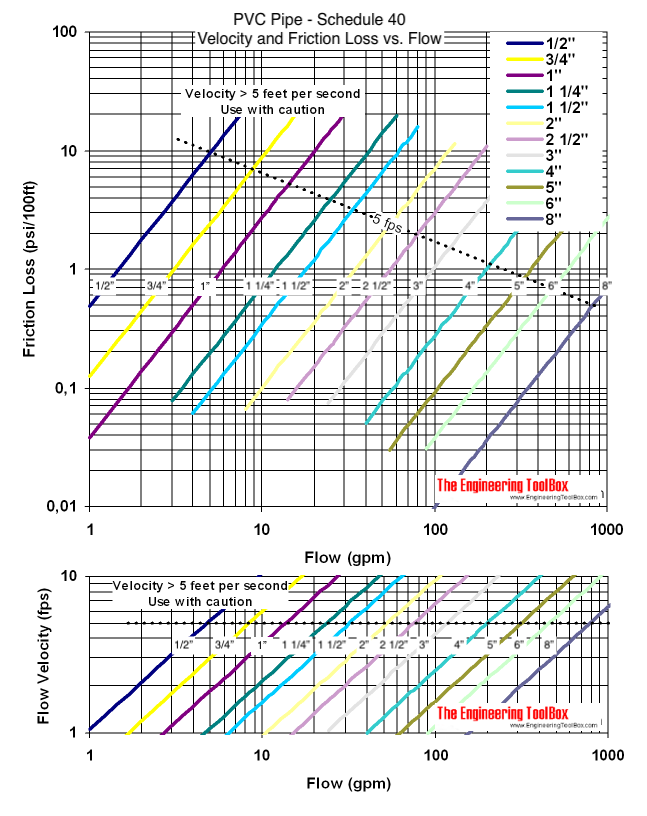
 
Thanks guys I was just wondering with the wet/dry how much effect the 90 degree turns and 45 degree turns would have on the water pressure at the outlet in the tank. I just want to have two pumps turning the tank over around 8 times an hour so I was wondering if there are say 4 90's how much that would slow the water rate that the pumps can produce. I will be running to overflows and I will have 1.5 inch going to the wet/dry and 1.25 going from the wet/dry to the tank.
 
The question still can't be answered the way you want it. Where the flow is significantly less than the 5 fps limit, the friction loss approaches zero. This is why the head loss in the fittings and straight runs can be neglected. It is infinitismally small in comparison to the region at the operational flow limit. You are worrying about nothing.

The pump's output is sized according to its flow rate. That size is your minimum plumbing size. You can use a larger size, just don't use a smaller one.
 
Here is the chart that Dr. Joe had found. Notice the scale on the side and bottom. This is a logarithmic scale. If the chart were expanded in both directions to even increments, it would be one thousand times larger than what you see here. In other words, the friction loss at the left hand side of the chart is roughly one thousand times (give or take) of that at the flow limit.

plastic-pipe-pressure-loss-diagram.png
 
MonsterFishKeepers.com