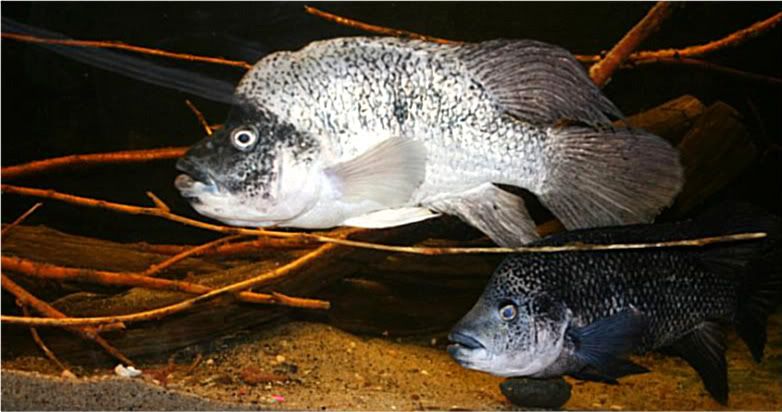
When does nandopsis beani!!

  • We are currently upgrading MFK. thanks! -neo
I don't believe beani are any more susceptible to bloat than any other cichlid, as long as optimum conditions are met.
I've kept beani for about 4 years, they have spawned several times, but none have developed bloat.
My first pair though, died of Flexibactor columnaris during a summer heatwave, so since that time, I have kept them in non heated tanks in summer, and only lightly heated tanks in winter, temps high 60sF to low 70sF.
In the aquarium, I do not house them with other species of cichlids, and I feed lightly with low protein, high spirulina based foods.
When in the pond last summer, other species of cichlids were present, but the beani pair held an area of approximately 500 gal to themselves, water temps fell as low as low 50sF.
I did not feed, while in the pond, they seemed to live on algae, insects, and the fry of other cichlids that had spawned in the pond. None of the other species of adult cichlids were molested, but they always seemed to steer clear of the beani end.
 
I agree with Duane that if you maintain the right, low stress conditions, bloat might not be an issue at any size. For me unfortunately, I seem to keep missing something since I just lost a 3 year old 6" female to bloat like symptoms. I treated with Epsom salts and metronidazole over the course of 8-10 weeks but she stopped eating and just wouldn't resume. In the past they seemed to be most sensitive to these issues when they hit about 4". After that I thought things would get better. And they did, especially keeping them cooler and also having them out in the pond for four months. But you always have to be on guard.
MVI_1051-003.jpg

MVI_1046.jpg

MVI_1051-003.jpg

MVI_1046.jpg
 
For a long time, I treated most "tropical" fish the same.
But the bloat stigma brought to mind when my attitude changed.
Nandopsis haitiensus, another often considered "bloater" was the one to change my ways.
My first group of 12 all died 1 by 1 of bloat, in what were normal tropical conditions, (mid 70sF, regular pellet foods, normal water changes). I tried 8 more, only 1 survived. Why'd so many die?
I needed to do research, and found in Haiti where they are endemic, water temps, often hit 90F rarely dip below mid 80s, the staple food is algae, and they are the only endemic cichlid on the island.
After raising temps, feeding a spirulina based diet, and "not" keeping them in a community, I had a good 10 year run, with my pair of haitiensus spawning many times, and growing to large fabulous specimens.
Though some cichlids can be treated normally, because like domestic dogs they have grown accustomed thru years of breeding and many generations in aquariums, to domesticity, Oscars and angelfish come to mind).
There are those though that, not so far removed from the wild still require special care, and have idiosyncrasies that need attention. Be it temp, diet, specific flow rate, tank mates or not, etc etc, these may be needed to be really successful.
Hope this is not seen as a derail, just a little food for thought.
 
Seems like the approach to both Beani and Haits is very similar. Other than water temps which are drastically different.

I'd guess its safe to say Haits grow much faster than Beani in those temps too huh?


Sent from my iPhone using MonsterAquariaNetwork app
 
For a long time, I treated most "tropical" fish the same.
But the bloat stigma brought to mind when my attitude changed.
Nandopsis haitiensus, another often considered "bloater" was the one to change my ways.
My first group of 12 all died 1 by 1 of bloat, in what were normal tropical conditions, (mid 70sF, regular pellet foods, normal water changes). I tried 8 more, only 1 survived. Why'd so many die?
I needed to do research, and found in Haiti where they are endemic, water temps, often hit 90F rarely dip below mid 80s, the staple food is algae, and they are the only endemic cichlid on the island.
After raising temps, feeding a spirulina based diet, and "not" keeping them in a community, I had a good 10 year run, with my pair of haitiensus spawning many times, and growing to large fabulous specimens.
Though some cichlids can be treated normally, because like domestic dogs they have grown accustomed thru years of breeding and many generations in aquariums, to domesticity, Oscars and angelfish come to mind).
There are those though that, not so far removed from the wild still require special care, and have idiosyncrasies that need attention. Be it temp, diet, specific flow rate, tank mates or not, etc etc, these may be needed to be really successful.
Hope this is not seen as a derail, just a little food for thought.

This is one of the most informative and well thought out responses I have read on MFK. It is all too true that some specimens reflect their wild counterparts more then others and this needs to be accounted for. Good fish keepers ( as yourself) take the time to seek this information out and by sharing it will add to the success of those who decide to keep the same species. Thanks for sharing
 
My beani are not large, compared to haitiensus, my male hait was a good 14"-15".
And maybe the the cooler temps have something to do with keeping the beani less than 10", but I do prefer health to bulk.
And yes, I believe other than temp, requirements are similar. Both are the alpha dogs in their particular habitat, and the most plentiful food available seems to be algae.
Even for Jack Dempsey's I've watched in Mexican cenotes, algae seems to be the staple, although they attempt to eat the abundant live bearers that surround them, they almost always seem to miss, and end up rummaging thru the ever present algae.


Seems like the approach to both Beani and Haits is very similar. Other than water temps which are drastically different.

I'd guess its safe to say Haits grow much faster than Beani in those temps too huh?


Sent from my iPhone using MonsterAquariaNetwork app
 
MonsterFishKeepers.com