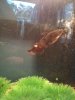
Wow, nice rescue man! I would use some Stress Coat or Aquarium Salt (1 Tablespoon Per 5 Gallons Of Water) and then try feeding him again in a couple hours. If that doesn't work....
(I got the following off of a website.)
"For badly stressed fish we prepare a mixture consisting of crushed pellets (the usual pellets we feed them) mixed with a few drops of a vitamin liquid, suitable for aquaria (Esha Optima is our favourite) and a couple of grains of aquarium salt. We stir the mixture well until it becomes a slightly runny pulp. The constitution of the pulp is important; if it is too creamy (like a paste) you will be unable to discharge it with the syringe. We then take a clean 20 cc syringe (without the needle) and place its front opening in the pulp.The plunger of the syringe at this stage is pushed down fully."
"To fill the syringe, hold the barrel firmly and pull the plunger upwards (towards you). Do not put too much food in; we find that 1cc is more than sufficient for one feeding of a fish 10-20 cm TL. After placing the pulp in the syringe always press the plunger back in to expel any air which got in the syringe accidentally. When a little bit of pulp is expelled from the front end of the syringe it is ready to use. At this stage attach, to the front opening of the syringe, a small piece of soft (silicone) airline, about 4 cm long."
"Gently net the fish from the tank and place it on a wet, soft, non fluffy towel. It is important to ensure the towel is wet so as the skin of the fish is not damaged. If the fish is already in its own tank and weak enough to move around you may just hold it in your hand and keep it firm against the aquarium glass. With your other hand gently insert the airline attached to the front of the syringe with the food in the fish's mouth and press it as far back as it will go. It is always easier if the mouth of the fish is turned upwards (to face you) or is out of the water, though this is not always necessary."
"If you are doing this for the first time it may be difficult to get to the fish's oesophagus and you may need another person to help you. Gently moving the airline around will indicate where the oesophagus is (the airline will go deeper into the fish's mouth while the fish will open its mouth wider). Be very gentle with your movements or you may hurt the fish. Once you are confident the tip of the airline is correctly placed press on the plunger quickly to discharge some of the food. Repeat until the syringe is empty. You may then release the fish back in the tank."
"Things to look for: if all or most of the food comes out of the fish's gills it means either that the quantity of food discharged is too big or that the airline is not inserted properly.Try administering less food at a single push or relocating the airline. Again, if the food is simply placed in the fish's mouth it may just spit it out."
"Depending on the condition of the fish it is up to the aquarist to determine how many feeds a day they will offer. If the fish is in really poor condition (stressed) it may be preferable to offer less feeds and more peace and quiet. If the aquarist is concerned more about the loss of weight and less about stress then more feeds would be recommended. No matter what do not try more than 3 feeds daily."
"In some cases it may be necessary to mix some medication or salts in the food offered to improve the general condition of the fish. Aquarium salt (2-3 grains) or Epsom salts can be easily mixed with the food."
"You can also force feed fish using a pill discharger, such as the ones used by the vets to give pills to cats and dogs. There are different types of these implements, some of which have a particularly long curved end. These are used by vets to give pills to fish. We have occasionally used a regular pill discharger and we found it quite handy for large size pellets."