

I have taken upon the task of repairing a 8 foot aquarium. I picked it up fairly cheap and got it home. Upon the initial fill it started to leak from the front seam. I emptied the tank and cut away the front bottom brace. I re-siliconed the front bottom brace in place and let planned to let it sit for a few days for the silicone to completley cure.
while I was fixing the tank I had it sitting in our warehouse on a buch of styrofoam box lids.
A few days later I was busy, working away in the shop when at about lunch time I heard a massive crash. I immediatley ran out the back to find about of 1500L of water pouring all over the warehouse floor.
My brother had decided it would be a great idea to fill the tank to test my repair job. He didnt bother to take it off the styro lids and put it on a flat surface tho. It turnedout that one of the lids was thicker than the others and created a high spot, when the tanks was full the weight of the water bowed the glass over the high spot and it broke.
The only thing he had to say for himself was:
"Well at least the seam of fixed didnt leak..."
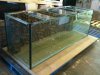


So onto the repair of the tank:
To buy a new sheet of 12mm glass to fix the base would cost me more than I paid for the tank so I am hoping to use a different method.
I have fixed many smaller tnaks before with cracked bases. In these tanks I have simply siliconed a piece of glass over the crack. This method has never failed me before.
On hand I have a bunch of 12mm glass that is about 500x800. I am hoping to use the above method with a a few panels of glass.
The other idea i have is to completley remove the shattered base and replace the base with a series of panells with glass stripping siliconed over the joins.
This method origionally souned crazy to me but I have two 4x2x2's, one 6x2x2 and a 7x18x18 that were made form the factory this way. They are all still holding water.
The only downside to the second method is that I think I will have to take appart the whole tank which I really want to avoid. The advantage of the first method is I think I can get away with not having to take the tank appart.
I will post some basic diagrams of the two methods I have attempted to explain.
while I was fixing the tank I had it sitting in our warehouse on a buch of styrofoam box lids.
A few days later I was busy, working away in the shop when at about lunch time I heard a massive crash. I immediatley ran out the back to find about of 1500L of water pouring all over the warehouse floor.
My brother had decided it would be a great idea to fill the tank to test my repair job. He didnt bother to take it off the styro lids and put it on a flat surface tho. It turnedout that one of the lids was thicker than the others and created a high spot, when the tanks was full the weight of the water bowed the glass over the high spot and it broke.
The only thing he had to say for himself was:
"Well at least the seam of fixed didnt leak..."
So onto the repair of the tank:
To buy a new sheet of 12mm glass to fix the base would cost me more than I paid for the tank so I am hoping to use a different method.
I have fixed many smaller tnaks before with cracked bases. In these tanks I have simply siliconed a piece of glass over the crack. This method has never failed me before.
On hand I have a bunch of 12mm glass that is about 500x800. I am hoping to use the above method with a a few panels of glass.
The other idea i have is to completley remove the shattered base and replace the base with a series of panells with glass stripping siliconed over the joins.
This method origionally souned crazy to me but I have two 4x2x2's, one 6x2x2 and a 7x18x18 that were made form the factory this way. They are all still holding water.
The only downside to the second method is that I think I will have to take appart the whole tank which I really want to avoid. The advantage of the first method is I think I can get away with not having to take the tank appart.
I will post some basic diagrams of the two methods I have attempted to explain.



