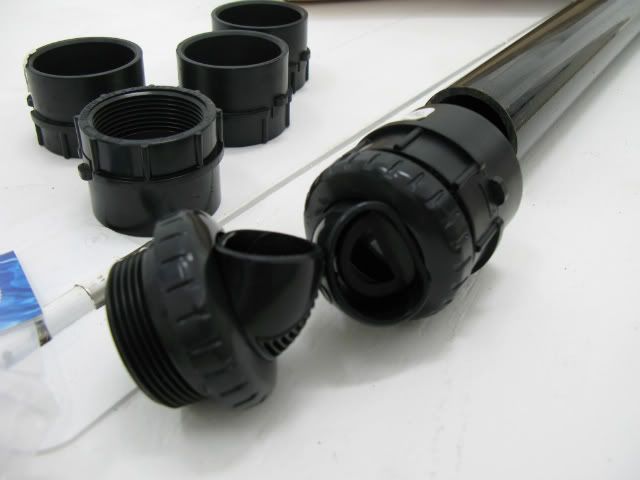
2" drains so what size returns?

  • We are currently upgrading MFK. thanks! -neo
Step 1: Determine desired GPH. If you want 10x turnover on a 450G (US) tank, then you want 4,500GPH (US) flowing through your sump.

Step 2: Determine head height (how high does the pump need to push the water)- I'll assume 6'.

Step 3: Determine which pump(s) you would like to use that push 4,500GPH @ 6' of head.
--Running two Laguna Max Flo 2900's @ 6' of head will get you 4,502GPH total on less than 260 total watts (I'd challenge anyone to find more efficient pump(s) while pushing that much water @ 6' of head height).

Step 4: Determine what plumbing you will need to handle that type of flow.
--If you have two overflows and plan to run Durso stand pipes, I would make them 3" each. If you have three overflows, you might be able to use 2", but you will be cutting it close**. For two returns, I would use 1.5" plumbing.

**I know this from personal experience. I have (3) 2" overflows and my Reeflo Hammerhead pump overpowered them @ 9' of head pressure (according to Reeflos performance chart, the pump pushes 4,400 GPH @ 9' of head, so my three 2" drains could not handle the 1,466GPH each that the Hammerheard Gold was throwing at them- I had to valve the pump back, very slightly so that it would not suck my sump dry and overflow my display).

I think a lot of the flow rate charts for various PVC sizes are overstated because they A) are stated for full siphon (which a Durso is not), B) do not account for any elbows or horizontal runs of plumbing below the bulkhead fitting which we all have and will slow flow C) are rated for smooth/new pipe; you can count on mulm building up within the pipe that will definitely slow your GPH rates.

In case you don't want to read all of the above, to make a long story short, this is what I would do.
- two 3" drains
- two 1.5" returns
- two Laguna Max Flo 2900 pumps

Great info! I'm looking to upgrade my pumps and I really like the Reflow numbers. Are you saying the Laguna are more efficient than Reflow?
 
Great info! I'm looking to upgrade my pumps and I really like the Reflow numbers. Are you saying the Laguna are more efficient than Reflow?

Certain models perform better than others at various head heights and flow rates, so I wouldn't make a blanket statement about one brand of pump being more efficient than the other. I think that in certain scenarios (at various head heights and flow rates), Laguna will be more efficient than Reeflo and vice versa. You would need to know what GPH you wanted and what head height the pump had to overcome to achieve the desired GPH in order to come up with a definitive answer to your question. I like to geek out on this type of stuff, so if you provide your head height and desired GPH, I can run a comparison.

In another thread, the OP mentioned he was looking to run 2 submersible pumps, so that's why I made the recommendation of running two Max Flo 2900s and didn't even consider Reeflo. But let's have a look...

For a simple comparison, if we run the numbers for a system with 6' of head height with someone looking for at least 2,500GPH it looks like Laguna comes out on top:

Reeflo Super Dart Gold @ 6' of head = 2,580GPH @ 182 Watts (14.2 GPH per watt)
Laguna Max Flo 4200 @ 6' of head = 2,853GPH @ 160 Watts (17.8 GPH per watt)

At 9' of head, the Laguna is also more efficient (Below are the numbers for my setup, which I tested with a Kill-a-watt to confirm the wattage draw. I am however relying on the manufacturers posted GPH at the given head height because I have no way to reliably test GPH).
Reeflo Super Dart Gold @ 9' of head = 1,970GPH @ 172 Watts (11.5 GPH per watt)
Laguna Max Flo 4200 @ 9' of head = 2,092GPH @ 155 Watts (13.5 GPH per watt)

It gets tricky when you can't rely on the manufacturer’s wattage numbers. After testing the pumps on my Kill-a-watt I found the energy consumption for the Reeflo Super Dart Gold to be consistent with what they list (172 watts @ 9' of head). But the Reeflo Hammerhead Gold (HHG) was a different story. Reeflo states the HHG draws 291 watts @ 9' of head, but per my Kill-a-watt, it was drawing 332 watts! I think they changed motors (they initially used Marathon motors on the HHG model, but are now using Baldor motors, which may draw more watts) and they never updated the wattage draw on their charts. My Laguna Max Flo 4200 plugged into the Kill-a-watt reads 155 watts, which sounds right considering Laguna lists the max wattage at 160.

Laguna does not post the wattage draw of their pumps at various head heights; they only list the maximum wattage draw. This makes it tough to compare with other pumps. But even if you compare it to other pumps using the maximum wattage draw listed, I have found that the Lagunas are still very competitive, if not better than most all other pumps (submersible or external). It's counterintuitive, but pumps typically use less watts the more head pressure they have to push against. I believe it has to do with the fact that the impeller is spinning more slowly.
 
Good thread. I just got my 600 up and running a couple of weeks ago and Aldiaz recommendation was the way to go as far the pumps. Went with 2 Laguna 2400's.

My question however is, the tank came 2 - 1.5" drains and 2 - 3/4" returns. I questioned the returns but was told by the tank guy that's sufficient.
I'd love to upgrade to 1" or 1.25" but it seems like LocLine doesn't have 1" or 1.25" nozzles and currently I'm using two per return to spread out the flow in the tank.

How much flow is being restricted with the 3/4" vs 1"?
What type of return nozzles are you guys using who are running 1" or greater returns?
 
Good thread. I just got my 600 up and running a couple of weeks ago and Aldiaz recommendation was the way to go as far the pumps. Went with 2 Laguna 2400's.

My question however is, the tank came 2 - 1.5" drains and 2 - 3/4" returns. I questioned the returns but was told by the tank guy that's sufficient.
I'd love to upgrade to 1" or 1.25" but it seems like LocLine doesn't have 1" or 1.25" nozzles and currently I'm using two per return to spread out the flow in the tank.

How much flow is being restricted with the 3/4" vs 1"?
What type of return nozzles are you guys using who are running 1" or greater returns?

Glad to hear you like the pumps.

In regards to the return size, a lot of aquarium builders seem to know a lot about building tanks, but not very much when it comes to plumbing. It doesn't make too much sense to use the same 3/4" returns on your 600G tank as they would on a 100G; are they assuming you are running the same GPH on a system that is 6 times as large as the other? Having said that, although it's not ideal, I don't think it's that big of a deal. I would think that since the 3/4" is 25% smaller than 1", it would be like closing a ball valve by 25%. This is just a semi-educated guess, but I would imagine that would add a foot or two to the head pressure on the pump, so you'd be losing around 150GPH on each pump.

I've never seen or heard of locline larger than 3/4" either; if you find some, please let me know. My returns are just two 2" bulkhead fittings that flow into the top of my tank. I had to build a screen on them because I had a few mischievious (big 6") clown loaches that despite water flowing out of the fitting like mad, used to like to swim into my return line and hang out in there. The first time I saw them do it, I almost shat myself. :jaw-dropp
 
Glad to hear you like the pumps.

In regards to the return size, a lot of aquarium builders seem to know a lot about building tanks, but not very much when it comes to plumbing. It doesn't make too much sense to use the same 3/4" returns on your 600G tank as they would on a 100G; are they assuming you are running the same GPH on a system that is 6 times as large as the other? Having said that, although it's not ideal, I don't think it's that big of a deal. I would think that since the 3/4" is 25% smaller than 1", it would be like closing a ball valve by 25%. This is just a semi-educated guess, but I would imagine that would add a foot or two to the head pressure on the pump, so you'd be losing around 150GPH on each pump.

I've never seen or heard of locline larger than 3/4" either; if you find some, please let me know. My returns are just two 2" bulkhead fittings that flow into the top of my tank. I had to build a screen on them because I had a few mischievious (big 6") clown loaches that despite water flowing out of the fitting like mad, used to like to swim into my return line and hang out in there. The first time I saw them do it, I almost shat myself. :jaw-dropp

+1 on the tank builders.

I use 1" returns from my pump directly to the top of my tank. I cut a couple holes in the top/acrylic and fit 1" bulkheads. I have a 1" gap between the bulkhead and the water so the water splashes down creating lots of turbulence and surface agitation. Each 1” pump return gets 1” plumbing and goes to a 1” bulkhead. No head loss from restricted plumbing/ maximum efficiency. If I had larger pumps like a reflow with 1.5” return fittings on the pump I would run 1.5 all the way to the top of my tank.
 
Good thread. I just got my 600 up and running a couple of weeks ago and Aldiaz recommendation was the way to go as far the pumps. Went with 2 Laguna 2400's.

My question however is, the tank came 2 - 1.5" drains and 2 - 3/4" returns. I questioned the returns but was told by the tank guy that's sufficient.
I'd love to upgrade to 1" or 1.25" but it seems like LocLine doesn't have 1" or 1.25" nozzles and currently I'm using two per return to spread out the flow in the tank.

How much flow is being restricted with the 3/4" vs 1"?
What type of return nozzles are you guys using who are running 1" or greater returns?


Each of my overflow boxes has two 1 1/2" drains and four 1/2" returns. I would have preferred bigger return lines, but am not going to redrill the tank and the overflow boxes. The tank came with 1/2" LocLine returns, so will have use all EIGHT of them. :(

On my separate mechanical filtration, I am going with three 1 1/2" Venturi returns staggered at different heights. Husband is afraid the tank will be turned into a whirlpool. The nozzles can be turned so the flow can be directed where we want it. We'll put valves on the return lines so we can decrease the flow if we have to.
2012-01-13001003.jpg


I searched high and low for 1 1/2" returns--there is no such thing available from any aquatic vendors. I had to go to a pool/spa site to find return nozzles.
 
+1 on the tank builders.

I use 1" returns from my pump directly to the top of my tank. I cut a couple holes in the top/acrylic and fit 1" bulkheads. I have a 1" gap between the bulkhead and the water so the water splashes down creating lots of turbulence and surface agitation. Each 1” pump return gets 1” plumbing and goes to a 1” bulkhead. No head loss from restricted plumbing/ maximum efficiency. If I had larger pumps like a reflow with 1.5” return fittings on the pump I would run 1.5 all the way to the top of my tank.

The nice thing about the returns on the top is that you never have to worry about backsiphon overflowing your sump.

Something I found out by talking to the owner of Reeflo (btw, great guy who stands behind his product) is that just because the outlet to a pump is 1.5" doesn't necessarily mean you should use 1.5" pipe. It seems strange to me that they wouldn't make the outlet the same size as the plumbing that they recommend, but here are the numbers taken directly from Reeflo's site:

PIPE SIZE FOR
RECOMMENDED FLOW
US............ gpm....... USgph
1"............ 10....... 600
1 1/4"....... 20....... 1,200
1 1/2"....... 30....... 1,800
2"............ 60 ....... 3,600
2 1/2"....... 90....... 5,400
3"............ 175....... 10,500

Here's the link: http://www.reeflopumps.com/images/tips.pdf
 
From the referenced PDF: http://www.reeflopumps.com/images/tips.pdf

There are two elements that cause pressure requirements in your system; vertical lift and
“FRICTION LOSS”. Simply stated it is the pressure created by trying to squeeze large flows
through a narrow opening (think bar straw). There are two important aspects 1) It matters the
length of the narrow line (1” bar straw vs. 10” bar straw) and 2) Friction loss increases at an
increasing rate when either flow is increased or pipe is narrowed. The narrower the line the more
the pump has to work (think clogged ateries and your heart).

Minimize friction losses by using large diameter pipe. First determine the approximate flow rate
you want, and the total length of your pipe. The Friction Loss chart will allow you determine the
amount of extra “head pressure” will be added to your systemdue to the diameter of your piping.
(The size of the pump’s suction and discharge ports does not indicate your proper pipe size.)
Choose a pipe diameter that keeps your friction loss below about five feet per hundred feet of
pipe. Even if you have a section of small diameter pipe that you can’t change, as with a through
the wall fitting, it is still beneficial to use larger pipe on the majority of the run. It matter how much
wide pipe you use.Friction loss chart- The narrowness of the pipe increases friction loss in a
geometric manner.EXAMPLE: At 2700 gph using 1.5” instead of 1” pipe reduces friction loss from
97.75’ per 100’ to 11.73’ per 100’. A big reduction in “head pressure”
 
The nice thing about the returns on the top is that you never have to worry about backsiphon overflowing your sump.

Yup, and it's super easy to drill/plumb the holes to the top and it creates a lot of surface agitation and I like the look.
 
Step 1: Determine desired GPH. If you want 10x turnover on a 450G (US) tank, then you want 4,500GPH (US) flowing through your sump.

Step 2: Determine head height (how high does the pump need to push the water)- I'll assume 6'.

Step 3: Determine which pump(s) you would like to use that push 4,500GPH @ 6' of head.
--Running two Laguna Max Flo 2900's @ 6' of head will get you 4,502GPH total on less than 260 total watts (I'd challenge anyone to find more efficient pump(s) while pushing that much water @ 6' of head height).

Step 4: Determine what plumbing you will need to handle that type of flow.
--If you have two overflows and plan to run Durso stand pipes, I would make them 3" each. If you have three overflows, you might be able to use 2", but you will be cutting it close**. For two returns, I would use 1.5" plumbing.

**I know this from personal experience. I have (3) 2" overflows and my Reeflo Hammerhead pump overpowered them @ 9' of head pressure (according to Reeflos performance chart, the pump pushes 4,400 GPH @ 9' of head, so my three 2" drains could not handle the 1,466GPH each that the Hammerheard Gold was throwing at them- I had to valve the pump back, very slightly so that it would not suck my sump dry and overflow my display).

I think a lot of the flow rate charts for various PVC sizes are overstated because they A) are stated for full siphon (which a Durso is not), B) do not account for any elbows or horizontal runs of plumbing below the bulkhead fitting which we all have and will slow flow C) are rated for smooth/new pipe; you can count on mulm building up within the pipe that will definitely slow your GPH rates.

In case you don't want to read all of the above, to make a long story short, this is what I would do.
- two 3" drains
- two 1.5" returns
- two Laguna Max Flo 2900 pumps


Wow thanks for the comprehensive reply. Food for thought. I will have 350 uk gallon 1600 ltr tank so was going to use 2 aquamedic eco 9000 to give me 18000 ltr so around ren time turn over by the time i allow for 4 eet of head and volume of water in the sump etc. Still not sure about 3" drains though. I was going for 2" durso and 1.5" return because the pump return takes 1.5". If the flow is too much i will T off the returns back through the sump or through the U.V
 
MonsterFishKeepers.com