Healing open wounds

  • We are currently upgrading MFK. thanks! -neo
that is weird. I have no idea. Dosed with prazi immediately after convict died.


ammonia was only a problem with my QT tank. Main tank level was 0 for ammonia and nitrites most of the time. Although looking at the tank right now, the water still looks a little dark, maybe tannins from the driftwood? Although, definitely a possibilty for the water quality being off. Before he was sick I was only doing WC every other week.....Recently, I did remove all of the old substrate and decorations. Could it possibly be from the filter? The only other thing I can think of was that I did use a garden hose for water changes.
Doubt its the hose ive been ising one for yrs now
newest one occurred in main tank. Honestly, I have no idea. Starting to think there's something wrong with the water.....My beta fish also developed fin rot. Despite me doing regular water changes. I mean I have kept fish alive for 3 years with no health problems(had to rehome them when I moved), but that was in a different area. So i have no idea what I'm doing wrong. My only fish that has been doing well is my clownfish which gets pure RODI water.

You arent doing anything wrong infact your doing everyrhing right... your trying to heal your sick fish and have been open to all the suggestions everyone made...allot of times people ask a question then get all argumentative when they dont like the suggesrions you have been open to anything that was suggested kudooos to you
 
This maybe one of those cases where a swab/scrape needs to be looked at under the microscope. Cause most of the time we treat blindly by what it looks like and likely bug. Which works most of the time. This is likely not of them.
 
  • Like
Reactions: Polyaddict86
This maybe one of those cases where a swab/scrape needs to be looked at under the microscope. Cause most of the time we treat blindly by what it looks like and likely bug. Which works most of the time. This is likely not of them.

Please dont shoot me... Im no expert but I have read through this thread a few times and based on your comment of a swab i would just like to share something for what it might be worth

microbacterial subcutaneous TB can live dormant in fish tanks without you ever actually knowing...
If it infects the skin it forms ulcers such as the ones on the pictures and no normal antibiotics will cure it
It will aslo most likely not show on a swab, only if a small biopsy is done
I dont know how feasable that is and if you have vets that would do that
Like I said... its just a thought but after all that has been tried... i thought it worth mentioning
I found out the hard way.... a piece of driftwood from the fish tank fell on my leg while i took it out to clean and made a sore... nearly a year later and many admissions to hospital, 101 swabs later, I nearly lost my leg as the infection did not respond to any antibiotics
9 months ago when it was very close to losing my leg they did biopsies and that's what it was
I was told it can live dormant in fish tanks and suddenly raise its head if it gets to an open wound. Not something that happens every day but possible
Only problem is I have no idea if the antibiotics needed can be administered to fish and obviously dont know if any possibility that this could be the case
 
No shots fired. Could be TB and thought crossed my mind. That's another slew of antibiotics.

Plus never seen it polys. But will see what the other guys say as well. Probably need some more experienced eyes on it.

Point well taken MariaS MariaS .
 
This is what i read about ulcer on fish.
IMG_3730.JPG IMG_3731.JPG IMG_3733.JPG IMG_3732.JPG
Bacterial Ulcers In Fish
Bacterial ulcers are a very common problem in fish and seem to strike ornamental and pond fish such as goldfish and koi more often than other types. If lots of fish are affected they can prove difficult to treat as it can demand a high degree of patience, skill and expertise. However the good news is that the success rate when treating bacterial ulcers is often very high, even with severe or very advanced cases, unlike other infections such as bacterial gill disease.

What is an ulcer?
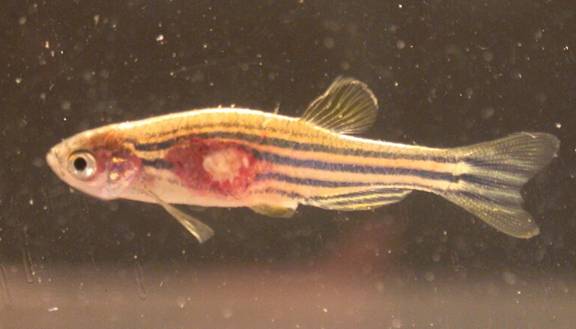
We’re used to dealing with ulcers in our own mouths, but ulcers can occur on the skin too and if they appear on the skin of animals that live in water, they can be hard to manage. An ulcer is a wound on the skin that penetrates all the way through the layers to the muscle beneath. Typically the ulcer will fail to heal and will feature an area of inflammation surrounding a central area of erosion. An area of white, necrotic tissue will normally surround the central wound and the inflamed area will usually extend into the healthy tissue, and the scales surrounding the affected area may become swollen and infected. In most cases the ulcer will not heal on its own and is typically caused by bacteria present in the tank or pond.

How are they caused?
Ulcers are usually caused by damage to the skin inflicted by either parasites or exposure to high levels of chemicals such as ammonia or extreme ph. levels. Trauma caused by breeding or handling can also create damage to delicate skin structures that can then become infected, leading to ulceration. Stressed fish, such as those who have recently been introduced to a tank or pond and whose immune system may be compromised may also be susceptible. Animals living in environments containing high levels of organic materials can also be prone to ulceration. If just one fish become ulcerated then it’s likely to be a problem with that particular animal. However, if more than one fish develops ulcers, then the cause is likely to be environmental. If the pond or tank is thought to be the cause, it is worth investigating the root cause of the problem and eradicate any bacteria or parasites. Simply adding anti-bacterial treatments to the water will only work for so long if the cause is not addressed. It’s important to remember that parasites will not ‘grow’ in a tank. They can only be introduced. Bacteria and viruses can exist in a tank as they can live quite happily on the fish that live there. If the equilibrium of the tank remains the same, the fish will remain healthy, however if the environment is disturbed either by a change in the maintenance routine or the introduction of new fish, then these pathogens can develop and grow, causing disease.

Treating ulcers
If only one fish is affected, and providing the infection is caught early enough, topical treatment may be enough. If more than one animal is ulcerated then all fish must be examined thoroughly to properly determine the spread of the infection. Many experts believe that debriding any wounds and applying a good quality topical treatment will be sufficient, but if you are inexperienced treatment should be carried out in conjunction with a vet. Often when a fish develops an obvious ulcer the infection has already been present for some time. This could mean that many more fish are affected than just one with an obvious injury. It’s vital that all affected fish are treated simultaneously. Any untreated animals will continue to harbour bacteria and will continue to deteriorate. Many cases of bacterial infection can continue for months if only the most obviously affected animals are treated. It may seem like fresh outbreaks, but in actual fact you may be dealing with a chronic problem. Treatment can consist of many things and your vet or local aquatic expert may suggest a programme of treatment made up of many elements. Any course of treatment of course depends on the severity of the infection, and if you’re not sure, you must consult a veterinarian or a fish expert. Treatment options include topical medication that can be applied directly to the affected area of individual fish. Bathing treatments can also be used over the short or long-term and in extreme cases antibiotic injections can be administered. Whichever course of treatment is chosen, the aim should be for the problem to be resolved in two or three weeks. If the problems persist then a different treatment plan should be considered and an investigation into the cause of the infection should be carried out again. Dirty pond or tank water can certainly cause bacterial infections, particularly if one or more fish have existing injuries. Attention should be paid to water quality and the filtration system to ensure this is working efficiently. Overcrowding can also contribute to disease as it can stress the animals and may even cause fights, and regular maintenance of the tank should also be thorough. Cases of ulceration should be addressed in a systematic way as they can persist if treatment is not exhaustive. Trying different treatments in succession is unlikely to be effective and may even make the problem worse. A 90% survival rate should be the aim and anything less than this is likely to be down to ineffective treatment, rather than the infection itself.
 

hmm. It does look like an ulcer. Thank you for posting the article. I was also reading up on some of the things J jaws7777 mentioned about ulcers as well. This is a new possibility!

Whichever course of treatment is chosen, the aim should be for the problem to be resolved in two or three weeks. If the problems persist then a different treatment plan should be considered and an investigation into the cause of the infection should be carried out again. Dirty pond or tank water can certainly cause bacterial infections, particularly if one or more fish have existing injuries. Attention should be paid to water quality and the filtration system to ensure this is working efficiently. Overcrowding can also contribute to disease as it can stress the animals and may even cause fights, and regular maintenance of the tank should also be thorough. Cases of ulceration should be addressed in a systematic way as they can persist if treatment is not exhaustive. Trying different treatments in succession is unlikely to be effective and may even make the problem worse.

Overcrowding:
I don't think overcrowding wasn't an issue cause just had the 3 fish in the 55g tank. All were 5 inches or less. Then the ornate was in the tank for about a month by himself. Convict cichlid died (was super bloated and or/ maybe super fat from months of my dad overfeeding) and I rehomed the pike. Immediately after cichlid died, dosed with prazipro.

Water Quality and maintenance:
I did change the maintenance routine. From my dad occasionally cleaning the tank(maybe 1x a month.....the water typically smelled for some reason)...to me changing it every other week. Then I got my bichir. He was in the tank for two months without any problems, doing every other week WC of 25-30%. Then eventually went to every week cause the tank smelled sometimes. Then the scratches showed up in December. Then the wound on his back. Could have been from abrasions, burns, or punctures, no idea. WC went from every week 25%, then to 50%.

Would a maintenance change like this cause the ulcers? Seemed like they did get worse. Every time I when I got the water tested(maybe 2x a month at first), water parameters were considered "normal." 0,0,0-2for Ammonia, Nitrite, and Nitrate. Phosphate was always dark navy(through the roof) and pH was 7.6....I did use neutral regulator for a time to get the pH down to 7.3. However, made phosphates worse, so I stopped. Fish store said they were "normal" parameters were normal, except for my high pH. Could high phosphate or high pH be the culprit?

How do I know if the water is dirty, if parameters are "normal?" Seems clean, to me, but the tank is always tinted a greenish color, which makes me a little uneasy. The water itself is clear. Also the fact that the water could "smell" slightly foul, is peculiar to me as well. I've never had water smell before....especially since I'm good about doing water changes. Don't know if it is from the driftwood or the glass, tank, or maybe just the water itself? Also i know that there appears to be green algae growing in the silicone seals of the tank. There also was red circular algae in the tank and brown algae on the walls.

Could there be bacteria in the brace of the tank at the top? I know it was leaking at one point and I never sealed it? That's my guess. Cause the smell is located all around the border of the tank. Kinda smells like mold....maybe this is getting into the water? Again this is all speculation.

That's literally everything I can think of. lol. It's a lot I know. This has been a mystery.

~~~~~~~~~~~
How do I test the water to see what bacteria/parasite is present? Could it be that the city water/ hose water supply line to my house is of poor quality? Could it be there is a bacteria culture growing somewhere in the tank or filter?

how do I see if the filter is working effectively? It's a penguin 350 HOB, been replacing cartridges every month, and putting in poly-fil. The grates are not in there anymore, but the biowheels are still present.

How do I treat the tank and clean everything in it? Should I bleach everything and start over?


THANK YOU EVERYONE FOR YOUR ENDLESS PATIENCE, ADVICE, AND SUPPORT FOR ALL OF MY QUESTIONS. I've never had problems EVEN CLOSE TO THIS with a tank before, so I really appreciate the troubleshooting and advice.:)
 
Last edited:
  • Like
Reactions: Polyaddict86
When you bought the ornate did you see anything that might look like a sore, or maybe it did got puncture somewhere and did get infected.
 
When you bought the ornate did you see anything that might look like a sore, or maybe it did got puncture somewhere and did get infected.

nope. he was pristine on the outside. clear eyes, good coloration, no deformities or lacerations. I'm the guy(or gal in this case) who spends about 30 mins inspecting the fish to make sure it's healthy externally. :p

Could have gotten punctured/scratched from any of the potentially sharp decorations I had in the tank before. Not out ruling that. Or maybe he got stressed out from the old background lol :p

Then I think because the upper brace/inner border of the tank still slightly smells, despite my "normal" parameters(excluding 7.6 pH and billion phosphates) and regular water changes....... starting to think there is some bacteria or mold in/ on the upper brace of the glass. When I clean it, it's usually black underneath. Maybe this + puncture= ulcer wound from hell?
 
  • Like
Reactions: Polyaddict86
Please dont shoot me... Im no expert but I have read through this thread a few times and based on your comment of a swab i would just like to share something for what it might be worth

microbacterial subcutaneous TB can live dormant in fish tanks without you ever actually knowing...
If it infects the skin it forms ulcers such as the ones on the pictures and no normal antibiotics will cure it
It will aslo most likely not show on a swab, only if a small biopsy is done
I dont know how feasable that is and if you have vets that would do that
Like I said... its just a thought but after all that has been tried... i thought it worth mentioning
I found out the hard way.... a piece of driftwood from the fish tank fell on my leg while i took it out to clean and made a sore... nearly a year later and many admissions to hospital, 101 swabs later, I nearly lost my leg as the infection did not respond to any antibiotics
9 months ago when it was very close to losing my leg they did biopsies and that's what it was
I was told it can live dormant in fish tanks and suddenly raise its head if it gets to an open wound. Not something that happens every day but possible
Only problem is I have no idea if the antibiotics needed can be administered to fish and obviously dont know if any possibility that this could be the case

Thank you for sharing. That sucks and is scary that you were in that situation! So glad to hear that you didn't lose your leg. :]

I've heard about TB being really difficult to cure in fish. If was TB, would that cause a sooner fish death? He's been dealing with this for 2 months not. However, I'm not sure. Thanks for your input! It definitely could be a possibility!
 
Did the gravel ever get vacuum, cause you mentioned that your dad over feeding the other fish, maybe bacteria formed in between the gravel.
 
MonsterFishKeepers.com