

This thread will be outlining the stand build, delivery, setup, filtration modifications, scape, stocking and any future changes. Thanks for reading!
My tank of choice is a 240 Gallon acrylic Uniquarium by Clear For Life (Advance Aqua Tanks). Its dimensions are 96x24x24. It was ordered with a "Deep Blue" colored back panel. I would've preferred black, but for whatever reason it wasn't available at the time and I was kind of worried about becoming tired of black and it being "too black". Obviously this tank is a long term tank and investment, so I wanted something that could be versatile and changed up in the future.
The display area is roughly 200 gallons of water, while the sump has the capacity to be 40 gallons if full, but would never be completely full.
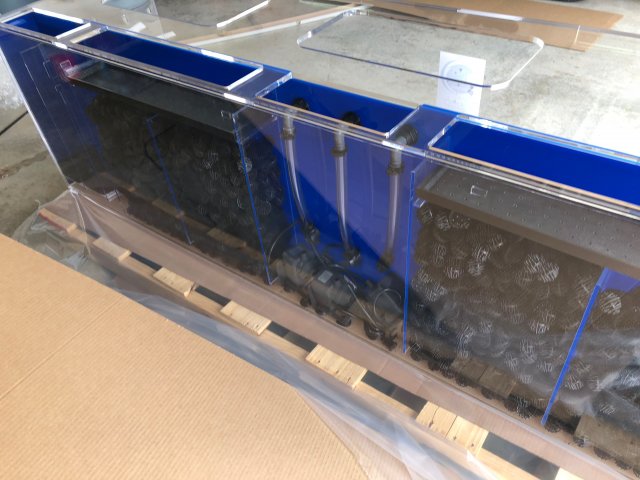
The internal sump is a wet/dry with dual overflows that flow into a mechanical filtration chamber, one at each end of the tank, then flows out to each have their own respective drip trays and columns of bio-balls underneath. Each side eventually flows back to the middle of the sump where (3) RIO 2100 return pumps are located.
The logic behind this had a few reasons.
First, I have gone through a handful of large tanks over the years, I have had a full canister filtered tank, a tank with a fluidized external sump, combo setups, etc. I like trying new things and testing to see what works best for me, so when I came across this it was something I hadn't tried, but it seemed like a great idea. I don't keep what I consider "monster fish" anymore, so losing display area wasn't really a big deal to me. Unless the future stocking ideas drastically change, I won't have anything in this tank that is larger than 10" when fully grown, at least for the foreseeable future.
Second, I have always purchased used glass tanks in the past, my luck eventually ran out and I purchased a 210 gallon that lasted 5 months before a perfect looking seam failed. Luckily it wasn't a huge leak and was something I caught early on and was able to put fish in temporary housing and address the issue, which turned into selling the tank and calling it a day.
So when my wife and I moved into our newly built house in August, I wanted to minimize the risk of damaging flooring, walls, etc. with water. So, I decided I was only going to buy a brand new tank and I was only going to buy acrylic, because I was tired of moving heavy glass tanks. Plus, with the sump being inside the tank, it reduces the risk of an external factor causing a failure. Power outages? Not a big deal on this tank, because the water isn't leaving the tank, so power goes out, the tank drains into the sump until it can't anymore and that's that. No reverse suction issues, etc. Plumbing failures? Nope, because there is no plumbing. Pump failures? Not really, if all 3 pumps happen to fail at the same time it'll be just like a power outage, the tank will drain until it can't anymore.
Granted, most of these are easily minimized on a typical display + sump system, but I didn't want to minimize them, I wanted to eliminate them.
Last, but certainly not least. COST.
I got a fantastic deal on this tank. This tank is basically a turn key system, all I have to do is move my heaters and some existing media over to seed and this tank is ready to run as a full system. Something I noticed on my fluidized sump system, was that cost builds QUICKLY, especially if you haven't established a plan and budget before you begin. The more frustrated you become with the setup, the more money you are willing to spend to sort it out. With this setup I was able to have everything bundled into the cost with the filtration already done, for less than a standard 96x24x24 acrylic tank and all I sacrificed was 4" of depth, so it just made sense. My only concern is the use of RIO Pumps, which seem to have a hit and miss success rate. I was going to wait until they failed to do anything with them, but after discussing this in a previous post, Fish Tank Travis
recommended swapping the pumps with DCP 8000s before putting the tank in place, which made perfect sense to avoid future headaches, so that's the plan for now. However, I will reduce the (3) 2100s to (2) DCP 8000s. I haven't decided if I want to block off the middle return after swapping pumps or leave it and just "Y" one pump into 2 return outlets.
Fish Tank Travis
recommended swapping the pumps with DCP 8000s before putting the tank in place, which made perfect sense to avoid future headaches, so that's the plan for now. However, I will reduce the (3) 2100s to (2) DCP 8000s. I haven't decided if I want to block off the middle return after swapping pumps or leave it and just "Y" one pump into 2 return outlets.
FIRST DELIVERY
Ordered the tank late early August, it was delivered Oct 1st but was damaged in multiple areas, so I refused it and called AAT, they told me they would put a rush on this one and try to get it out ASAP. It was shipped to me from LA on Oct 19th, so I am hoping it will be here late this coming week, but I am expecting it to be in early next week instead. They have to hand off the delivery to a local freight company and they took over 5 days after the handoff to deliver the first one and that was only after I started calling and asking where it was.
October 1st arrives, unloaded and in the garage and find the following bad spots during inspection. Some worse than others.
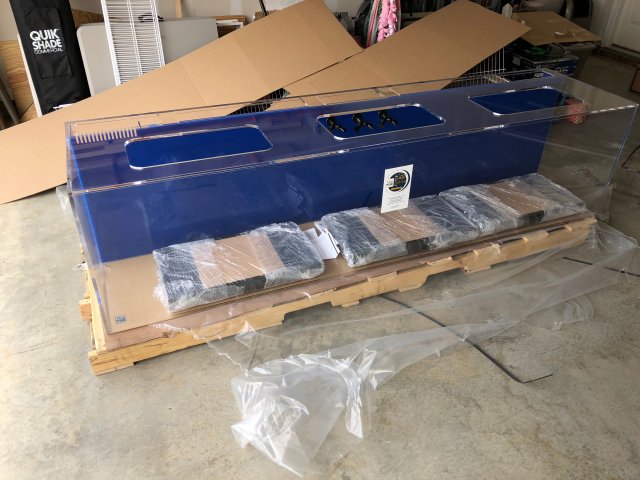
Full Tank Shot
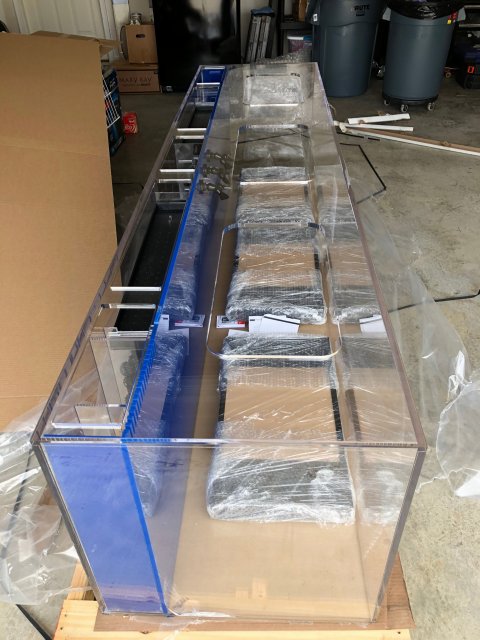
SIDE Shot
Filtration Compartment Shot
Crushed bottom
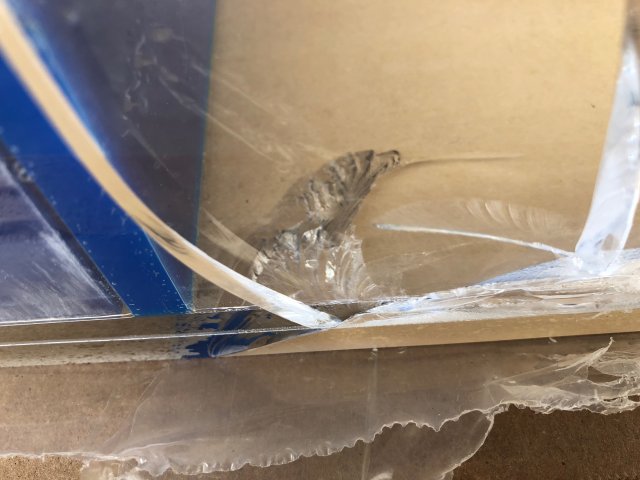
Cracked/Separate Top Joint
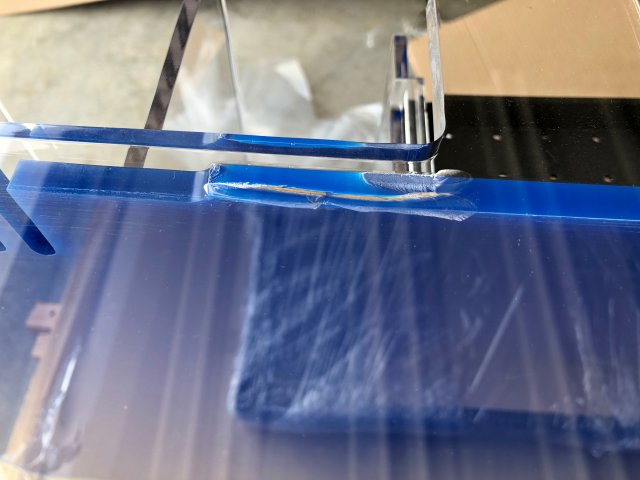
Crack on baffle in sump

My tank of choice is a 240 Gallon acrylic Uniquarium by Clear For Life (Advance Aqua Tanks). Its dimensions are 96x24x24. It was ordered with a "Deep Blue" colored back panel. I would've preferred black, but for whatever reason it wasn't available at the time and I was kind of worried about becoming tired of black and it being "too black". Obviously this tank is a long term tank and investment, so I wanted something that could be versatile and changed up in the future.
The display area is roughly 200 gallons of water, while the sump has the capacity to be 40 gallons if full, but would never be completely full.
The internal sump is a wet/dry with dual overflows that flow into a mechanical filtration chamber, one at each end of the tank, then flows out to each have their own respective drip trays and columns of bio-balls underneath. Each side eventually flows back to the middle of the sump where (3) RIO 2100 return pumps are located.
The logic behind this had a few reasons.
First, I have gone through a handful of large tanks over the years, I have had a full canister filtered tank, a tank with a fluidized external sump, combo setups, etc. I like trying new things and testing to see what works best for me, so when I came across this it was something I hadn't tried, but it seemed like a great idea. I don't keep what I consider "monster fish" anymore, so losing display area wasn't really a big deal to me. Unless the future stocking ideas drastically change, I won't have anything in this tank that is larger than 10" when fully grown, at least for the foreseeable future.
Second, I have always purchased used glass tanks in the past, my luck eventually ran out and I purchased a 210 gallon that lasted 5 months before a perfect looking seam failed. Luckily it wasn't a huge leak and was something I caught early on and was able to put fish in temporary housing and address the issue, which turned into selling the tank and calling it a day.
So when my wife and I moved into our newly built house in August, I wanted to minimize the risk of damaging flooring, walls, etc. with water. So, I decided I was only going to buy a brand new tank and I was only going to buy acrylic, because I was tired of moving heavy glass tanks. Plus, with the sump being inside the tank, it reduces the risk of an external factor causing a failure. Power outages? Not a big deal on this tank, because the water isn't leaving the tank, so power goes out, the tank drains into the sump until it can't anymore and that's that. No reverse suction issues, etc. Plumbing failures? Nope, because there is no plumbing. Pump failures? Not really, if all 3 pumps happen to fail at the same time it'll be just like a power outage, the tank will drain until it can't anymore.
Granted, most of these are easily minimized on a typical display + sump system, but I didn't want to minimize them, I wanted to eliminate them.
Last, but certainly not least. COST.
I got a fantastic deal on this tank. This tank is basically a turn key system, all I have to do is move my heaters and some existing media over to seed and this tank is ready to run as a full system. Something I noticed on my fluidized sump system, was that cost builds QUICKLY, especially if you haven't established a plan and budget before you begin. The more frustrated you become with the setup, the more money you are willing to spend to sort it out. With this setup I was able to have everything bundled into the cost with the filtration already done, for less than a standard 96x24x24 acrylic tank and all I sacrificed was 4" of depth, so it just made sense. My only concern is the use of RIO Pumps, which seem to have a hit and miss success rate. I was going to wait until they failed to do anything with them, but after discussing this in a previous post,
Fish Tank Travis
recommended swapping the pumps with DCP 8000s before putting the tank in place, which made perfect sense to avoid future headaches, so that's the plan for now. However, I will reduce the (3) 2100s to (2) DCP 8000s. I haven't decided if I want to block off the middle return after swapping pumps or leave it and just "Y" one pump into 2 return outlets. FIRST DELIVERY
Ordered the tank late early August, it was delivered Oct 1st but was damaged in multiple areas, so I refused it and called AAT, they told me they would put a rush on this one and try to get it out ASAP. It was shipped to me from LA on Oct 19th, so I am hoping it will be here late this coming week, but I am expecting it to be in early next week instead. They have to hand off the delivery to a local freight company and they took over 5 days after the handoff to deliver the first one and that was only after I started calling and asking where it was.
October 1st arrives, unloaded and in the garage and find the following bad spots during inspection. Some worse than others.
Full Tank Shot
SIDE Shot
Filtration Compartment Shot
Crushed bottom
Cracked/Separate Top Joint
Crack on baffle in sump




