mayan cichlid in a marine set up???

  • We are currently upgrading MFK. thanks! -neo
Aclockworkorange is right, I would also suggest Groupers, I used to have a Poleni Grouper, they look like cichlids and act like cichlids,
gets to 16" or so
poleni.jpg
Groupers are so SWEEEEEEEETTTTTTT!! I love the Panther groupers.
Squrrielfish are also cichlid like, I love the Hawaiian squrriels remind me of the ol' red bay snooks.
 
I would like to add that many non-reef fish do not know to be scared of corals and anemones, and are therefore eaten.
Good article about Cichlids and salinity tolerance. The Black Belt Cichlid is another one to consider:

https://deepblue.lib.umich.edu/bitstream/handle/2027.42/51532/Oldfield_Saltwater_Cichlids_2004.pdf
According to this, the Mayan should be fine. It also seems that a WC fish would have a better chance than one that has been CB for generations.
Allow me to elaborate on a "short" time.
I'm speaking in terms of geologic years, meaning for example 10,000 - 100,000 years as being a short period of time.
I believe the uropthalmus of Isla Mujeres (Heros troscellii) was described in 1867 by Steindachner (only a few moments ago in geologic time), so the ancestral uropthalmus could have ended up in the islands mangrove millions of years earlier after some volcanic or other catastrophic (storm) event separated them from their freshwater brethren (maybe as far back as when the meteor crashed to earth, creating the Caribbean) and have taken 10,000 to a million+ years time to develop a sustainable salt water tolerant population, or possibly only a few hundred,, not realistically an aquarium line breeding concept.
.
Yes.. but there are many people out there trying to breed the frostproof tilapia. Don't tell them....
 
I think catch location is important when doing a brackish/salt cichlid. Just because one population can tolerate salt doesn't mean one that has never been exposed to salt can. At least in the long term.
Another question:
What barriers are there to prevent the Isla Mujeres Mayans from migrating further north? I mean as long as it doesn’t get too cold, they should be able to move up most of the Mexican Coastline. Maybe just north of Tampico, but certainly not beyond the Rio Grande.
 
http://digitalcommons.unl.edu/cgi/viewcontent.cgi?article=1008&context=ichthynicar

All the heroine cichlids evolved from one spp and have some resilience to salt water, in fact all secondary fish spp that invaded central America might have crossed the sea to do so. Evan though some spp might of evolved to better withstand salt waters I personally don't think they can survive as true marine fish, if so wouldn't there be wide spread colonies of mayans down the coast of central America but also south America.
 
When I was in Isla Mujeres, I only found the mayans in the mangrove, and reedy areas, in fairly shallow water. I did not see any in deeper, open waters, or even in or around the reef near the southern tip of the island, or Manchones reef further out to sea.
Not saying they couldn't migrate, but the tendency of the species seems to be, to stay in shallower areas, near shore.
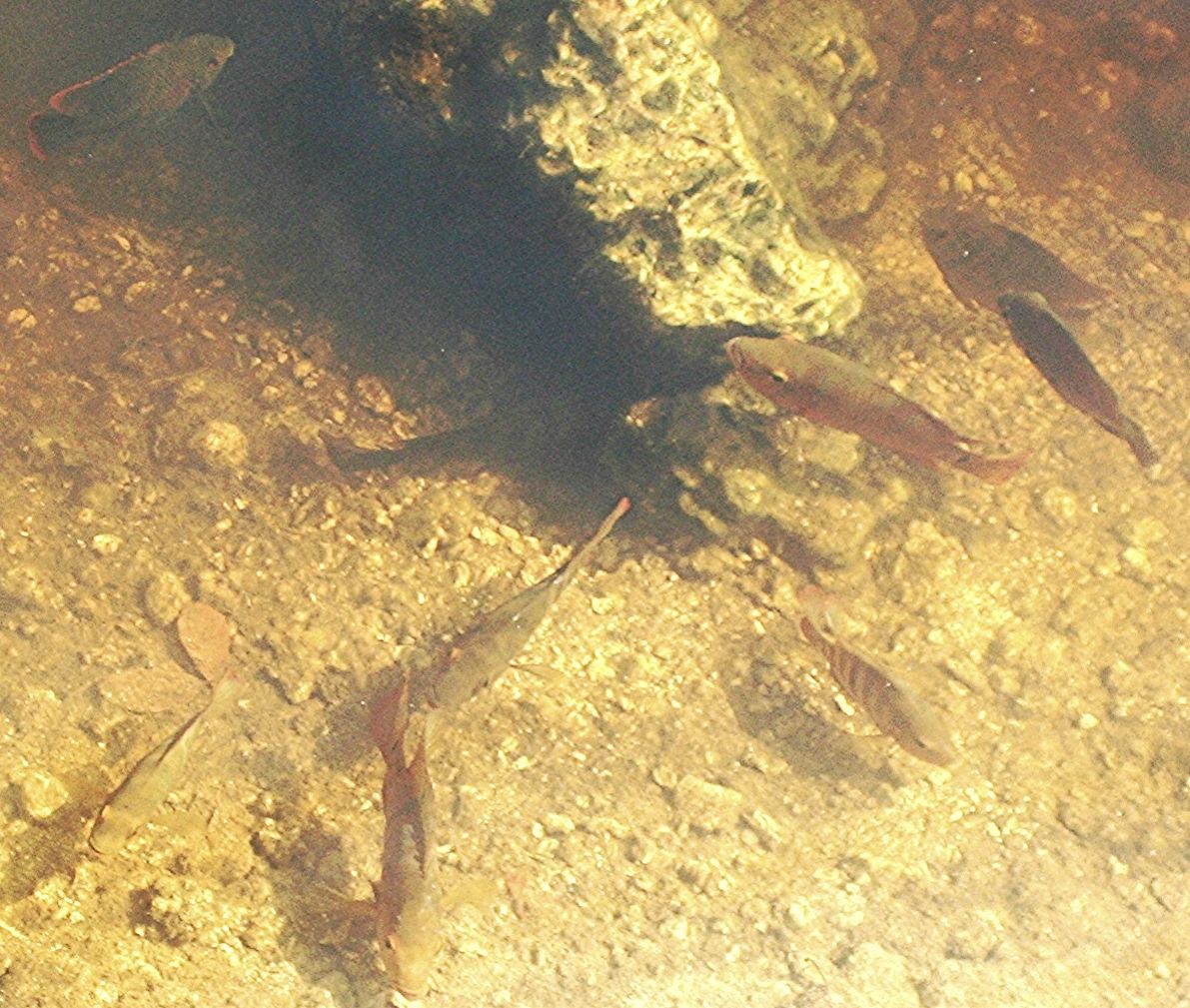
The photo above is from a slightly brackish area north of the Everglades in Florida, in less than 3 ft of water.
The first individuals of the population now on Isla Mujeras may occurred when the sea was much more shallow, and maybe even semi attached to the mainland thousands, or a million years ago, giving them a chance to evolve into the sub species (maybe a separate species (Troeschelli)) which is as salt tolerant as they now are.
In the mainland Cenotes the large shoals tend to stay near shore, in shallower areas.

 
When I was in Isla Mujeres, I only found the mayans in the mangrove, and reedy areas, in fairly shallow water. I did not see any in deeper, open waters, or even in or around the reef near the southern tip of the island, or Manchones reef further out to sea.
Not saying they couldn't migrate, but the tendency of the species seems to be, to stay in shallower areas, near shore.

The photo above is from a slightly brackish area north of the Everglades in Florida, in less than 3 ft of water.
The first individuals of the population now on Isla Mujeras may occurred when the sea was much more shallow, and maybe even semi attached to the mainland thousands, or a million years ago, giving them a chance to evolve into the sub species (maybe a separate species (Troeschelli)) which is as salt tolerant as they now are.
In the mainland Cenotes the large shoals tend to stay near shore, in shallower areas.


Behavior could be a limiting factor. Not being adaptable to life on the reef. I saw a post by someone else who somehow managed to keep a demasoni Cichlid alive in a marine tank. The Demasoni quickly picked a fight with a Trigger fish. The Trigger quickly made short work of the cichlid and tore it apart.
 
That's crazy to think of a small pond fish like a Mayan living in full sea salinity. I do know that Mozambique tilapia can survive in marine habitats, allowing them to survive in the Salton sea. Yeah, I'd be very interested to see if Mayan cichlids can live alongside reef fish.
 
MonsterFishKeepers.com
