Hi to anyone following up on these fish.
Here's the scoop as I can tell from being on the fore in collecting/importing of both species in question.
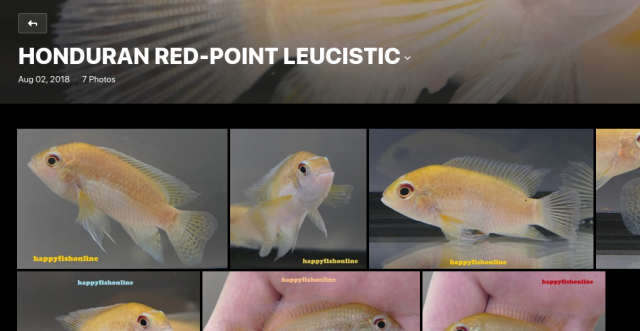
The xanthic form of Cichlasoma as seen at the beginning of this post is a fish I originally imported from an Ecuador collection about 2 years ago. My friend/exporter explained to me how this acara came into his possession.
He emailed me with photos taken first in the field of the fish that his fishermen collected while filling an order for me of M. festae. As was explained to me, they were fishing Rio Esmeraldas tributaries and found a 'new gold cichlid' living in a lagoon nearby to their festae fishing location.
I was intrigued and shared some photos with acara expert friends. Alf Stalsberg, for one, figured that the fish 'is not a real cichlid species' - or something to that effect.
I explained this is not a scenario in which perhaps an aquarist released fish into the wild or a commercial importer/breeder may have lost captive stock to rains/flooding, etc.
The fish were found in a remote region - not in proximity to above possible sources.
Xanthic = 'yellow form' or leucistic = 'partial loss of pigmentation' or true albino forms of fish (in particular) are not doomed to fail in the wild, but the odds are against their long term survival for many reasons. Recessive genetics, greater conspicuousness to predators (from both under and above the water level) due to lighter coloration (as opposed to normal cryptic wild coloration), and the often associated issues that come with albinism (visual impairment, susceptibility to sun exposure, etc.) all amount to the unlikelihood of the accidental discovery of this population of acaras in Ecuador.
That is the background scenario on how this particular fish came to become in the trade.
Upon import of the original stock, I counted soft rays and hard spines of the fish in attempt to key them out. At least two of my customers who received the fish from me (and subsequently bred them) did the same. Both of these aquarists have no doubt shared their husbandry of this fish on this site at some time or another.
I don't believe them to be an undescribed species, but rather a color form of a known species. It is of my shared opinion that they are a xanthic sport of Cichlasoma amazonarum.
I could be wrong and do not mind being corrected if proven otherwise. It would be interesting to know what we have here. As I am typing this reply, it occurred to me that I have the ability and connections to send samples of the fish to ichthyologists who, personally or via colleagues, may compare results of DNA analysis to known C. amazonarum data for initial match or similarities. Perhaps I ought to follow up on that.
At any rate, the fish have been bred (quite easily and prolifically) in captivity and I have seen them erroneously marketed as <Amatitlania> 'leucistic Honduran red point convict'.
Of course we know these are two completely different, vastly unrelated species - as the author of this thread, Hybridfish7 was correct to point out.
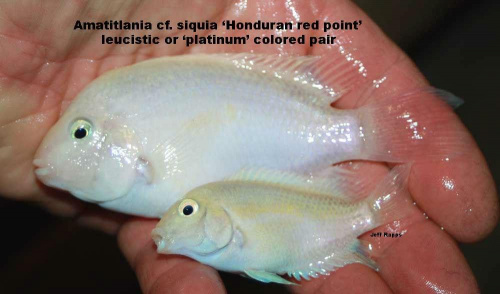
I wanted to comment briefly on the speculation of the origin of the 'platinum' form of Honduran convict.
This form was simultaneously encountered by some of my customers (and myself) who received wild and F1 Honduran convicts way back when I collected in Honduras ( > 10 years ago) and subsequently bred wild form stock in their tanks. We'd see a few 'white colored' babies in the spawns which we then grew out. Upon comparison at maturity to the well known 'pink convict' of trade, these known Honduran origin fish exhibited a subtle, yet entirely different appearance.
The previously posted photo in this thread by Hybridfish7 is a good example of a pair
I kept many years ago. Incidentally, my wife really digs this form of the convict and could never understand why more people don't keep them. She's collected so many convicts with me in the wild and has seen more barred form species of Amatitlania than most!
These are one of her (if not the) favorite cichlid.