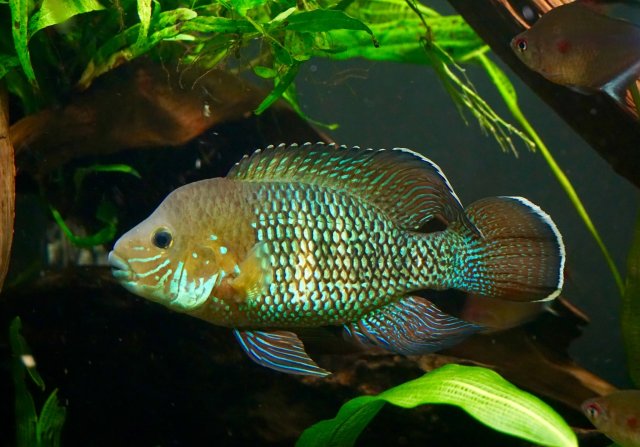
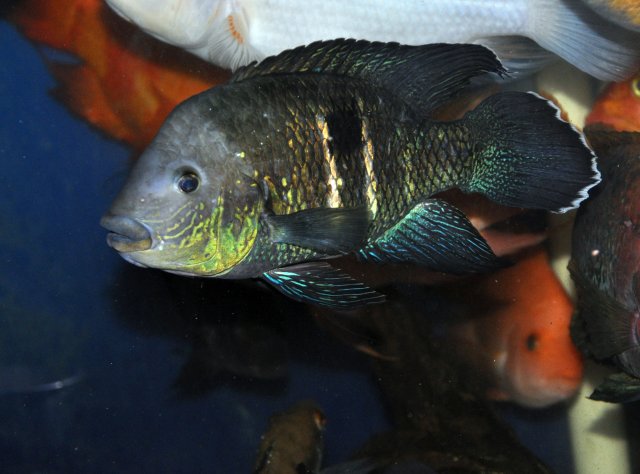
Ecuador lies directly above Peru on the Pacific coast, rivulatus' range is in Ecuador and just a small corner of northern Peru. Stalsbergi is in Peru. Both fish consistently have their own typical scale patterns, rivulatus with rows of black markings formed from the center of their scales and stalsbergi with light centers and dark edges on the scales as in the photos above. Rivulatus can have either white or gold to orange edges on their fins, stalsbergi have white edged fins, so while individuals of each species may differ slightly from one another in color or how wide the fin edge markings are, the scale pattern is always an obvious difference between the species.
You might notice in the Wayne Leibel article, despite hobbyist 'experts' who insist white edge rivulatus and gold edge rivulatus are the same species (and to this point they haven't been separated, so officially they're one species and I'm not saying different), Leibel, a scientist and biology professor with impressive credentials, leaves this open to further study. So I say wait and see, hobbyist 'experts' have been wrong before. Even expert experts, like Ad Konings, have had opinions or conclusions later found wrong after further study was done. Stalsberg's a collector, not a scientist, but he says the range of white edged and gold edged rivulatus overlaps and he considers them color morphs of the same species. I don't disagree, I'm just saying time will tell.
There's another similar looking fish, A. blombergi, also in Ecuador, with white edged fins and black centers in the scales like rivulatus. The white on blombergi fins is thinner than rivulatus and there are other subtle differences, scale counts, etc. Blombergi is rare, almost nonexistent in the US, other than the possibility some came in as rivulatus in the past.