Pumice filtration media

  • We are currently upgrading MFK. thanks! -neo

jamesucla

Plecostomus
MFK Member
Jul 19, 2008
61
65
51
LA
It is well known that Seachem matrix & pond matrix are pumice, of known origin, purity & consistent grade. That said, at the end of the day it is still "just pumice" although sold by the milliliter at a high markup.

The main objection to using any other source of pumice is uncertainty with its composition and perhaps possibility of containing heavy metals or other undesirable chemical components.

I am building a sump which i have room for 2 cubic feet of biological media, going with seachem would cost about $300 plus shipping. As an alternative I found this supplier of very clean pumice that has known composition & commonly sold for use in filtration, grow media, cosmetics, beverage filtration, and many other applications. They claim the source of this pumice does not contain the heavy metals & impurities found elsewhere.

More info about their pumice can be found on their website here:
https://hesspumice.com/pumice-pages/pumice-uses/filtration-pumice.html

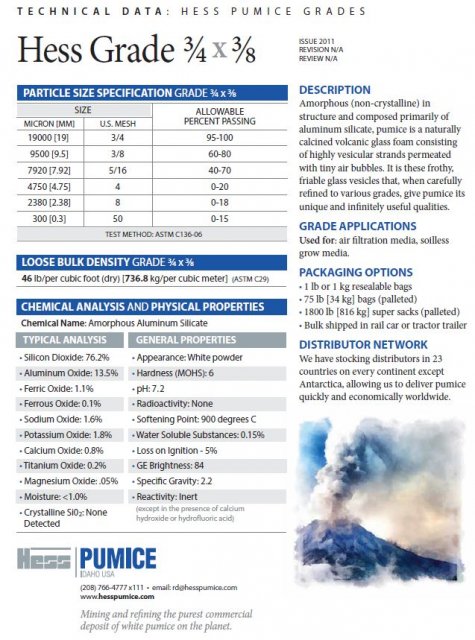
The data sheet of the product i will be using is below; it is about 1/3 the price of Seachem including the shipping. I ordered 100 lbs (2 cubic feet) for about $75 not including shipping.

Interested in thoughts of the experienced people here on if this is a good call or not.
Capture.JPG
 
Last edited:
Looks like it should work out. Just check out lava rock for the price as it’s really cheap and will do the same job. May save u some more money.
 
I'm running 20L of matrix (~.75cu ft) and around the same amount of ceramic. The problem with this type of media is once it gets dirty the pores clog which blocks flow. If you haven't purchased it yet I would recommend k1 (either fluidized or static), pot scrubbers from the dollar store, or 30ppi poret sponge.

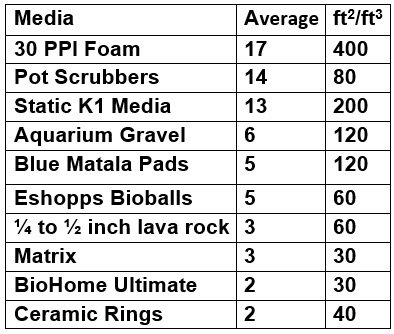
According to a test on 10 types of filter media by Aquariumscience.org lava rock and BioHome were the worst media. Bioballs and Matrix were twice as good as the [ceramic] rings. Aquarium gravel and Matala pads were three times as efficient as the rings. Static K1 media and pot scrubbers were five time more efficient than the rings. And 30 ppi Poret foam (“sponge”) was nine times more efficient than the rings.

In the format below the first number is the average ammonia oxidizing that roughly 15 cubic inches of media accomplished over a 90-day period. The second number is the effective surface area in feet squared per feet cubed, calculated by simple math. The correlation between the test results and the calculated surface area is very significant and means both are good ways to judge the efficacy of filter media.
7.1.4-filter-media-3.jpg
It appears the surface area calculations for the pot scrubbers was way off. But other than that the numbers correlate quite well.

Note that the surface area calculations were only for voids in a media which exceeded one millimeter (0.040 inch) in size. Many ceramic media manufacturers (such as Matrix or Biohome) measure the surface area as the area that incredibly tiny nitrogen gas molecules can access.

The openings in the media need to be a sizable diameter for bacteria to grow in them. A bacteria is trillions of times larger than a nitrogen molecule. If the bacteria can’t fit in a pore with room to spare, the pore is useless. So the huge surface area numbers coming from the ceramic media manufacturers is simply misleading marketing hype.

The small pore size also creates problems even for large pores like 2 millimeter (0.040 inches). The water flows through the path of least resistance. The water will not flow through small 2 millimeter pores if the water can flow around the media. If water doesn’t circulate through the holes of the media then obviously the water can’t have its ammonia oxidized by bacteria.

So the effective surface area of all media becomes the surface area over which water flows, not the surface area that nitrogen gas can somehow find its way to. This is what was calculated above.

The higher the number the better the media. So, foam is the best media and ceramic rings are the worst media by this test and roughly by math calculations. Since foam must be exactly cut to the proper size to prevent flow around, static K1 media or pot scrubbers are much easier to use.

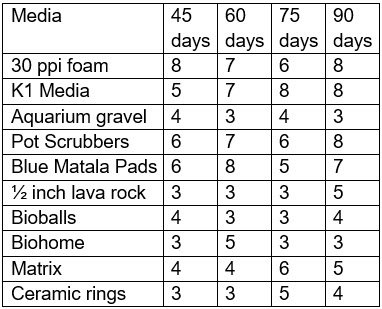
These are the numbers for the media over the span of 90 days. Eight is crystal clear water. Six is “dull” water. Four is “cloudy” water.
test-of-media-water-clarity-2.jpg
Ceramic rings did oxidize ammonia but did not give crystal clear water. This test shows that “crystal clear water” requires some twenty times the EFFECTIVE surface area of just ammonia oxidation, one hundred square feet of surface area per pound of fish.

It should be noted that crystal clear water appears to need three things:

-100 square feet of EFFECTIVE surface area per pound of fish
-Very good aeration
-High flow through the filter, at least two turn-overs per hour of the tank.

The important item here is that there is one immutable guideline:

One Pound of Fish Needs 100 Square Feet of Biomedia Surface Area to have Crystal Clear Healthy Water

It has to be noted that ammonia oxidation only appears to require a surface area of five square feet per pound of fish, only 5% of what crystal clear healthy water requires.

What this says is that a media with 5 square feet per cubic feet of effective surface area will oxidize ammonia for one pound of fish. However crystal clear healthy water requires 100 square feet per pound of fish. Note this surface area rule is supported in the literature (“Understanding Biological Surface Area in Aquaponics”, Michael, 2016).

“Remember: as an absolute minimum, your system needs at least: 5 ft2 of biological surface area/pound of fish (at low stocking densities and low feeding rates). For a healthier system, we would recommend: 100 ft2/pound of fish.”
 
Last edited:
Lot of information there to process; interesting results and admire the effort to conduct those experiments though I question some of the assumptions made. Particularly the idea that pores less than 2mm are useless from a surface area calc... I don't buy that; there is diffusion in water on that small of a scale that would make chemical exchange very real. If that were really the case you would see no difference between ceramic media and regular gravel.

Admire the effort put into this experiment but would take it with a grain of salt unless duplicated by more aquarists, in setups more conventional application. For example I would expect to see a big difference of the same media between a canister filter vs a sump with lots of oxygenation. Also odd to test a moving bed media in a static setting, not sure how useful that data point really is.

For my setup I don't want moving bed because it is noisy. My tank is in the living room & I want no noise. So my solution is a giant sump with relatively slow moving water and lots of biological media (2 cubic feet is a lot, about 55 liters), for. 300 gal relatively lightly stocked tank, cheers.
 
Seems like this would be a reasonably easy thing to test with something like a handful of small beta tanks. Small powerhead drawing through a container filled with different media in each tank. Add ammonia and test. Should be able to get an idea of the relative biological capability of each.
 
K1 says it can be used as static biomedia on the label, although it is typically used as self-cleaning mechanical filtration in a separate chamber. If noise is a concern you can use small wavemakers to boil the k1 instead of airstones. Here's some more info on Matrix from aquariumscience.org

The surface area claims made for Matrix are 700 meters per liter. This is 700,000 m2/m3 or 213,416 ft2 per ft3 of surface area. As usual with Seachem this is a mix of truth and lies, in a masterfully wordsmithed narrative.

Per a very complicated test called the BET nitrogen infusion test, Matrix may well have the “surface area” it claims to have. But this is incredibly misleading. Matrix has roughly 15 to 30 ft2/ft3 of EFFECTIVE surface area, confirmed by testing under actual aquarium conditions. The BET test gives 213,416 ft2 per ft3. And the math gives 15 to 30 ft2 per ft3. How’s that for marketing hype?

This surface area claimed for Matrix is based on how much nitrogen gas can penetrate the media and adsorb on the surface via something called a pycnometer via a complex calculation called the BET equation. This test doesn’t even come close to reflecting reality in the aquarium.

The nitrogen gas molecule is billions of times smaller than a beneficial bacterial cell. So, the nitrogen gas is adsorbed in billions of tiny pores where bacteria can’t even fit.

Depending on the ceramic process used, the pore size in ceramic media can be as low as 0.001 microns in size. The ceramic media claiming the highest surface area have the smallest pore sizes. A bacterium is 2 to 5 microns in size. So the BET nitrogen infusion test is simply worthless in determining the surface area available for beneficial bacteria to colonize.

And the “porous” Matrix has a problem even for pores larger than a bacterium. For comparison 45 ppi urethane foam has a pore size of 650 microns. If you go to 45 ppi foam in a filter everyone knows that foam will clog rapidly in an aquarium. Any “porous” filter media with a pore size below 500 microns (20 thousandths of an inch) will rapidly clog and is not a good filter media.

Also, let’s say Matrix with its large surface area will have a pore size on the order of 30 microns (one thousandths of an inch). A bacterium is 2 to 5 microns in size. So, a bacterium only must divide a few times to clog a passageway into Matrix. Bacteria can multiple every 30 minutes. Think about that for a while. The pores are just too small. They clog far too rapidly. The actual effective surface area of Matrix after a few weeks is on the order of only 15 to 30 ft2 per ft3.

There is no way to sugar coat it. Seachem’s surface area claims are simply bogus. They are pure unadulterated marketing hype.

In any case, the other problem with Matrix has to do with flow. In order for nitrifying (ammonia oxidizing) beneficial bacteria to work there has to be a high flow over the surface of the bacteria. The flow with Matrix is around, not through the media. So the Matrix media will do a very poor job of biofiltration, even if the beneficial bacteria could somehow manage to fit into the structure of the Matrix.

Seems like this would be a reasonably easy thing to test with something like a handful of small beta tanks. Small powerhead drawing through a container filled with different media in each tank. Add ammonia and test. Should be able to get an idea of the relative biological capability of each.

The 2nd test above was conducted using seperate 40 gallon tanks with Sunsun HW 304 B canister filters (~one half cubic foot of media, 370 GPH). Various media was then placed in the filter. This was the only media in the filter. Each of the tanks was well aerated by a wavemaker aimed at the surface to produce a large area of “choppy waves”.

Brown squeezings from an established tank was put in at the start of each test. The tanks were then cycled with two grams per day of commercial dry flakes fish food and no fish. This is a high loading guaranteed to produce infusoria and a lot of cloudy water. Several dry runs with established media in filters showed this loading to be guaranteed to produce very cloudy water in matter of days. The tests were each run for ninety days (results in 2nd chart above).
 
You are literally copying and pasting from a website without addressing the concerns I raised. You already linked to the article, much of which I disagree with. Author of the article seems like a quack, won't even provide his name or credentials, and the math is fuzzy. K1 has gotta be the dumbest recommendation for static media that I can think of.
 
You are literally copying and pasting from a website without addressing the concerns I raised. You already linked to the article, much of which I disagree with. Author of the article seems like a quack, won't even provide his name or credentials, and the math is fuzzy. K1 has gotta be the dumbest recommendation for static media that I can think of.
If you would prefer anecdotal evidence to support the purchase you made before posting that's fine with me. I use 40L+ of matrix and fluval ceramic and my fish aren't dead so it must be good. The only concern you raised that I didn't address was there being a huge difference between matrix used in a canister or sump. Obviously a sump will provide more oxygen for denitrification and space for more media, but in a controlled experiment the results still stand.

So far I'm the only person who has bothered to share any actual data or scientific research. The author provided some of his extensive credentials and reasoning for not sharing his name online right on the homepage. I would love to see some actual data disproving anything I copied and pasted (with sources and links). It's rather ironic the author mentions "belief perseverance effect" on the page about matrix.
 
Last edited:
If you would prefer anecdotal evidence to support the purchase you made before posting that's fine with me. I use 40L+ of matrix and fluval ceramic and my fish aren't dead so it must be good. The only concern you raised that I didn't address was there being a huge difference between matrix used in a canister or sump. Obviously a sump will provide more oxygen for denitrification and space for more media, but in a controlled experiment the results still stand.

So far I'm the only person who has bothered to share any actual data or scientific research. The author provided some of his extensive credentials and reasoning for not sharing his name online right on the homepage. I would love to see some actual data disproving anything I copied and pasted (with sources and links). It's rather ironic the author mentions "belief perseverance effect" on the page about matrix.
I'm not using matrix so not defending them. I disagree with his surface area calculations, which are BS, completely neglecting the effect of surface roughness on the calculation (huge difference), as well as the general handwaving dismissal of any pores smaller than 2mm. Neither of those concerns I brought up were addressed in your copy paste. Furthermore I have no concerns with ammonia or nitrite in this kind of setup, the goal of a lot of this is to provide some anerobic support for nitrates as well. Agree there is a lot of dogma and unsubstantiated claims in this hobby and general BS in the form of marketing. That said extraordinary claims should be duplicated by more than 1 source, who has some faulty assumptions on his initial setup, testing, & premise for analysis.

More to the point it is annoying that you copy paste pages from someone's website, it is a lot of blathering & waste of space on this thread, and redundant because the link was already posted.
 
Last edited:
Besides my posts this whole thread is a waste of space. No you're not using matrix you're just using the closest thing to it you could find. You asked for advice on a product you already purchased knowing if it's suitable for beverage filtration it's safe for fish. You claim his assumptions are BS but provide no actual info of your own besides biased assumptions. Any surface area calculations of rough porous objects will have some degree of error. He did account for pores in all media though (eg 512 per cu in for gravel) and only pores smaller than 1mm weren't included, not 2mm. Honestly I fail to see a fault in the majority of his assumptions or test results.
 
Last edited:
  • Like
Reactions: jamesucla
MonsterFishKeepers.com