how big of a tank do you need to have a functional ecosystem going?

  • We are currently upgrading MFK. thanks! -neo

Hybridfish7

Bronze Tier VIP
MFK Member
Dec 4, 2017
2,902
2,843
739
And I mean relatively. Like say I just wanted to have a community type setup for smaller fish where I can occasionally replicate seasonal changes to make things spawn. How big would that need to be? Kind of out of character and as much as I don't like mixing continents too extremely, just for example, some small species of cichlid, rasboras or endlers, shrimp, snails, some interesting sp of small pleco just to have something to look for, and cories or loaches
 
10 liters? Really not clear what you mean. "Functional ecosystem" sounds like trying to make it self sustaining, for that I'd say you're looking at a thousand liters+ and very good lighting. But for "occasionally replicate seasonal changes" That's just maybe turning the heater up and down at the simplest.
 
In my opinion a 20 gallon long if you want a bunch of breeding guppies with a single predator. For an actual ecosystem, atleast 120 gallons, but the predators can’t be more than an 2 inches. Unless by ecosystem, you mean a biotop.
I have a mini ecosystem in a vase with a bunch of life forms that randomly appeared after a month.
 
probably should have specified, as for functional ecosystem I mean like everything can reproduce successfully, plants grow, algae and microfauna grows, things eat eachother
so yes self sustaining in a sense
and as for seasonal changes, I would do things like dry seasons, rainy seasons and of course lowering and increasing temps
 
probably should have specified, as for functional ecosystem I mean like everything can reproduce successfully, plants grow, algae and microfauna grows, things eat eachother
so yes self sustaining in a sense
and as for seasonal changes, I would do things like dry seasons, rainy seasons and of course lowering and increasing temps
Well for this to truly work you would need ample room for stuff to be able to breed and thrive and not be eaten before that happens. Obviously a massive tank with a relatively low stocking on the more predatory things would be the best case scenario. You could accomplish this with "safe" areas for the prey in a smaller setup but it would need to really be pretty attractive to that animal to keep a small population there breeding. I've noticed in small tanks with say gammarus shrimp and mandarin goby's no matter how well you prepare the predator will sooner or later eradicate the prey.

I had a 30g with overhead and under tank sumps the overhead sump was the perfect breeding ground of gammarus shrimp lots of algae, I put food in there, and I had seeded it with tons of gammarus. I seeded the entire set up and let the tank stabilize and grow out all the shrimp for 6 months before I moved in a pair of mandarin gobies. There were tons of shrimp and with the overhead sump and gravity return design of it I knew the shrimp would breed there and some would get down to the dt. Gammarus shrimp are pretty easy to breed kind of like when fresh tanks get snail infestations it's from over feeding. So I continued to feed the shrimp and watch water quality (kind of hard to do). I added the pair of gobies and they happily started to explore and eat shrimp these guys were so happy it was super cool. At that time mandarin gobies had not only not been bred in captivity they also were supposedly very hard to feed as they would not eat prepared or frozen foods. Care for these guys always said mature tanks only experienced keepers only. Not a beginners fish for sure. After about a year the shrimp population had been pretty much exhausted there were some still hiding in the rocks and breeding but not in adequate numbers to be a sole food source. Lucky for me mine would accept frozen foods. I never got them to breed there was, maybe still is, virtually no way to tell the males and females apart. Mine acted as if they could have been a pair but any rate no babies or even spawning events that I saw. The moral of the story is it took them about a year to destroy the food population in a set up that was designed to allow the food items a safe haven in which to breed and really flourish.
 
Well for this to truly work you would need ample room for stuff to be able to breed and thrive and not be eaten before that happens. Obviously a massive tank with a relatively low stocking on the more predatory things would be the best case scenario. You could accomplish this with "safe" areas for the prey in a smaller setup but it would need to really be pretty attractive to that animal to keep a small population there breeding.
Agree with the above.
In nature fish are generally in a feast or famine situation. If food is available, its eaten until gone, and this is the problem in any but the largest tanks, even with the smallest fish.
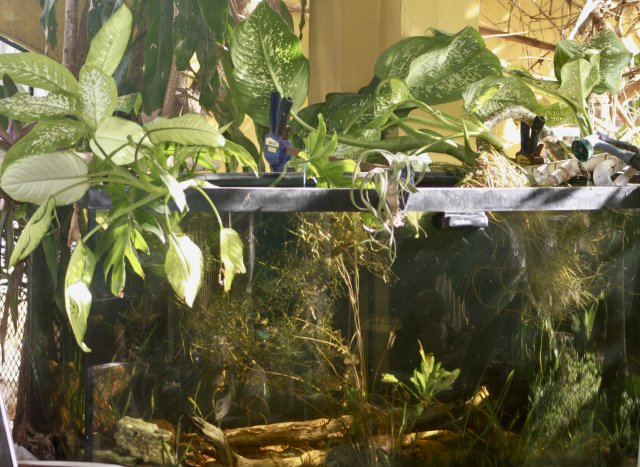
In my current tank, I try to run it as naturally as possible. No heater, no artificial lights (only sun), a pump and sumps for filtration and during seasonal changes, water changes are done using only rain water during the rainy season.
D7ECA5D9-CC50-4476-9247-7FA058D7EC99_1_201_a.jpeg
This can be disconcerting when rains drips tannins in the tank to such a degree, as to make it impossible to see much more than 2" into it, also blocking out the sun enough to make all plants melt back, and drop pH from low 8s, to 7 or below, there were 15 fish.
Even though the tank is 180 gallons, and the largest fish are no more than 7", the seasonal changes have brought on spawning ruts, where the 2 dominant males have lately killed any other males, and divided the entire tank in half.
Natural waters are very much influenced by terrestrial vegetation growing in them, and or sending roots that suck out a plethora of nutrients.
I use terrestrial plants for this, but compared to real live, I believe they are a pittance.
The pics below is from 2 days ago, the rains have slowed, and am doing 20% daily water changes with municipal water.
0CFEB1CE-6316-413F-AC62-6AB81EFE8D2A_1_201_a.jpeg
I added about a dozen fairly large shrimp into the tank (small ones in the sumps) but they only lasted a couple weeks with the cichlids.
The first fish were about 2 dozen mosquito fish, and they barely lasted a week once the young (2-3" cichlids back then) once the cichlids were added.
I believe a 6 ft tank, with fish no larger than a couple inches (killifish, small live bearers, neons or the like), initially heavily stocked with adult gammarus, other crustaceans, mollusks and aquatic insects, and heavily planted might work, but any larger fish such as cichlids (even dwarf type) is probably not a reasonable candidate for sustainability without regular intervention


3745F493-8120-4BAB-8798-40575B8D9484_1_201_a.jpeg
 

Attachments

  • D7ECA5D9-CC50-4476-9247-7FA058D7EC99_1_201_a.jpeg
    D7ECA5D9-CC50-4476-9247-7FA058D7EC99_1_201_a.jpeg
    1.9 MB · Views: 1
  • 0CFEB1CE-6316-413F-AC62-6AB81EFE8D2A_1_201_a.jpeg
    0CFEB1CE-6316-413F-AC62-6AB81EFE8D2A_1_201_a.jpeg
    3.1 MB · Views: 0
Last edited:
Your best bet might be to have a divided setup, a big section for something like guppies, divided off so the adults can't get to the other section that has some smaller predatory fish that can survive on the fry. This way the predators don't eat all the breeders. Even then, it will take some balancing to ensure that enough fry survive in the protected area to keep breeding the next generation.

But you should be able to manage with a smaller tank this way.
 
Kinda depends on what you really want to keep. Not sure how much this will help, but one of my tanks is a heavily planted 40 breeder that houses, yellow tiger endlers, blue dream neos, one otocinclus, two reticulated hillstream loaches, and tons of snails (4 different types). It's an extremely satisfying tank. Always something to watch in there for sure. Always new fish and shrimp. Very minimal maintenance. In fact I could probably go months at a time doing nothing except feeding, so I probably do too many water changes, but I like to be on the safe side and replace minerals and water hardness.
 
  • Like
Reactions: MatteoTheEnder22
MonsterFishKeepers.com


