

Experienced keepers please help / anchor worms
- Thread starter craigfish1
- Start date
-
- Tags
- anchor worms
You are using an out of date browser. It may not display this or other websites correctly.
You should upgrade or use an alternative browser.
You should upgrade or use an alternative browser.

I will start the salt regiment tomorrow, slowly bringing it up. Thanks again.I've read that rock salt can also be used.

I've found the most effective treatment for anchor worm (learnea) is trichlorphon especially for large water volumes. Half life is short so it quickly disappears. Usually sold as lawn grub killer. It's easily overdosed so I won't recommend a dosage but plenty of info online.
Salt isn't effective on anchorworm in my experience.
Salt isn't effective on anchorworm in my experience.
Thankyou for the infoI've found the most effective treatment for anchor worm (learnea) is trichlorphon especially for large water volumes. Half life is short so it quickly disappears. Usually sold as lawn grub killer. It's easily overdosed so I won't recommend a dosage but plenty of info online.
Salt isn't effective on anchorworm in my experience.

I had a couple wild fish arrive with Lernaea.
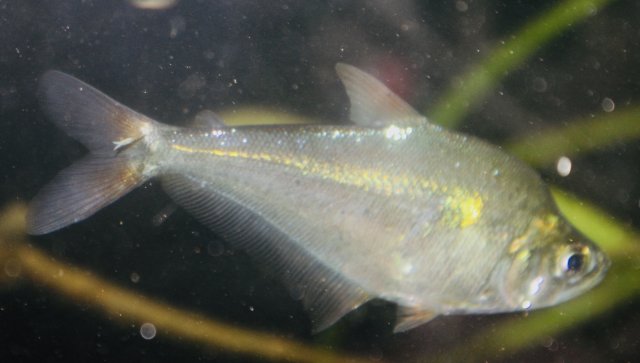
The adults are notoriously iresistant and almost mmune to salinity and some medications.
So I found I had to physically remove the adults with a tweezers.
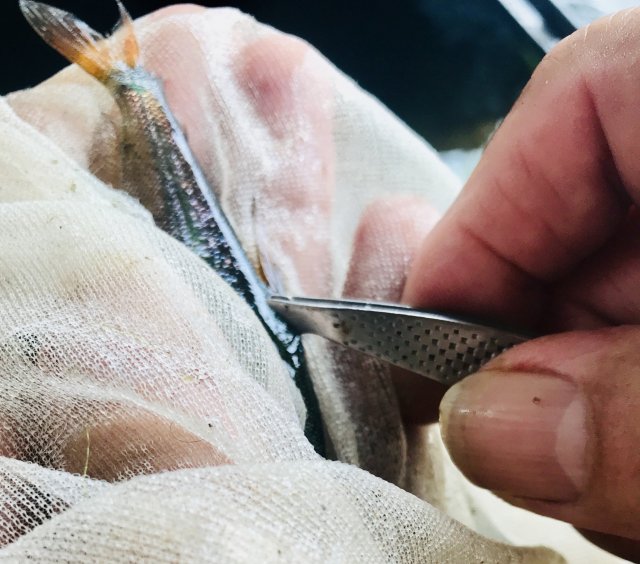
At the same time as physical removal, I treated the tank for the emergent larval stage with a salinity of slightly higher than 3 ppt parts per thousand).
Unless all adults removed and larvae are killed with salinity, it will reinfect.
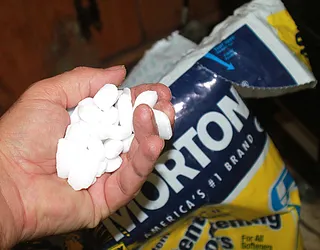
To achieve that salinity, at least 3 lbs of salt need to be added per 100 gallons. Rock salt, kosher salt, iodized salt, it doesn't matter as long as its NaCl (many aquarium fish are iodine deficient).
I use the weight method because 3 lbs is 3 lbs no matter how salt is graded, but using the volume method (Tsps, Tbps) its to easy to under-dose.
My tank is also a 180 gal, with a sump so I add 6 lbs of salt at once, and they never returned.

The adults are notoriously iresistant and almost mmune to salinity and some medications.
So I found I had to physically remove the adults with a tweezers.
At the same time as physical removal, I treated the tank for the emergent larval stage with a salinity of slightly higher than 3 ppt parts per thousand).
Unless all adults removed and larvae are killed with salinity, it will reinfect.
To achieve that salinity, at least 3 lbs of salt need to be added per 100 gallons. Rock salt, kosher salt, iodized salt, it doesn't matter as long as its NaCl (many aquarium fish are iodine deficient).
I use the weight method because 3 lbs is 3 lbs no matter how salt is graded, but using the volume method (Tsps, Tbps) its to easy to under-dose.
My tank is also a 180 gal, with a sump so I add 6 lbs of salt at once, and they never returned.
Agree with Duanes, you have to remove the adults with tweezers, do a nice size water change to remove larvae/eggs, and add salt until you don’t see them anymore.
Interestingly, when I used meds, it would keep infestations down for a bit but the anchor worms would always come back between redosing. I assumed that was from the meds wearing out. It was a pain since I’d have to keep removing adult anchor worms to add another dose of meds…and that was according to the manufacturer’s dosing schedule. Endless madness…
With salt, there is no half life. So once I plucked off the adult anchor worms and added salt, the fish didn’t get reinfected again and eventually the anchor worms were eradicated
Interestingly, when I used meds, it would keep infestations down for a bit but the anchor worms would always come back between redosing. I assumed that was from the meds wearing out. It was a pain since I’d have to keep removing adult anchor worms to add another dose of meds…and that was according to the manufacturer’s dosing schedule. Endless madness…
With salt, there is no half life. So once I plucked off the adult anchor worms and added salt, the fish didn’t get reinfected again and eventually the anchor worms were eradicated
Last edited:
I have read so much information over the last months, about salt, and availableThankyou for the info
I had a couple wild fish arrive with Lernaea.
View attachment 1505505
The adults are notoriously iresistant and almost mmune to salinity and some medications.
So I found I had to physically remove the adults with a tweezers.
View attachment 1505506
At the same time as physical removal, I treated the tank for the emergent larval stage with a salinity of slightly higher than 3 ppt parts per thousand).
Unless all adults removed and larvae are killed with salinity, it will reinfect.
To achieve that salinity, at least 3 lbs of salt need to be added per 100 gallons. Rock salt, kosher salt, iodized salt, it doesn't matter as long as its NaCl (many aquarium fish are iodine deficient).
I use the weight method because 3 lbs is 3 lbs no matter how salt is graded, but using the volume method (Tsps, Tbps) its to easy to under-dose.
My tank is also a 180 gal, with a sump so I add 6 lbs of salt at once, and they never returned.
View attachment 1505507
View attachment 1505508
Thankyou very much for your informationI had a couple wild fish arrive with Lernaea.
View attachment 1505505
The adults are notoriously iresistant and almost mmune to salinity and some medications.
So I found I had to physically remove the adults with a tweezers.
View attachment 1505506
At the same time as physical removal, I treated the tank for the emergent larval stage with a salinity of slightly higher than 3 ppt parts per thousand).
Unless all adults removed and larvae are killed with salinity, it will reinfect.
To achieve that salinity, at least 3 lbs of salt need to be added per 100 gallons. Rock salt, kosher salt, iodized salt, it doesn't matter as long as its NaCl (many aquarium fish are iodine deficient).
I use the weight method because 3 lbs is 3 lbs no matter how salt is graded, but using the volume method (Tsps, Tbps) its to easy to under-dose.
My tank is also a 180 gal, with a sump so I add 6 lbs of salt at once, and they never returned.
View attachment 1505507
View attachment 1505508
Thankyou for your help!Agree with Duanes, you have to remove the adults with tweezers, do a nice size water change to remove larvae/eggs, and add salt until you don’t see them anymore.
Interestingly, when I used meds, it would keep infestations down for a bit but the anchor worms would always come back between redosing. I assumed that was from the meds wearing out. It was a pain since I’d have to keep removing adult anchor worms to add another dose of meds…and that was according to the manufacturer’s dosing schedule. Endless madness…
With salt, there is no half life. So once I plucked off the adult anchor worms and added salt, the fish didn’t get reinfected again and eventually the anchor worms were eradicated
One thing I forgot to mention, I kept salinity at that high concentration for at least 2 months.
After each water change, more salt was added to keep concentration up.
This parasite is a lot like ick in that salinity (and meds) only work during the larval stage, but not when on the fish.
And each female anchor worm can produce at least 250 larvae.
Because the parasite is a crustacean, not a worm, meds need to reflect that morphology, and include a chitin inhibitor, or the med is useless.
The problem with that type med, is it may be carcinogenic to humans, and has been banned in many places, one reason I rely on the >3ppt salinity.
After each water change, more salt was added to keep concentration up.
This parasite is a lot like ick in that salinity (and meds) only work during the larval stage, but not when on the fish.
And each female anchor worm can produce at least 250 larvae.
Because the parasite is a crustacean, not a worm, meds need to reflect that morphology, and include a chitin inhibitor, or the med is useless.
The problem with that type med, is it may be carcinogenic to humans, and has been banned in many places, one reason I rely on the >3ppt salinity.
I sure appreciate this information. I believe that the dimlin x, has a chitin inhibitor, , and I am glad that I wash my skin well, after any contact. I purchased Pool salt, which says it is pure NaCl. I already attempted a salt water eradication, couple months ago , but I am sure I did not achieve high enough salinity, and only kept the water salted for 3 weeks or so. I am going to follow the advice given with the salt content and 2 month duration at minimum. I am so appreciative of getting advice from knowledgeable keepers like yourself.One thing I forgot to mention, I kept salinity at that high concentration for at least 2 months.
After each water change, more salt was added to keep concentration up.
This parasite is a lot like ick in that salinity (and meds) only work during the larval stage, but not when on the fish.
And each female anchor worm can produce at least 250 larvae.
Because the parasite is a crustacean, not a worm, meds need to reflect that morphology, and include a chitin inhibitor, or the med is useless.
The problem with that type med, is it may be carcinogenic to humans, and has been banned in many places, one reason I rely on the >3ppt salinity.
