How to keep fish alive while at college?

  • We are currently upgrading MFK. thanks! -neo

Freeze Dried Skittles

Feeder Fish
MFK Member
Mar 25, 2025
19
7
8
17
Florida
I unfortunately will be leaving for college in two months and am wondering if my critters will be alive when I return?

Feeding them won't be an issue, as I've got automatic feeders for my tanks and my sister knows how to fill them up. My main worry is if my tanks can go without water changes while I'm gone. I have no actual filters for my tanks, all have plants in them, and I usually do water changes every couple days, depending on the tank. None of my family members know how to take care of the animals properly, so I unfortunately cannot rely on them to change any water. I will be back at home during normal breaks, and can change water then.

I currently only have two tanks. ~60 gal. breeder w/ 1 Convict and 1 Dragon Blood Peacock Cichlid and ~300 gal. w/ 3 small turtles.

 
You’ve got two months to answer that question. Start testing for nitrates daily to see how long they can go before the nitrates climb to an unhealthy level. Are they going to make it without water changes, water top offs, daily observation, and proper feedings, my money is on not a chance. If you don’t have anyone to do the basics I’d recommend rehomimg the fish and turtles.
 
  • Like
Reactions: tlindsey and deeda
I would suggest if you are going away to school, taking an environmental science course as an elective might help if you are planning to keep fish, or other aquatic animals long term.
Learning to do the basic testing procedures could go a long way to your own success, and you could gain a couple science credits to boot.
All serious aquarists should know the basics of ammonia, nitrite, and nitrate testing, along with the testtng pH, and a few other basic test procedures, and how to read tand interpret hem.
IMG_2885.jpeg
 
If you're going to be basically gone for a year, with maybe a couple visits back and no one can properly look after them...You're probably best rehoming the fish and shutting down everything until they can be looked after properly.
 
I don't know how to test any of that. The water stays relatively clean in the turtle tank for about a month. I don't know about the other one. I figured I'd have to rehome them. >:(
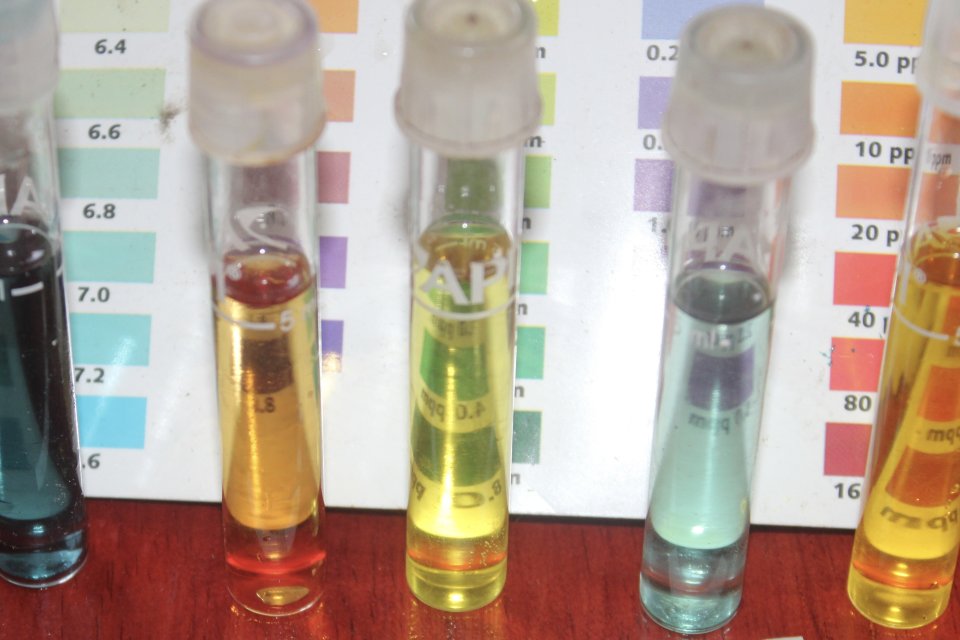
Test kits come with instructions and they are pretty simple. I have them memorized because I had to do them for my university vivarium maintenance job. If you buy an API master test kit, you just fill the tubes the kit comes with to the line with tank water, and then:
pH - add 3 drops of the test solution and turn it upside down a few times
high range pH - add 5 drops of the test solution and turn it upside down a few times
nitrite - add 5 drops of test solution, shake for a few seconds, wait 5 minutes
ammonia - add 8 drops of the first solution then 8 drops of the second solution. shake for 5 seconds and wait for 5 minutes
nitrate - shake the bottle of the first test solution for 30 seconds, add 10 drops of the first solution to the vial, turn it upside down a few times, then add 10 drops of the second bottle and shake for a minute. then wait 5 minutes
then compare the color of the liquid in the tubes to the chart to get your reading. you only need to do the high range pH if your pH reading with the normal test is higher than what the chart can display.

or the easy way to consolidate it is just
- label and fill up all your tubes with tank water
- add the pH test solution, nitrite test solution, ammonia solutions 1 and 2, and first nitrate solution to their respective tubes
- cap all of them and shake them all for a few seconds. pH test is ready to read now, nitrite and ammonia are done preparing/will be ready to read in 5 minutes.
- shake the second bottle of nitrate solution for 30 seconds then add the 10 drops of that to the nitrate tube and shake for another minute, then wait 5 minutes.

and then once youre done dump them out and rinse them out 3 times.

Aquariums only have 3 forms of nitrogen you need to worry about (ammonia, nitrite, nitrate). Ammonia turns into nitrite, nitrite into nitrate. The bacteria in your filter is aerobic and its main purpose is to detoxify ammonia into nitrate. Ammonia is released when organic matter (food, poop, dead fish) decays. Ammonia and nitrite reading should always be 0 as these are both toxic. Nitrate is safe at lower levels (realistically "low" is below 30-50 ppm but some fish are more sensitive and need it below 10 or close to 0... convicts and peacocks are not those fish). The lack of ammonia and nitrite but presence of nitrate means your filter is working. A new tank with new water can reveal 0's across the board because nothing has happened yet. If your tank has been running for months and tests reveal 0's across all 3 then you have a good functional "clean" tank.
 
Last edited:
I unfortunately will be leaving for college in two months and am wondering if my critters will be alive when I return?

Feeding them won't be an issue, as I've got automatic feeders for my tanks and my sister knows how to fill them up. My main worry is if my tanks can go without water changes while I'm gone. I have no actual filters for my tanks, all have plants in them, and I usually do water changes every couple days, depending on the tank. None of my family members know how to take care of the animals properly, so I unfortunately cannot rely on them to change any water. I will be back at home during normal breaks, and can change water then.

I currently only have two tanks. ~60 gal. breeder w/ 1 Convict and 1 Dragon Blood Peacock Cichlid and ~300 gal. w/ 3 small turtles.
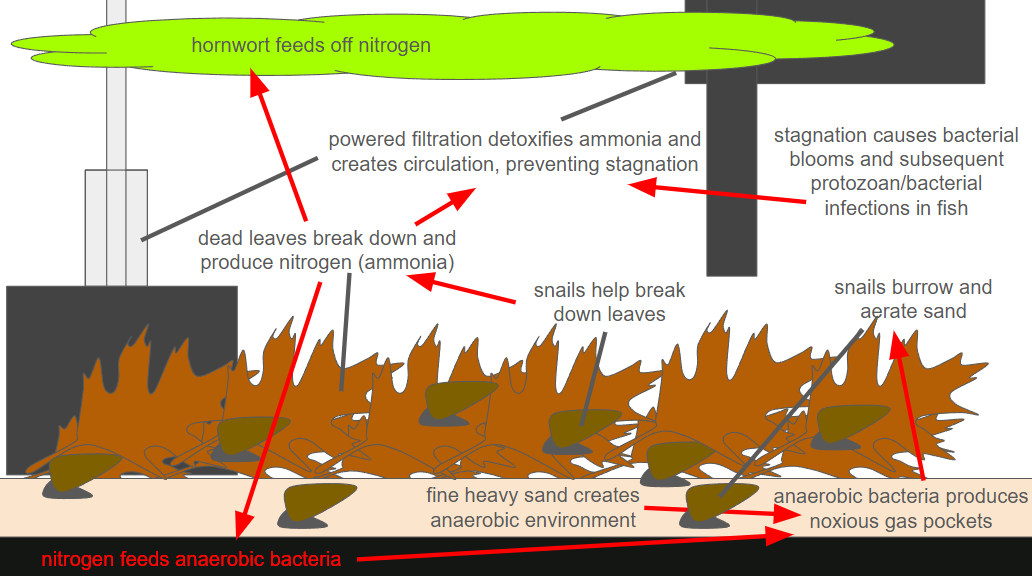
I kept all my tanks through college. Albeit I only went to school an hour away and my dad took care of some things while I was gone, I still went the first 2 years with 26 tanks and the following 2 with 14. I set my tanks up in a way that I don't really have to do much. Some I don't even have to feed directly. The key is good circulation, plants, and mature microfauna populations. Sounds like a lot on paper but all I do is use play sand from home depot (washed manually because it's dusty), put hornwort in my tanks, use sponge filters or hang on backs with oversized pumps for their respective tanks, and throw dry oak leaves/trumpet snails in the tank. Your filter is already running so you don't have to worry about that part.

The sand is fine and heavy, so throwing oak leaves in the tank quickly makes anaerobic bacteria in the sand as they break down. Trumpet snails help break down the leaves for the anaerobic bacteria and then aerate the sand so I don't get noxious gas pockets from the anaerobic bacteria. The decaying leaves also create a lot of nitrogen which feeds the plants and makes them grow like crazy, and the overfiltration helps detoxify said nitrogen. The plants and anaerobic bacteria then consume the nitrate so I have 0 nitrates. The overfiltration prevents stagnation which can cause bacterial blooms and subsequent outbreaks of diseases from protozoans/bacteria like epistylis and columnaris. Thus I don't need to do waterchanges. Here is a quick diagram:
1780027181200.png
I don't really do waterchanges on most of my smaller tanks unless they have fry or are relatively overstocked. Your tanks are not. The turtles may be a bit tricky given they will eat plants and possibly snails, but the snails do burrow and reproduce pretty fast. The tannins from the leaves breaking down do drop the pH a bit which is not good for the peacock but if you have limestone in there it will keep it above 8.

If I'm gonna be honest it may be less hassle to just teach your family to take care of your tanks given you only have two of them. But if you want to make them self sufficient for the most part... this is how I do it.
 
MonsterFishKeepers.com