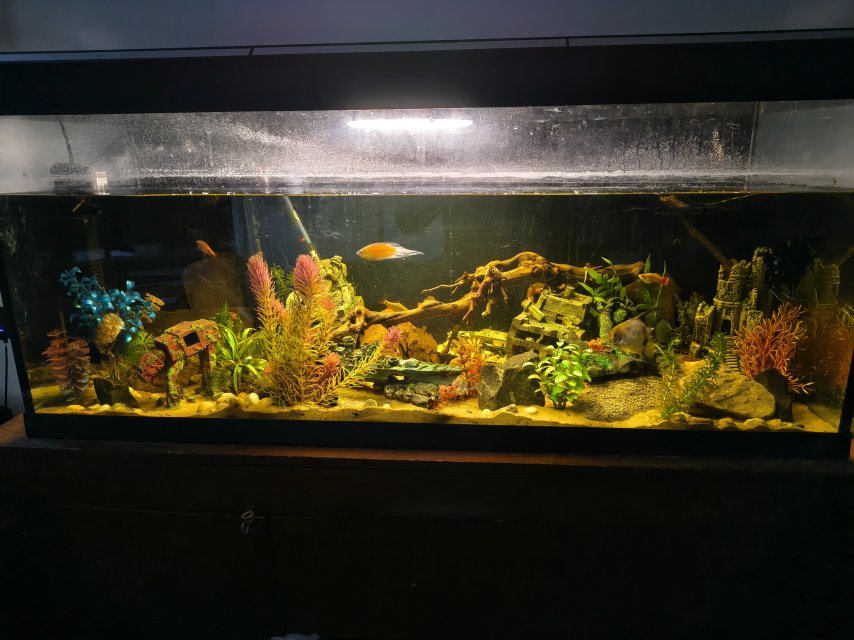
Rethinking standard practice: 8 years, no testing, no disease.

  • We are currently upgrading MFK. thanks! -neo

vain

Feeder Fish
Jun 6, 2026
4
1
3
34
Durham
What started as a goldfish tank 8 years ago has now become a stable miniature ecosystem for tropical fish. In this tank, I currently have 2 Angelfish, 2 Tiger Barbs, 2 Cherry Barbs, 2 Red Paradise Fish, a Chinese Algae Eater, as well as a singular guppy that decided to coexist and school with the barbs after losing his female companion (she also schooled with the barbs). They exist peacefully together and have been on flake food since the day I got them.

I have never tested my water and use very few live plants. It's a low-maintenance tank that requires a 50% water change once every 3 months. The tank manages its own bioload, the water remains constantly clear, and I've never had a single outbreak of Ich or fin rot.

1000006754.jpg
 
  • Haha
Reactions: danotaylor
Hello; Prepare for a potential onslaught. There likely will be accusations of poor water quality because of rare water change (WC). They will not know the water conditions because you do not list testing results. By the same token you will not be able to rebut because you also do not know the water parameters. Could become entertaining.

I do not know the water conditions either but can make a couple of educated guesses. You have low stocking density which is a positive for slowing buildup of the most commonly tested chemicals. Water cycle territory which I will leave to someone else. The end of that cycle is a relatively mild toxin called nitrate. Nitrate builds up in a closed system such as an aquarium.
Lots of live plants, especially the emergent sort can remove some of the nitrates is my understanding. A thing seems to be some of the plant parts either need to be harvested or some plant parts need to grow out of the water (emergent) At the very least all or most dead and/decaying leaves need to be removed and not allowed to rot in the water. The last few decades I have gone to very light stocking of fish but have lots of plants. I pull the live (healthy) plants from time to time and take them to a fish shop in Kingsport TN. I still do WC more often than you report.

Next WAG has to do with evaporation. In three months, you likely have to top off the tank with water because some evaporates. All tap water, well water and such sources will have some dissolved minerals in the water. As tank water evaporates the minerals remain. A WC every three months likely means you have a large buildup of minerals & salts over a year. Rule of thumb by me is to WC at least twice as much new water as has evaporated. If the thank water goes down two inches, then drain out at least four inches and replace.

But in the end, you get to run your tank any way you please. Good ,bad or in between. Other than low density stoking & live plants I cannot defend a three-month WC schedule.

You do not mention a low-level feeding schedule but that might help some. That means sparce feedings along with one or two days a week of fasting. That way not much excess food left to rot in the water.

Kind of wish you had kept on keeping on and not posted. Gives those who are zealots ammunition for finding ways to enforce their favored way of doing things inside our homes.

I will steal a line from duanes duanes . Compare the nitrate/mineral buildup of most all aquariums to the build up of natural/wild water habitats. The wild waters most often do not have measurable nitrates. Some wild water can have minerals, but the fish have adapted to such. :popcorn:
 
  • Like
Reactions: HUKIT
I get what you mean about the mineral buildup from evaporation, but I don't just top it off. When I do the water change every 3 months, I do a massive 50% drain. That big of a flush dilutes whatever built up and completely resets it.
I actually don't feed light, either. I feed pretty heavy on a daily basis, some times twice a day. The tank just processes it. The bacteria colony is 8 years old, so it handles the load easily, and the bottom feeders clear the rest before anything can foul the water.
And lol no, nitrates don't evaporate. But the deep substrate and 8 year old filter media hold enough bacteria to process a lot of it naturally, and the 50% water change takes care of the rest.
I wouldn't tell someone to do this on a brand new setup, but the proof is in the fish. 8 years running, clear water, zero disease, and a guppy that schools with tiger barbs without getting shredded. It just found its balance a long time ago.
 
every 3 months, I do a massive 50% drain. That big of a flush dilutes whatever built up and completely resets it.

I feed pretty heavy on a daily basis, some times twice a day.

nitrates don't evaporate. But the deep substrate and 8 year old filter media hold enough bacteria to process a lot of it naturally,
Hello; I suspect the wording may be more like look what I get away with rather more than all is good. That you apparently let it evaporate for three months likely explains the photo. But how the tank looks is a personal choice so not an issue. Here is something I have gleaned from others and experience. A common strategy when WC have been absent or low % for a long time is to suggest a slow buildup to bigger volume & larger % WC so to give the fish a chance to adjust to the different water chemistry. Reduce the shock of very different water. Similar to the way I accustom new bought fish to my tanks slowly.

I am not on site so do not know if we are comparable with each other on what is heavy feeding. Sounds too heavy to me.

My take is deep substrate and old filters loaded with bacteria have little to nothing to do with the buildup of nitrates in the water column. This may indicate a misunderstanding of the tank cycle and the work of the beneficial bacteria in that cycle on your part.
 
  • Like
Reactions: jjohnwm
I get why you're skeptical since it goes against what everyone says. But this isn't luck. I keep Angels, Paradise Fish, and Barbs in there, and they’re sensitive fish that get aggressive if things aren't right.

The reason it works is that I leave the tank alone. I’ve got 8 years of buildup in the sand and filter doing the heavy lifting. Every time you vacuum or mess with chemicals, you’re just killing the balance that keeps the water stable. My fish have been peaceful for years because the environment never changes. The proof is in the tank, the fish are healthy and they aren't fighting. Stability beats constant maintenance in my opinion.
 
I'm not a compulsive water tester like many others are, but I think this situation cries out for a test to be done. As S skjl47 said...it will be "entertaining" and also informative.

IMHO, there's a vast difference between a "low-maintenance tank" and a tank that receives low maintenance. Either way...good luck!
 
The irony here is that if the parameters were actually off, these sensitive species wouldn't have survived a month, let alone years. The fact that they are alive, vibrant, and peaceful tells me all I need to know. I don't need a chemical kit to tell me what the biological reality already proves. The tank works as it should.
 
The reason it works is that I leave the tank alone. I’ve got 8 years of buildup in the sand and filter doing the heavy lifting. Every time you vacuum or mess with chemicals, you’re just killing the balance that keeps the water stable. My fish have been peaceful for years because the environment never changes. The proof is in the tank, the fish are healthy and they aren't fighting. Stability beats constant maintenance in my opinion.
Hello; let me repeat the mantra. You get to run your tanks any way you want. Same applies for opinions. I am often at odds with members on here over certain procedures. A guess is many on here would love to ditch WC all together and every three months sounds good.
A thing to consider are the big differences between natural/wild bodies of water and the closed systems which are our tanks. I live in a farm/cattle area. I see what i call closed ponds nearby. The sort which are man-made and do not have a constant inflow of water and get rain runoff. They get rank in dry spells such as the current one we are having.
Natural pools most often have both an inflow and an outflow. A constant refreshing and flushing of the water. The nitrates often measure zero nitrates. The volume of water per fish is not measured in gallons but in 100's or 1000's of gallons per fish.

I know it is not the same analogy but picture no inflow nor outflow inside your house. That all waste is contained inside for three months and not removed nor flushed away. I imagine a decent filter system could be arranged in such a house but the waste would still be in the environment of the house.

Back in 1959 I got my first tanks. I did not know about WC on a regular basis. I tore down the tanks ( 5,10 & 20 gallons) around once a year. In a year the gravel would be nasty. When i refilled the cleaned tank the fish perked up. Yes they survived. The fish looked good. The fish can endure a lot. I learned about WC + low density stocking + light feeding + live plants over the decades. I find the small fish species do live a lot longer than back in the day.

We have fish in very crowded conditions compared to the wild. The fish are in closed systems which do not flush so we substitute WC. WC is a pain to do so we rationalize some level of frequency & % so we can feel alright about it. I do not want to pay the water bill for even a continuous drip system. So I come up with a plan which still falls short of a natural habitat. The fish are tough and take it.
 
  • Like
Reactions: jjohnwm
MonsterFishKeepers.com