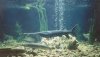
Here's a little info on paddlefish:
Polyodon spathula
American paddlefish
(Also: paddlefish)
By John Jerome
Kingdom: Animalia
Phylum: Chordata
Subphylum: Vertebrata
Class: Actinopterygii
Order: Acipenseriformes
Family: Polyodontidae
Genus: Polyodon
Species: Polyodon spathula
Geographic Range
Polyodon spathula (American paddlefish) is currently found in 22 states that are part of the Mississippi River drainage (Mims, 2001). American paddlefish distribution is now restricted to this system of large, slow-moving rivers. In the past, P. spathula was located in 4 more states in this drainage, the Great Lakes, and Canada (Graham, 1997). The many dams that have been added throughout the Mississippi River drainage have limited the ranges of many populations of these fish (Wills, 1993). Due to these unnatural blockages, migratory breeding behavior has been disrupted, and many areas previously sustaining paddlefish must be annually stocked by local conservation agencies (Graham, 1997). (Graham, 1997; Mims, 2001; Wills, 1993)
American paddlefish have also been introduced into the lower Danube River, in the Balkans region of Europe, as sportfish. (Vassilev, 2006)
Habitat
American paddlefish are mainly freshwater fish but can survive in brackish water (Billard, 2001). They generally reside in large rivers with deep water (greater than 6 meters) and slow moving currents (less than 5 cm/s) (Zigler, 2003; Southall, 1984). Turbid (muddy) water is preferred by P. spathula. During migratory breeding events, P. spathula needs access to areas with sand or gravel bars (Wills, 1993). (Billard and Lecointre, 2001; Southall and Hubert, 1984; Wills, 1993; Zigler, Dewey, and Knights, 2003)
These animals are found in the following types of habitat: temperate
Aquatic Biomes:lakes and ponds; rivers and streams; fresh to brackish water
Physical Description
Mass
70 kg (high); avg. 18 to 45 kg
(154 lbs; avg. lbs)
Length
2.50 m (high)
(8.2 ft)
American paddlefish are clearly distinguishable from other North American fish by the presence of an extended snout, or rostrum. This rostrum is covered with electroreceptors to locate zooplankton and facilitate migratory behavior. American paddlefish are large, reaching maximum lengths of up to 2.5 meters and weighing from 18 to 70 kg. Males are generally larger than females (Wilkens, 2002). Large gill rakers are present in these fishes for zooplankton consumption from turbid waters (Russell, 2002). They also have a cartilaginous skeleton, heterocercal tail, and lack scales (Wills, 1993). (Russell and Neiman, 2002; Wilkens, Hoffman, and Wojtenek, 2002; Wills, 1993)
Some key physical features: ectothermic; heterothermic; bilateral symmetry .
Sexual dimorphism: male larger.
Development
After fertilization, developing American paddlefish may be seen through their transparent roe, or eggs. In 24 hours the notochord develops, and a heartbeat is apparent by day four. By the fifth day, young P. spathula hatch and begin their larval stage of life. They are then carried somewhere downstream by slow moving river currents (Wills, 1993). Once gill rakers fully form, juvenile paddlefish can effectively filter feed (Mims, 2001). Female American paddlefish are not fully mature until they reach 12 to 14 years of age and males are mature at ages of 6 to 7 years (Wills, 1993). (Mims, 2001; Zigler, Dewey, and Knights, 2003)
Reproduction/Breeding interval: American paddlefish breed every 2 to 3 years.
Breeding/spawning season: American paddlefish spawn in the late winter and spring.
Number of offspring: many thousands (average)
Time to hatching: 5 days (high)
Age at sexual or reproductive maturity (female)
10 to 12 years; avg. 11 years
Age at sexual or reproductive maturity (male)
6 to 7 years; avg. 6.50 years
Paddlefish are broadcast spawners whereby multiple males swim near and release milt onto the eggs liberated by a female. The eggs are very sticky and thus adhere to a substrate such as gravel or sand (Wills, 1993). A spawning migration occurs within the Mississippi River system making paddlefish a potamodromous species. During the peak of the breeding season in the spring, large shoals of male and female fish form in specific breeding areas to spawn (Billard, 2001). (Billard and Lecointre, 2001; Wills, 1993)
Mating systems:
polygynandrous (promiscuous) <http://animaldiversity.ummz.umich.edu/site/gloss_icon.gif> .
Female American paddlefish are very particular about when they will release their eggs for reproduction. It has been noted that spawning generally occurs only every 2 to 3 years based upon certain environmental stimuli. At a specific spring photoperiod, there must be a rise in the water level of the river accompanied by a water temperature of approximately 55 to 60 degrees Fahrenheit (Wills, 1993). (Wills, 1993)
Key reproductive features:
iteroparous; seasonal breeding; gonochoric/gonochoristic/dioecious (sexes separate); sexual; fertilization (external); broadcast (group) spawning; oviparous.
Beyond the production of roe and milt, female and male American paddlefish provide nothing in the form of parental investment. The yolk sack of larval padlefish is consumed after hatching which may be considered a form of pre-fertilization provisioning by the female (Wills, 1993). These fishes are an excellent example of a species with a life history strategy designed to maximize success by producing many more eggs than will survive, rather than providing parental care. (Wills, 1993)
Parental investment:
no parental involvement; pre-fertilization (provisioning).
Lifespan/Longevity
Longest known lifespan in wild
55 years (high)
Expected lifespan in wild:
20 to 30 years
American paddlefish are relatively long-lived, they may live up to 55 years. The average lifespan as estimated in dentary studies seems to be about 20 to 30 years (Wills, 1993). (Wills, 1993)
Behavior
Relatively little is known of P. spathula behavior towards conspecifics or members of different species. More is known about American paddlefishes physiological behavior in terms of feeding and respiration. American paddlefish can often be seen swimming around with their very large mouths wide open. This is a behavior that allows the fish to filter feed and ventilate their gills (ram ventilation) at the same time (Burggren, 2003). It is also known that American paddlefish swim in a fairly primitive manner involving undulation of nearly the entire body (Wills, 1993). (Burggren and Bemis, 1992; Wills, 1993)
Home Range
Polyodon spathula ranging behavior has been inferred from radio tagging experiments. These show that paddlefish generally restrict their movement to a certain home range, but that they frequently stray from this area, especially during spring breeding seasons (Zigler, 2003; Jennings, 1993). During the breeding season, American paddlefish migrate upstream to gravel or sand bars, but they generally never leave the freshwater of the Mississippi River basin (Wills, 1993) (Jennings and Wilson, 1993; Wills, 1993; Zigler, Dewey, and Knights, 2003)
Key behaviors: natatorial; motile; migratory.
Communication and Perception
The large rostrum (paddle) of P. spathula is covered with electroreceptors (Russell, 2002). This paddle is essentially a highly sensitive antenna used to gather information about the surrounding environment through changing electrical fields. This electric sense is used by American paddlefish to locate prey and successfully migrate during spawning seasons (Wilkins, 2002). This system is so sensitive that juveniles can locate single zooplankton from up to 9 cm away by sensing the miniscule electrical pulses given off by the animal?s muscle contractions (Wilkins, 2002; Wills, 1993). It is unclear how P. spathula individuals communicate during spawning, but they may use a combination of visual and tactile cues. (Russell and Neiman, 2002; Wilkens, Hoffman, and Wojtenek, 2002; Wills, 1993)
Communicates with: visual; tactile.
Perception channels: visual; tactile; chemical; electric.
Food Habits
Polyodon spathula is a faunivore specialized for filter feeding. As described above, American paddlefish use electroreceptors to locate zooplankton in turbid water (Wilkins, 2002). Examples of animals in the P. spathula diet are copepods, cladocerans such Daphnia pulex, and ephemeropteran nymphs (Hoxmeier, 1997). Polyodon spathula possesses huge gill rakers along with jaws that are anatomically independent from the neurocranium (Carroll, 2003). These features allow for a larger surface area to be filtered by American paddlefish. (Carroll and Wainwright, 2003; Hoxmeier and DeVries, 1997; Wilkens, Hoffman, and Wojtenek, 2002)
Primary Diet: planktivore.
Animal Foods: insects; aquatic crustaceans; zooplankton.
Behaviors: filter-feeding.
Predation
Known predators
* humans (Homo sapiens)
* fish (Actinopterygii)
* birds (Aves)
It is speculated that the large size and extended life span of P. spathula is an adaptation to avoid predation. Producing high concentrations of paddlefish offspring in a single season may be a predator satiating mechanism used to maximize the chances of survival for a smaller, but significant proportion of P. spathula. When American paddlefish are in their larval stage they are easy prey for many different birds and fishes, but at maturity their only real predators are humans (Wills, 1993). (Wills, 1993)
Ecosystem Roles
American paddlefish are predators of zooplankton and prey to other fishes, birds, and humans. Also, silver lampreys have been found to use American paddlefish as hosts (Cochran, 2004). Beyond these relationships, relatively little is known of the role of American paddlefish in their ecosystem. (Cochran and Lyons, 2004)
Economic Importance for Humans: Negative
There are no known adverse affects of P. spathula on humans.
Economic Importance for Humans: Positive
Perhaps to the benefit of humans and the detriment of American paddlefish, these fish are highly valuable in many ways. Due to their large size and succulent flesh, P. spathula has long been utilized as a source of meat. Also, being closely related to sturgeons (family Acipenseridae), American paddlefish produce highly coveted roe, or caviar. In the 1980?s a trade embargo of Iranian imports severely limited the amount of caviar that was imported to the United States from the Caspian Sea. As the demand for caviar increased, American paddlefish suffered heavy population losses as the illegal acquisition of their roe became a highly profitable endeavor (Wills, 1993). (Wills, 1993)
Beyond P. spathula being a source of caviar, their skin is thick, scaleless, strong, and tans well, making it a marketable product. There is also a growing interest in the immune system of American paddlefish. Despite their extremely simple immune system, they rarely, if ever, get cancer due to their cartilaginous skeleton. Cartilage prohibits blood flow to cancerous cells that is necessary for their growth, thereby stopping the spread of cancer. Therefore, American paddlefish have been a useful and promising test subject in the field of aquatic pharmacology (Wills, 1993). (Wills, 1993)
Since American paddlefish are extremely beneficial to humans in many ways, they are currently being farm raised in the U.S. (Mims, 1999), and as far away as Russia, Romania, and Moldavia (Vedrasco, 2001). Most of the fish at these farms are produced for their valuable meat and caviar (Vedrasco, 2001). (Mims and Shelton, 1999; Vedrasco, Lobchenko, and Billard, 2001)
Ways that people benefit from these animals: food; body parts are source of valuable material; research and education.
Conservation Status: IUCN Red List: Vulnerable.
US Federal List: No special status.
CITES: Appendix II.
Other Comments:
Polyodon spathula was first described by J. Walbaum in 1792 (Walbaum, 1792). (Walbaum, 1792)
Contributors:
Tanya Dewey (editor), Animal Diversity Web, University of Michigan Museum of Zoology.
John Jerome (author), University of Michigan. William Fink (editor, instructor), University of Michigan.
References
Billard, R., G. Lecointre. 2001. Biology and conservation of sturgeon and paddlefish. Reviews in Fish Biology and Fisheries, 10/4: 355-392.
Burggren, W., W. Bemis. 1992. Metabolism and ram gill ventilation in juvenile paddlefish, Polyodon spathula (Chondrostei, Polyodontidae). Physiological Zoology, 65/3: 515-539.
Carroll, A., P. Wainwright. 2003. Functional morphology of prey capture in the sturgeon, Scaphirhynchus albus. Journal of Morphology, 256/3: 270-284.
Cochran, P., J. Lyons. 2004. Field and laboratory observations on the ecology and behavior of the silver lamprey (Ichthyomyzon unicuspis) in Wisconsin. Journal of Freshwater Ecology, 19/2: 245-253.
Graham, K. 1997. Contemporary status of the North American paddlefish, Polyodon Spathula. Environmental Biology of Fishes, 48: 279-289.
Hoxmeier, R., D. DeVries. 1997. Habitat use, diet, and population structure of adult and juvenile paddlefish in the lower Alabama River. Transactions of the American Fisheries Society, 126/2: 288-301.
Jennings, C., D. Wilson. 1993. Spawning activity of paddlefish (Polyodon spathula) in the lower Black River, Wisconsin. Journal of Freshwater Ecology, 8/3: 261-262.
Mims, S., L. Shelton. 1999. Monosex culture of paddlefish and shovelnose sturgeon. Proc. Symp. on Harvest, Trade and Conservation of N.A. Paddlefish and sturgeon: 42-51.
Mims, S. 2001. Aquaculture of paddlefish in the United States. Aquatic Living Resources, 14/6: 391-398.
Russell, D., A. Neiman. 2002. Noise-induced afferent bursting in electroreceptors of paddlefish. Society for Neuroscience Abstract Viewer & Itinerary Planner: 86-88.
Russell, D., L. Wilkin, F. Moss. 1999. Use of behaviourial stochastic resonance by paddlefish for feeding. Nature, 402: 291-293.
Southall, P., W. Hubert. 1984. Habitat use by adult paddlefish in the upper Mississippi River. Transactions of the American Fisheries Society, 113/2: 125-131.
Vassilev, M. 2006. Lower Danube- The Last Refuge for Surviving of Sturgeon Fishes in the Black Sea Region. BALWOIS : Water Observation and Information System for Balkan Countries, 1: 1-10. Accessed June 21, 2006 at
http://balwois.mpl.ird.fr/balwois/administration/full_paper/ffp-858.pdf..
Vedrasco, A., V. Lobchenko, R. Billard. 2001. Introduction of the paddlefish Polyodon spathula in Europe. Aquatic Living Resources, 14/6: 383-390.
Walbaum, J. 1792. Petri Artedi renovati. Part 3. Petri Artedi sueci genera Piscium in quibus systema totum ichthyologiae proponitur cum classibus, ordinibus, generum characteribus, specierum diffentiis, observationibus plumiris. Redactis Speciebus 2. Ichthyologiae, III: 723.
Wilkens, L., M. Hoffman, W. Wojtenek. 2002. The electric sense of the paddlefish: a passive system for the detection and capture of zooplankton prey. Journal of Physiology, 96/5-6: 363-377.
Wills, B. 1993. The Paddlefish: An American Treasure. Fort Worth, TX: Earthwave Productions Inc..
Zigler, S., M. Dewey, B. Knights. 2003. Movement and habitat use by radio-tagged paddlefish in the upper Mississippi River and tributaries. North American Journal of Fisheries Management, 23/1: 189-205.
2007/05/20 08:53:43.279 GMT-4
To cite this page: Jerome, J. and W. Fink. 2004. "Polyodon spathula" (On-line), Animal Diversity Web. Accessed May 20, 2007