Almond leaves in aquariums

  • We are currently upgrading MFK. thanks! -neo
Oh certaintly. Last i checked it my kh is through the roof. But ph stays right around 7. I keep them in the tank at all times because my blue acara pair is rough on eath other and their firemouth buddy (at least he is when they arent in a spawning mood)
 
  • Like
Reactions: islandguy11
If the fish are from areas that have tannins during certain times of the year or year round, then I would think it's beneficial to have some amount in. It could be the one thing missing for fish like oscars that get HITH. Tons of reading on it.

Humic substances. Part 2: Interactions with organisms. Meinelt T1, Schreckenbach K, Pietrock M, Heidrich S, Steinberg CE.

  • zleibniz Institute of Freshwater Ecology and Inland Fisheries, Müggelseedamm 310, 12587 Berlin, Germany
Humic substances. Part 1: Dissolved humic substances (HS) in aquaculture and ornamental fish breeding Meinelt T1, Schreckenbach K, Pietrock M, Heidrich S, Steinberg CE.

  • leibniz Institute of Freshwater Ecology and Inland Fisheries, Müggelseedamm 310, 12587 Berlin, Germany
Humic acid and moderate hypoxia alter oxidative and physiological parameters in different tissues of silver catfish (Rhamdia quelen) Riffel, Ana P; K; Saccol, Etiane M; H; Finamor, Isabela A; Ourique, Giovana M; Gressler, Luciane T

  • Journal of Comparative Physiology. B, Biochemical, Systemic, and Environmental Physiology184.4 (May 2014): 469-82.
Dissolved organic carbon from the upper Rio Negro protects zebrafish (Danio rerio) against ionoregulatory disturbances caused by low pH exposure; Rafael M. Duarte, D. Scott Smith, Adalberto L. Val & Chris M. Wood

  • Scientific Reports 6, Article number: 20377 (2016) doi:10.1038/srep20377 Published online: 08 February 2016
Can dissolved aquatic humic substances reduce the toxicity of ammonia and nitrite in recirculating aquaculture systems?; Thomas Meinelta, , , Hana Kroupovab, , Angelika Stübera, Bernhard Rennerta, , Andreas Wienkec, , Christian E.W. Steinbergd

  • Martin-Luther-University Halle-Wittenberg, Medical Faculty, Institute of Medical Epidemiology, Biostatistics and Informatics, Magdeburger Straße 8, 06112 Halle (Saale), Germany
The Use of Aqueous Humic Substances for in-situ Remediation of Contaminated Aquifers; D.R. van Stempvoort, S. Lesage, J. Molson

  • National Water Research Institute
Role of Humic Substances in the Complexation and Detoxification of Heavy Metals: Case Study of the Dnieper Reservoirs; P.N. Linnik, T.A. Vasilchuk

  • Department of Hydrochemistry, Institute of Hydrobiology, National Academy of Sciences
Use of Humic Substances to Remediate Polluted Environments: From Theory to Practice; Irina V. Perminova, Kirk Hatfield, Norbert Hertkorn

  • Proceedings of the NATO Advanced Research Workshop on Use of Humates to Remediate Polluted Environments: From Theory to Practice Zvenigorod, Russia 23–29 September 2002
Mitigating Activity of Humic Substances: Direct Influence on Biota; N.A. Kulikova, E.V. Stepanova, O.V. Koroleva

  • Department of Soil Science, Lomonosov Moscow State University
Cytotoxic and Radical Scavenging Potential of Indian Almond (Terminalia catappa) Leaf Extracts; D. R. Behera, Sunita Bhatnagar* and A.K.Mahapatra

  • Medicinal and Aromatic Plants Division, Regional Plant Resource Centre, Nayapalli, Bhubaneswar-751015, India.
Antiparasitic, Antibacterial, and Antifungal Activities Derived from a Terminalia catappa Solution against Some Tilapia (Oreochromis niloticus) Pathogens; C. Chitmanat, K. Tongdonmuan, P. Khanom, P. Pachontis and W. Nunsong

  • Department of Fisheries Technology College of Agricultural Production Maejo University, Chiang Mai, 50290 Thailand
Humic substances affect physiological condition and sex ratio of swordtail (Xiphophorus helleri Heckel) Thomas Meinelt, Kurt Schreckenbach, Klaus Knopf, Andreas Wienke, Angelika Stüber, Christian E. W. Steinberg

  • Meinelt, T., Schreckenbach, K., Knopf, K. et al. Aquat. Sci. (2004) 66: 239. doi:10.1007/s00027-004-0706-9
The effect of some tannins on trout erythrocytes exposed to oxidative stress; Donatella Fedelia, Marco Berrettinia, Teresa Gabryelakb, Giancarlo Falcionia

Department of General Biophysics, University of Lodz, Banacha, 12/16, Lodz 90-237, Poland Received 15 July 2003, Revised 28 January 2004, Accepted 10 June 2004, Available online 23 August 2004

Antibacterial Properties of Tannic Acid and Related Compounds against the Fish Pathogen Cytophaga columnaris; Guojing Zhao , King-Thom Chung , Kimberly Milow , Wenxian Wang & S. Edward Stevens Jr.

  • Published online: 09 Jan 2011 Department of Microbiology and Molecular Cell Sciences, University of Memphis
Growth Inhibition of Selected Aquatic Bacteria by Tannic Acid and Related Compounds: King-Thom Chung , Guojing Zhao , Edward Stevens Jr. , Bill A. Simco & C. I. Wei

  • Published online: 09 Jan 2011 Department of Microbiology and Molecular Cell Sciences, University of Memphis
Antileishmanial activity and immune modulatory effects of tannins and related compounds on Leishmania parasitised RAW 264.7 cells; Herbert Kolodzieja, Albrecht F. Kiderlenb

  • Robert Koch-Institut, Department of Infectious Diseases, Nordufer 20, D-13353 Berlin, Germany Revised 14 December 2004, Available online 12 February 2005
Antibacterial action of several tannins against Staphylococcus aureus; Hisanori Akiyama*, Kazuyasu Fujii, Osamu Yamasaki, Takashi Oono and Keiji Iwatsuki

  • Department of Dermatology, Okayama University Graduate School of Medicine and Dentistry, Shikata-cho 2-5-1, Okayama 700-8558, Japan
Humic substances affect physiological condition and sex ratio of swordtail (Xiphophorus helleri Heckel) Meinelt, T., Schreckenbach, K., Knopf, K. et al. Aquat. Sci. (2004) 66: 239. doi:10.1007/s00027-004-0706-9

  • Aquatic Sciences June 2004, Volume 66, Issue 2, pp 239–245
DISSOLVED HUMIC SUBSTANCES FACILITATE FISH LIFE IN EXTREME AQUATIC ENVIRONMENTS AND HAVE THE POTENTIAL TO EXTEND THE LIFESPAN OF CAENORHABDITIS ELEGANS. Steinberg, Christian E. W.; Saul, Nadine; Pietsch, Kerstin; Meinelt, Thomas; Rienau, Stefanie; Menzel, Ralph

  • Annals of Environmental Science . Feb2007, p81-90. 10p.
Physiological effects of humic substances on higher plants: Serenella Nardia, , , Diego Pizzeghelloa, Adele Muscolob, Angelo Vianelloc Received 16 July 2001, Revised 15 July 2002, Accepted 19 August 2002, Available online 28 October 2002

  • Dipartimento di Biologia ed Economia Agro-industriale, Sezione di Biologia Vegetale, Università di Udine, Via Cotonificio 108, 33100 Udine, Italy

 
My water is rock hard and alkaline out of the tap. I do not use these in any of my tanks...except one. I have some Satanoperca pappaterra F1s from a region of soft acidic water. I dont want to do to much to the water and endanger the stability, but I keep a dozen or so in the 40 breeder I have the fish in. This may present problems as they grow though and need to be moved to larger tanks. However, I think if I slowly adjust over the course of their life it should be helpful, fingers crossed
 
If the fish are from areas that have tannins during certain times of the year or year round, then I would think it's beneficial to have some amount in. It could be the one thing missing for fish like oscars that get HITH. Tons of reading on it.

I agree, stated the same many times over the years, including in the following sticky on HTH.


No problem, always glad to help fellow hobbyists.


Something else that is often asked is why does this disease seem to mostly affect Oscars, or Discus, or certain Geophagus species?

This has been discussed by myself, Tom, Matt, and no doubt numerous others over the years.
In the case of blackwater species I believe that those species found in acidic blackwater environments do not always cope well with various parasites/pathogens found in non blackwater environments. In their natural habitat many of these pathogens do not exist, and due to the acidity found in the water cannot survive.

There is much more than just pH involved, and even tannins, various other natural turpines and chemicals found in indigenous plant matter may not only keep the pH buffered quite low, but in some instances (such as Terminalia catappa aka Almond leaves) some of these various indigenous plant matter are also known to produce antimicrobial activity that suppresses both gram positive & gram negative bacteria. Take those species out of that "protective" environment, and introduce them to parameters outside their ideal range, and a fish that comes under stress (of any form) is going to be open for invasion from any number of pathogens that it would not normally encounter in the wild.


As far as nutrition and/or vitamins being a cause, or a potential cure, I know of only 2 studies that have involved HLLE and diet, the carbon study linked to above that was performed at the Toledo Zoo, and the one that author mentions by Tilghman et al from the University of Florida. I'm familiar with both studies and in both cases NLS was used as part of the control diet as it has been proven to NOT induce HLLE. In other words, if one wants to remove a nutrient poor diet from the equation it's as simple as feeding NLS. That won't solve or remove the various other potential causes, but it will remove any concerns with regards to insufficient nutrient levels. Although I am sure that at least with most freshwater species, the vast majority of the more premium commercial fish foods currently on the market will also be more than adequate at preventing any type of nutritional deficiencies. I wouldn't have said that 30 yrs ago.


So for those keeping any of the more sensitive species my current advice would be as follows.

Feed a nutrient rich well balanced diet (sparingly, NOT power feeding) and that solves any potential problems in that area.

Next, keep your water clean, including filters, the less bacteria present the less potential for stress from poor water quality. Ditto to 02 levels ect.

Keep all stress levels low, which will keep any major outbreaks of pathogens at bay. (such as S. vortens)

And probably best to keep blackwater fish in blackwater conditions. Lower pH values, higher tannin etc levels, along with including certain plant matter such as Terminalia catappa that is known to increase antimicrobial activity.

HTH


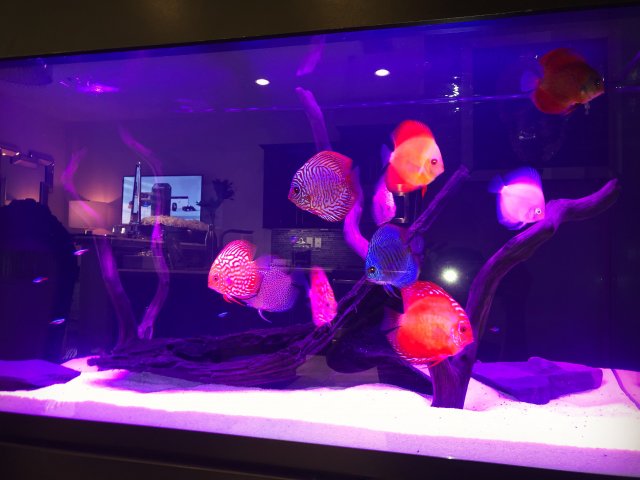
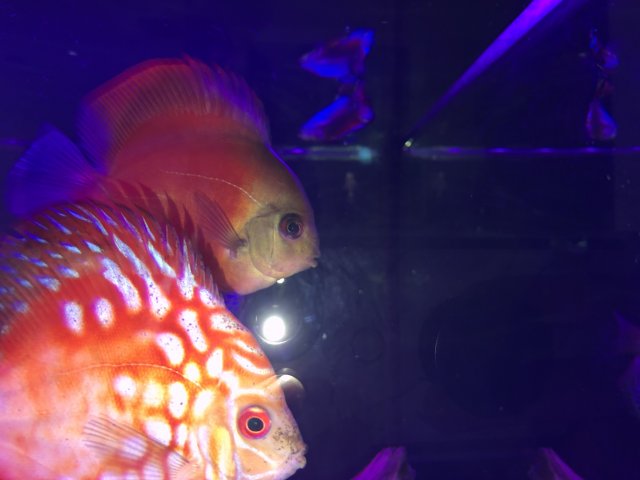
....... but IMO the OP's fish are designer fish, not even remotely close to anything from the wild, and again IMO with designer fish stability is key, and only tossing in a few leaves here and there will have zero, or near zero impact on the overall health of the fish. I have used almond leaves in the past, in certain tanks, but in quantity where I assumed there would be a benefit to the fish. In other words, if the water isn't amber colored, such as found in natural "blackwater" conditions, one won't be achieving much. I don't see that happening here, but the OP is certainly welcome to spend the $$$ on leaves if he feels the need.
 
Last edited:
Bingo!


Listen to your inner voice, sit back, and enjoy your fish. Throwing a few leaves into your sump won't achieve anything, your fish are all designer strains and don't require any magical pH value in order to thrive. KISS - keep it simple stupid
Thank you for the helpful and polite replies, as always.

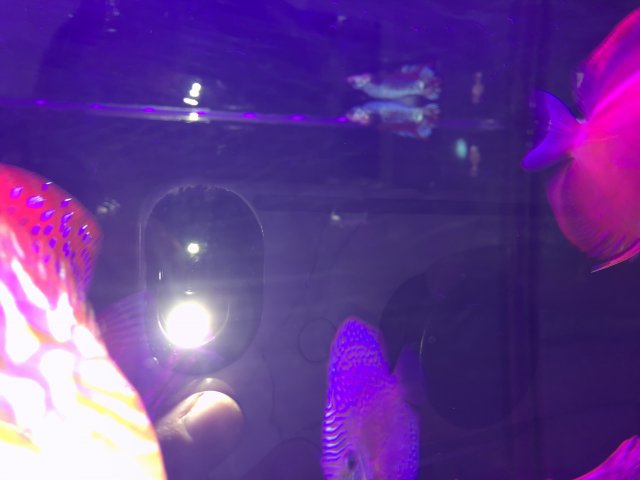
And thank you to everyone else. I was terrified of attempting to keep discus in the beginning after hearing so many horror stories about how difficult they are to keep. For me it’s been a breeze, shockingly. I chose to remove the few leaves I put in the sump, you guys are right.. they’re doing well so no need to change anything. All they really seem to require is clean water, and stable water.

4523B795-78BF-43A7-ADDD-5BEA55F2C8A6.jpeg
 
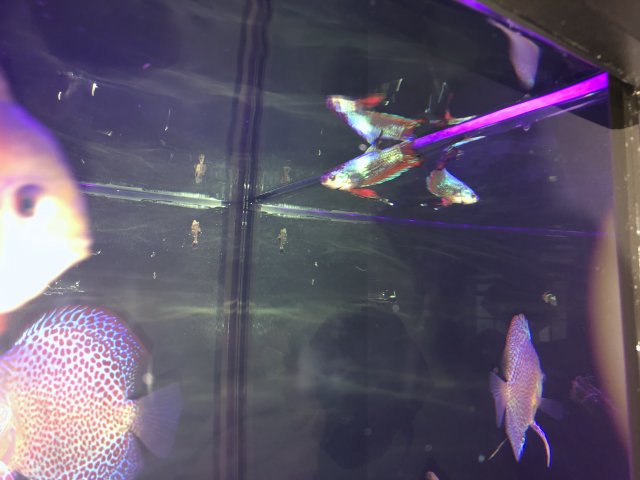
since you already have the leaves... get a betta
I recently added a king betta to the aquarium. But I think like everybody else said if the water is doing fine now why adjust it? Should I add a few to the sump or not lol? I hear if even helps fins repair, people make it seem like it’s an antibiotic.

But that night I posted the pics where I added a few leaves to the sump, and then you guys said to take them out (in other words) because my fish are fine as is. So which should I do? I did notice s clouding of the water from just adding several small leaves to the sump. Not staining, clouding.

Opinions please?

DA1B79AD-42A3-4268-8BBC-98EB0804DF49.jpeg

CEC4E11B-C716-47C7-BA6A-DF53849C07D5.jpeg

C34DA4D5-B7E7-4BD4-9511-26DA7B250BEA.jpeg

277EAD44-0011-4C8F-A031-87F95041FB1A.jpeg
 
MonsterFishKeepers.com