Swann;1522108; said:
Hi all. Just about to start up my new 8' x 2.5' x 2.5' in a couple of weeks. i've heard of using pure ammonia to rapid start the cycle process. Has anyone heard of this process and is it safe for the future inhabitance. The appeal to this is that rather waiting 4 weeks for a good cycle to commence, you can get it going in just 1-2 weeks.
Any guidence would be appreciated.
Fishless cycling is a superior way of cycling a tank, in that no fish are involved in the cycling process to be harmed, stressed or killed. Fishless cycling has the additional advantage of being able to generate massive amounts of beneficial bacteria in the biological filters which should easily handle the bioload of the fish which will eventually be added to the tank.
If you are just upgrading from a smaller tank to a larger tank, you can just take the filters off the old cycled tank and move them to the new bigger tank along with the fish--instant cycling. If you are starting up a new tank and are using new filters, then fishless cycling, IMO, is the way to go. Fishless cycling can take up to a month or longer.
A basic understanding of the Nitrogen Cycle will help you realize why cycling a tank is so important. Ammonia is produced in fish wastes and decomposing food in the tank. Ammonia is toxic to fish. Beneficial bacteria consume the ammonia and produce nitrites which are also very toxic to fish. Another group of nitrifying bacteria consume the nitrites and produce nitrates which are not as toxic to fish as ammonia and nitrites. In a "cycled" tank, there are enough beneficial bacteria to consume all the ammonia and nitrites in the tank. This means that in a "cycled" tank, the ammonia and nitrite readings are "0". Nitrates are still being produced and building up in the tank. Water changes are the easiest way to get rid of nitrates. High nitrates have been implicated in a host of fish ailments such as failure to thrive, stunting, hole-in-the-head disease, premature death. Many fishkeepers try to keep nitrates below 20 ppm, and do routine water testing to know what the nitrate levels are.
If you use fish to cycle a new tank, the fish are generating a small amount of ammonia. They will have to live with the ammonia and nitrites until enough beneficial bacteria (BB) are colonized to handle the ammonia/nitrites. If another fish is added, the fish are again subjected to ammonia/nitrites until more BB are colonized. Most people use "throw away" fish for cycling, because there is a good chance that the fish will not survive. When a tank is fishless cycled, massive amounts of pure ammonia are used to get the level of ammonia to 4 or 5 ppm (way more ammonia than the fish will produce). The ammonia is kept at that level until nitrites start showing, and then the ammonia feeding is decreased. Once the ammonia and nitrite levels are "0", the tank is considered cycled. At this point, you can add enough ammonia to get the tank level to 5 ppm, and in less than a day, there will be no ammonia or nitrite in the tank. The nitrate level will be very high. All you have to do is a massive water change (80% or more) to get rid of as much of the nitrate as possible. The beneficial bacteria predominately reside in the biological filters, so changing out the water does not get rid of the BB. After the water change, you can move your fish into the new tank.
Do to a fishing cycling, you will need a source of pure ammonia--one without additives like surfactants. Hardware stores or dollar stores usually carry this "cheap" ammonia. You will also need a freshwater master test kit.
http://www.bigalsonline.com/StoreCa...-def-USD-18535##7##3m&query=test+kits&offset=
The nitrate test is very technique sensitive, and you must follow the directions to the letter to get accurate results, i.e., vigorously shake the second bottle for a full 30 seconds, and vigorously shake the test tube for a full minute. There are other brands of test kits.
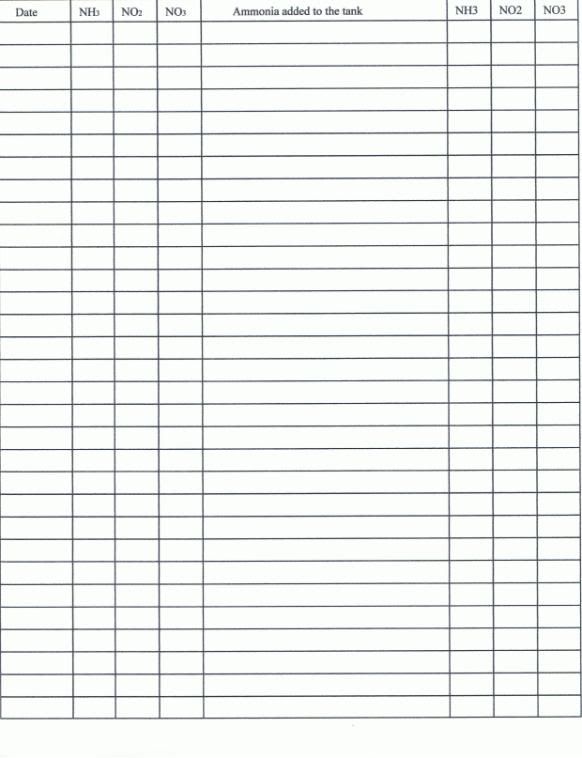
Be aware that ammonia comes in different concentrations. We had a dilute brand of ammonia, and had to add a lot of ammonia to our tank. I would suggest adding ammonia to a gallon of water and counting the drops of ammonia you added to get ammonia level to 4 or 5 ppm. This will give you a good indication of how much you will have to add to the tank. We had to add 132 ml of ammonia to our 300 gallon tank to get a 4 ppm reading. You will need to keep a log of your test results and how much ammonia you added. Here is the log sheet I made while cycling our tank:
Here are some articles on fishless cycling:
http://www.aquatic-hobbyist.com/profiles/misc/fishlesscycling.html
http://www.fishlesscycling.com/
http://www.aquarticles.com/articles/management/Cow_Fishless_Cycle.html