

I have been working on this article for a long time... 2-3 months. I wrote it for another forum with fewer members than MFK, and who are less 'in the know' about hybrid fish. If some of this seems rudimentary, that is why. My goal is to educate, not to fuel a never ending battle about this topic, so if you are looking for an arguement, please refrain from posting. Debate and discussion are welcome always. Please feel free to point out any errors or things you like/dislike about the article. I've got thick skin. The article is in its final drafts, but not complete. I am still looking for pictures of RTC x TSN and maybe a few more pure A. labiatus and FH's. Thanks for your input.
Matt
..................................................................................................
Hybrid fish
Hybrid fish have been a controversial topic since day one of their discovery. The conversations and arguements that surround this topic can be heated to say the least. I would like to start out by saying that I have kept both hybrid fish and wild caught, or pure fish. Despite my personal preference, I'd like to believe that the following is an unbiased rendering of my own observations.
Early in the hobby, not much was known about hybrids. They were unheard of and most fish back then were assumed to be pure. The general knowledge of fish keeping was still in the growing stages as was the market for tropical fish. Successful breeding was not common in the home aquarium because of the lack of information available to research and learn about the process. After some improvements in technology and the ability to gain knowledge at the 'click' of a button, we are able to reproduce (breed) many of the fish we keep ourselves. This inevitabley has led to some species cross-breeding (male and female of different species, breeding) and offspring that are not genetically pure, or 'hybrid'. Today there is a large crowd that favors hybrids and promotes the practice of cross-breeding. Naturally, there is also a large crowd that is against the idea of hybrids. The two groups have unofficially been called for lack of better terms, "purists" and "hybrid lovers". Not all fish keepers are either a Purist or a Hybrid lover, but these two groups make the middle of the spectrum long indeed.
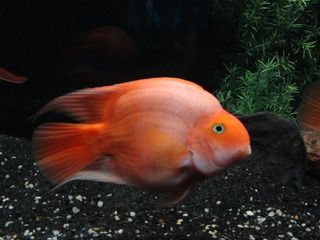
Blood Parrot fish - Popular hybrid whose true parentage is unknown to those other than its creators.
Purist - Purists are against any fish that is not of a pure genetic origin, and would cull anything that was not. They are of the opinion that hybrids are an 'abomination'. In the wild most of these parent species would never come in contact with each other and hence, the cross-breeding would never occur. The Purist wants to replicate the natural habitat of the fish they keep. They are well informed about the history of the species, and do their best to give the fish exactly what they would have in the wild. Their tank decorations are driftwood and sand and often live plants are used in the mix. Today most of the Purist's fish are wild caught or ordered from a reputable fish farm. They no longer feel that fish bought at your ***mart are pure specimens. They spend a lot of money on shipping to ensure that the fish they have are as close to their wild counterparts as possible, if not wild caught.
Hybrid lover - Hybrid lovers are more or less, Pro-life. They are less concerned about the origin of their particular specimen and are more concerned about its individual well being. The hybrid lovers are looking for something that pleases the eye. The fish they want has a unique look that cannot be ignored. A flash of color or a distinct body shape grabs their attention and keeps them hooked. Hybrid lovers have often tried their hand at creating a new type of fish. They have kept and bred fish that are of a different Species or sometimes even a different Genus or Family. This pulls them even deeper into the hybrid world and into a place of mystery and surprise. Cross-breeding different types of fish can lead to very different colors, shapes and sizes, and the hybrid lovers curiosity can be difficult to satisfy. Despite their fish lacking natural origin, hybrid lovers are very dedicated to their fish. Hybrid fish give their owners something no other fish can provide and in return, their owners go to great lengths to see their fish thrive.
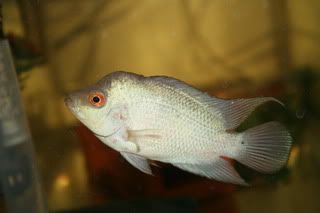
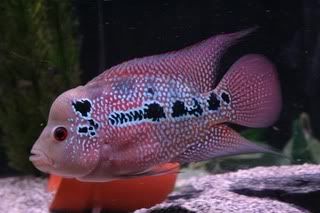
Left- Thai Silk Flowerhorn, Right- Red Dragon Flowerhorn
The Argument - Most of the arguments between these two groups seem to be based upon a few topics. Identification, and Nature. Identification is probably the single, largest problem that has been caused by hybrid fish being sold. The simple, albeit large problem being that people buy a fish at a store (or online) and that fish turns out to be something other than what they purchased. Identification is already difficult because most juvenile fish lack any prominent features, but having closely related species hybrids can make absolute identification impossible.
Hybrids do sometimes occur in nature, but typically not to the drastic degree that some of the hybrids today have been exposed to (i.e. crossing A. labiatum and H. cyanoguttatum - the native origin of these two species makes it impossible for them to meet in the wild, but in the home aquarium, they have been crossed). Two of the most popular hybrid cichlids are a mixture of species that is unknown to the majority of hobbyists. Many believe that the Flowerhorn, and the Blood Parrot are the result of a cross between two species, and then the product of those two species is bred again to a completely different species, and so on and so forth. Who knows how many times they have to be crossed to be left with a quality Flowerhorn or Blood Parrot. It's this exact conglomeration of unknown species that is said to be unnatural. Some proponents of pure fish even go so far as to say that the creators of the Flowerhorn and Blood Parrot are playing God and that this manipulation of species breeding is going to far.
ID please?
Scenario A - Joe has done some research on a cichlid that he would like to purchase. He wants to purchase a Convict Cichlid (Amatitlania nigrofasciatum). Joe goes to a local pet store and goes to a tank labeled - Convicts. He picks out a fish that looks healthy and colorful. One that is energetic and almost says 'pick me'. He returns home with his new friend and places it in his new cycled 20g tank. After a few weeks, Joe begins to wonder if the fish he bought is actually a Convict cichlid. It has small pearls of bluish color, and the body shape doesn't quite match pictures that you see of other Convict cichlids. He decides that his fish is unique and ignores the small differences. Several months later he is certain that what he bought isn't a Convict cichlid. Its grown much larger than the average Convict cichlid already (over 5 inches) and only shares a few physical characteristics. After several shared pictures and internet deliberation, it is suggested that Joe's fish is a hybrid. A cross between a Texas cichlid (Herichthys cyanoguttatum) and a Convict cichlid (Amatitlania nigrofasciatum). Not only is it not what Joe wanted, but it will likely outgrow the tank he has purchased. It is also very aggressive and will not likely take tank mates unless kept in a large aquarium. Joe was prepared for a Convict cichlid now he has to either take this fish back to the pet store, or re-adjust to a much larger more aggressive fish.
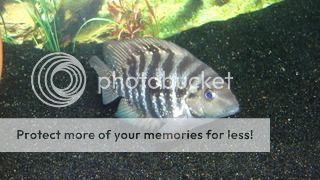
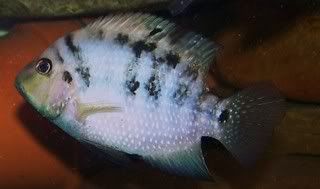
Texas cichlid x Convict cichlid hybrids
Scenario B - Joe wants to buy a Red devil cichlid. The Red devil (Amphilophus labiatum) is a popular new world cichlid due to its bright flashy color, and bold attitude. Its cousin, the Midas cichlid (Amphilophus citrinellum) is also a popular fish with many of the same physical characteristics. Both grow quite large (12+ inches) and are very aggressive. The two are so closely related that they have been known to cross breed. There is a strong belief that most Red devils and Midas cichlids sold in pet stores are hybrids of the two species (Red devil x Midas). Joe has done the research and is well aware of the cloud of doubt surrounding his current decision. Are the Red devils at the pet store pure Devils or are they a cross between a Red devil and a Midas? Many believe that today, the only way to ensure that you have a pure Red devil or a pure Midas is to order them from a reputable collector/breeder. The collector can tell you if they are wild caught (F0), if they are offspring from two wild caught specimens (F1), or if they are offspring from two F1 specimens (F2). Since there is no way of knowing where a Red devil from ***mart originated, most of the cichlid keepers assume that it is a hybrid because these (Red devil x Midas) hybrids are so prevalent. So what is Joe to do?
In Scenario A, the fact that Joe has a hybrid fish is plain to see. The physical features of the fish are drastically different than either parent species. There are definite characteristics from each parent fish mixed into the hybrid. It is clear to Joe that he didn't get what he wanted, and he now has to re-think his current situation. In this scenario Joe was able to identify his hybrid rather easily, but what about the hybrid that is not so easy to identify? What about a hybrid that is the result of two closely related species?
In Scenario B, Joe comes upon two fish that are almost identical as juveniles, and even difficult to tell apart as adults. A hybrid resulting from two species that are of the same Genus and relatively similar physical appearance is a problem. The offspring may not look drastically different than either parent. It could be this fish, but it could also be this fish. So what? you say, If you can't tell the difference, then what is the problem? The problem is in the sale. You should get what you pay for, plain and simple. If you paid for a Red Devil cichlid, then that is what you should get, not a Red Devil x Midas cross. Likely, the pure Red Devil is worth more money than the Hybrid and Joe feels he got ripped off, or maybe Joe intended to breed his Red Devil and the hybrid is infertile, either way it is wrong. So who is to blame? The store sold Joe this hybrid; they should be punished, correct? Truth is, they probably didn't know it was a hybrid either. Cichlids in general are hard to identify as juveniles. Some cichlid experts can pick out and identify them when they are small, but your typical fish store assistant? Probably not. Save the specialty stores, cichlids are not always high on the priority list. In chain stores they are sold mislabeled and with misinformation quite often. Hybrids have even fooled some of the best breeders/collectors. How unfortunate for one to spend the extra money on a pure fish either via the internet, or a specialty store, only to find out that they still ended up with a hybrid fish.
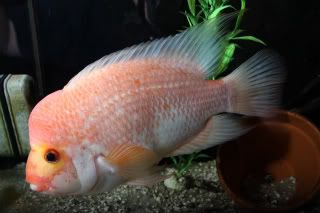
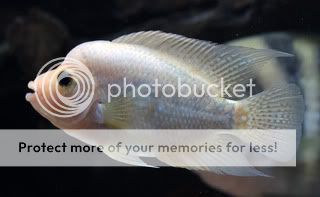

All of these fish are 'Red Devils'. One is F1 from Ken Davis, and two are hybrids. Can you tell which is which?
So one hybrid fish was somehow introduced into the hobby and now there are hundreds of thousands, maybe more. The emergence of hybrid fish is not specific to just cichlids, they are in virtually every Genus of fish available in pet stores. From Synodontis, Amphilophus, Pseudotropheus, Poecilia, Phractocephalus to Amatitlania, hybrids have either gone unnoticed, or made controversy. They are in pet stores, and they are in fish farms, they are even in some of our native waters. Now when Joe goes to buy a fish from the pet store he wonders, is it really what they say it is?
The Nature of things...
This is a difficult topic to debate. It's difficult because the question of 'what is natural' can be escalated to the very source of our hobby. Even when the question of what is natural and what is unnatural is satisfied, there is always the question of 'what is right'?
Is it natural to keep fish in a glass box? I suppose not. But like most of our pastimes that involve other animals, we have taken on the responsibility of care for our beloved creatures.
Are most of the hybrids created in home aquaria unnatural? Yes. The majority of hybrids that are bred in captivity are unnatural. Not many hobbyists confine themselves to keeping fish all native to the same areas. The fish that they do keep are most likely from different areas and some are so prolific that breeding with another species is not an uncommon occurrence.
Are there some natural occuring hybrids? Yes. Right here in our very own freshwater lakes and rivers there are hybrids. But these hybrids are a result of mother nature and are less common. The Bluegill (Lepomis macrochirus) and the Pumpkinseed (Lepomis gibbosus) are two species of sunfish that have been known to hybridize naturally. Examples such as the Tiger Muskellunge (Esox masquinongy x Esox lucius) and the Saugeye (Sander vitreus x Sander canadensis) are game fish hybrids produced in hatcheries released into lakes and rivers to promote fishing. The Tiger Muskellunge has become a popular trophy fish. It's vibrant colors and unique patterns make it the ultimate catch.



From left to right Northern Pike (Esox lucius), Muskellunge (Esox masquinongy), Tiger Muskellunge
Is it right to keep a fish in a fish tank? Fish cannot be domesticated so to speak, other than to acclimate them to different waters and make their future generations more tolerant to exposure of ammonia. So is it right to take these fish from the wild and keep them in our tanks? They lose the freedom of unending waters and some lose the chance to proliferate and pass on their bloodline. Conversely, they are free of predation, competition for food, and will be cared for specifically by a dedicated fish keeper.
Is it right to knowingly breed two fish of different species? Some hybrid specimens are stunning, beautiful, healthy creatures. There is now a huge market for hybrids and every day something new and exciting is created. Some however, are riddled with deformities and live short crippled lives. The result of mixing fish from completely different genetic foundations does not always yield a desireable product.
The question what is right? is not something that can be answered for you. It is a question you must ask yourself. You may not always have an answer but the first step is asking the question.
My Take on the world of hybrids...
It seems that the world of hybrid fish, and the hobby of fish keeping are intertwined. No matter how you look at it hybrid fish are here, and they are here to stay. My personal stance on hybrids, and fish keeping in general is simple. Education. I'm not going to tell you to hate or love hybrids. You need to make up your mind about what you enjoy for yourself. Research these fish. Find out what you like. Know where they come from, what they look like, and if they cross breed. Learn about the market for these fish, and get what you want... get what you deserve.
References: http://texascichlidmassacre.blogspot.co ... -part.html
Pictures: Camphilophus of MFK (Thai Silk Flowerhorn, Red Dragon Flowerhorn) fishfreak317 of MFK (R Texas x Convict Hybrid)
Matt
..................................................................................................
Hybrid fish
Hybrid fish have been a controversial topic since day one of their discovery. The conversations and arguements that surround this topic can be heated to say the least. I would like to start out by saying that I have kept both hybrid fish and wild caught, or pure fish. Despite my personal preference, I'd like to believe that the following is an unbiased rendering of my own observations.
Early in the hobby, not much was known about hybrids. They were unheard of and most fish back then were assumed to be pure. The general knowledge of fish keeping was still in the growing stages as was the market for tropical fish. Successful breeding was not common in the home aquarium because of the lack of information available to research and learn about the process. After some improvements in technology and the ability to gain knowledge at the 'click' of a button, we are able to reproduce (breed) many of the fish we keep ourselves. This inevitabley has led to some species cross-breeding (male and female of different species, breeding) and offspring that are not genetically pure, or 'hybrid'. Today there is a large crowd that favors hybrids and promotes the practice of cross-breeding. Naturally, there is also a large crowd that is against the idea of hybrids. The two groups have unofficially been called for lack of better terms, "purists" and "hybrid lovers". Not all fish keepers are either a Purist or a Hybrid lover, but these two groups make the middle of the spectrum long indeed.
Blood Parrot fish - Popular hybrid whose true parentage is unknown to those other than its creators.
Purist - Purists are against any fish that is not of a pure genetic origin, and would cull anything that was not. They are of the opinion that hybrids are an 'abomination'. In the wild most of these parent species would never come in contact with each other and hence, the cross-breeding would never occur. The Purist wants to replicate the natural habitat of the fish they keep. They are well informed about the history of the species, and do their best to give the fish exactly what they would have in the wild. Their tank decorations are driftwood and sand and often live plants are used in the mix. Today most of the Purist's fish are wild caught or ordered from a reputable fish farm. They no longer feel that fish bought at your ***mart are pure specimens. They spend a lot of money on shipping to ensure that the fish they have are as close to their wild counterparts as possible, if not wild caught.
Hybrid lover - Hybrid lovers are more or less, Pro-life. They are less concerned about the origin of their particular specimen and are more concerned about its individual well being. The hybrid lovers are looking for something that pleases the eye. The fish they want has a unique look that cannot be ignored. A flash of color or a distinct body shape grabs their attention and keeps them hooked. Hybrid lovers have often tried their hand at creating a new type of fish. They have kept and bred fish that are of a different Species or sometimes even a different Genus or Family. This pulls them even deeper into the hybrid world and into a place of mystery and surprise. Cross-breeding different types of fish can lead to very different colors, shapes and sizes, and the hybrid lovers curiosity can be difficult to satisfy. Despite their fish lacking natural origin, hybrid lovers are very dedicated to their fish. Hybrid fish give their owners something no other fish can provide and in return, their owners go to great lengths to see their fish thrive.
Left- Thai Silk Flowerhorn, Right- Red Dragon Flowerhorn
The Argument - Most of the arguments between these two groups seem to be based upon a few topics. Identification, and Nature. Identification is probably the single, largest problem that has been caused by hybrid fish being sold. The simple, albeit large problem being that people buy a fish at a store (or online) and that fish turns out to be something other than what they purchased. Identification is already difficult because most juvenile fish lack any prominent features, but having closely related species hybrids can make absolute identification impossible.
Hybrids do sometimes occur in nature, but typically not to the drastic degree that some of the hybrids today have been exposed to (i.e. crossing A. labiatum and H. cyanoguttatum - the native origin of these two species makes it impossible for them to meet in the wild, but in the home aquarium, they have been crossed). Two of the most popular hybrid cichlids are a mixture of species that is unknown to the majority of hobbyists. Many believe that the Flowerhorn, and the Blood Parrot are the result of a cross between two species, and then the product of those two species is bred again to a completely different species, and so on and so forth. Who knows how many times they have to be crossed to be left with a quality Flowerhorn or Blood Parrot. It's this exact conglomeration of unknown species that is said to be unnatural. Some proponents of pure fish even go so far as to say that the creators of the Flowerhorn and Blood Parrot are playing God and that this manipulation of species breeding is going to far.
ID please?
Scenario A - Joe has done some research on a cichlid that he would like to purchase. He wants to purchase a Convict Cichlid (Amatitlania nigrofasciatum). Joe goes to a local pet store and goes to a tank labeled - Convicts. He picks out a fish that looks healthy and colorful. One that is energetic and almost says 'pick me'. He returns home with his new friend and places it in his new cycled 20g tank. After a few weeks, Joe begins to wonder if the fish he bought is actually a Convict cichlid. It has small pearls of bluish color, and the body shape doesn't quite match pictures that you see of other Convict cichlids. He decides that his fish is unique and ignores the small differences. Several months later he is certain that what he bought isn't a Convict cichlid. Its grown much larger than the average Convict cichlid already (over 5 inches) and only shares a few physical characteristics. After several shared pictures and internet deliberation, it is suggested that Joe's fish is a hybrid. A cross between a Texas cichlid (Herichthys cyanoguttatum) and a Convict cichlid (Amatitlania nigrofasciatum). Not only is it not what Joe wanted, but it will likely outgrow the tank he has purchased. It is also very aggressive and will not likely take tank mates unless kept in a large aquarium. Joe was prepared for a Convict cichlid now he has to either take this fish back to the pet store, or re-adjust to a much larger more aggressive fish.
Texas cichlid x Convict cichlid hybrids
Scenario B - Joe wants to buy a Red devil cichlid. The Red devil (Amphilophus labiatum) is a popular new world cichlid due to its bright flashy color, and bold attitude. Its cousin, the Midas cichlid (Amphilophus citrinellum) is also a popular fish with many of the same physical characteristics. Both grow quite large (12+ inches) and are very aggressive. The two are so closely related that they have been known to cross breed. There is a strong belief that most Red devils and Midas cichlids sold in pet stores are hybrids of the two species (Red devil x Midas). Joe has done the research and is well aware of the cloud of doubt surrounding his current decision. Are the Red devils at the pet store pure Devils or are they a cross between a Red devil and a Midas? Many believe that today, the only way to ensure that you have a pure Red devil or a pure Midas is to order them from a reputable collector/breeder. The collector can tell you if they are wild caught (F0), if they are offspring from two wild caught specimens (F1), or if they are offspring from two F1 specimens (F2). Since there is no way of knowing where a Red devil from ***mart originated, most of the cichlid keepers assume that it is a hybrid because these (Red devil x Midas) hybrids are so prevalent. So what is Joe to do?
In Scenario A, the fact that Joe has a hybrid fish is plain to see. The physical features of the fish are drastically different than either parent species. There are definite characteristics from each parent fish mixed into the hybrid. It is clear to Joe that he didn't get what he wanted, and he now has to re-think his current situation. In this scenario Joe was able to identify his hybrid rather easily, but what about the hybrid that is not so easy to identify? What about a hybrid that is the result of two closely related species?
In Scenario B, Joe comes upon two fish that are almost identical as juveniles, and even difficult to tell apart as adults. A hybrid resulting from two species that are of the same Genus and relatively similar physical appearance is a problem. The offspring may not look drastically different than either parent. It could be this fish, but it could also be this fish. So what? you say, If you can't tell the difference, then what is the problem? The problem is in the sale. You should get what you pay for, plain and simple. If you paid for a Red Devil cichlid, then that is what you should get, not a Red Devil x Midas cross. Likely, the pure Red Devil is worth more money than the Hybrid and Joe feels he got ripped off, or maybe Joe intended to breed his Red Devil and the hybrid is infertile, either way it is wrong. So who is to blame? The store sold Joe this hybrid; they should be punished, correct? Truth is, they probably didn't know it was a hybrid either. Cichlids in general are hard to identify as juveniles. Some cichlid experts can pick out and identify them when they are small, but your typical fish store assistant? Probably not. Save the specialty stores, cichlids are not always high on the priority list. In chain stores they are sold mislabeled and with misinformation quite often. Hybrids have even fooled some of the best breeders/collectors. How unfortunate for one to spend the extra money on a pure fish either via the internet, or a specialty store, only to find out that they still ended up with a hybrid fish.
All of these fish are 'Red Devils'. One is F1 from Ken Davis, and two are hybrids. Can you tell which is which?
So one hybrid fish was somehow introduced into the hobby and now there are hundreds of thousands, maybe more. The emergence of hybrid fish is not specific to just cichlids, they are in virtually every Genus of fish available in pet stores. From Synodontis, Amphilophus, Pseudotropheus, Poecilia, Phractocephalus to Amatitlania, hybrids have either gone unnoticed, or made controversy. They are in pet stores, and they are in fish farms, they are even in some of our native waters. Now when Joe goes to buy a fish from the pet store he wonders, is it really what they say it is?
The Nature of things...
This is a difficult topic to debate. It's difficult because the question of 'what is natural' can be escalated to the very source of our hobby. Even when the question of what is natural and what is unnatural is satisfied, there is always the question of 'what is right'?
Is it natural to keep fish in a glass box? I suppose not. But like most of our pastimes that involve other animals, we have taken on the responsibility of care for our beloved creatures.
Are most of the hybrids created in home aquaria unnatural? Yes. The majority of hybrids that are bred in captivity are unnatural. Not many hobbyists confine themselves to keeping fish all native to the same areas. The fish that they do keep are most likely from different areas and some are so prolific that breeding with another species is not an uncommon occurrence.
Are there some natural occuring hybrids? Yes. Right here in our very own freshwater lakes and rivers there are hybrids. But these hybrids are a result of mother nature and are less common. The Bluegill (Lepomis macrochirus) and the Pumpkinseed (Lepomis gibbosus) are two species of sunfish that have been known to hybridize naturally. Examples such as the Tiger Muskellunge (Esox masquinongy x Esox lucius) and the Saugeye (Sander vitreus x Sander canadensis) are game fish hybrids produced in hatcheries released into lakes and rivers to promote fishing. The Tiger Muskellunge has become a popular trophy fish. It's vibrant colors and unique patterns make it the ultimate catch.
From left to right Northern Pike (Esox lucius), Muskellunge (Esox masquinongy), Tiger Muskellunge
Is it right to keep a fish in a fish tank? Fish cannot be domesticated so to speak, other than to acclimate them to different waters and make their future generations more tolerant to exposure of ammonia. So is it right to take these fish from the wild and keep them in our tanks? They lose the freedom of unending waters and some lose the chance to proliferate and pass on their bloodline. Conversely, they are free of predation, competition for food, and will be cared for specifically by a dedicated fish keeper.
Is it right to knowingly breed two fish of different species? Some hybrid specimens are stunning, beautiful, healthy creatures. There is now a huge market for hybrids and every day something new and exciting is created. Some however, are riddled with deformities and live short crippled lives. The result of mixing fish from completely different genetic foundations does not always yield a desireable product.
The question what is right? is not something that can be answered for you. It is a question you must ask yourself. You may not always have an answer but the first step is asking the question.
My Take on the world of hybrids...
It seems that the world of hybrid fish, and the hobby of fish keeping are intertwined. No matter how you look at it hybrid fish are here, and they are here to stay. My personal stance on hybrids, and fish keeping in general is simple. Education. I'm not going to tell you to hate or love hybrids. You need to make up your mind about what you enjoy for yourself. Research these fish. Find out what you like. Know where they come from, what they look like, and if they cross breed. Learn about the market for these fish, and get what you want... get what you deserve.
References: http://texascichlidmassacre.blogspot.co ... -part.html
Pictures: Camphilophus of MFK (Thai Silk Flowerhorn, Red Dragon Flowerhorn) fishfreak317 of MFK (R Texas x Convict Hybrid)
